June 8th, Friday – A Quiet Day

So they promised us a warm, sunny day.  Why is it that we awoke to the sound of rain on the roof?  Once again I believe someone was looking at the wrong charts or whatever.  But guess what?  By 10 am things began to clear up and the day turned out to be beautiful, warm and sunny like they said it was supposed to be.

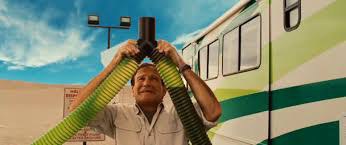
The only real chore we did today was driving over to the dump station to clear the tanks.  That in itself was no big deal.  We cycled the jacks up, slid the slides in, rolled the awning away, left everything on the counter and slowly motored over.  Suffice to say we had much better luck than our friend Robin Williams had.  Within 30 minutes we were back and all settled in again.  It

Related image

probably took more time to describe it then it actually took to accomplish it.

As to what else we did.  Barbara spent a good part of the day making phone calls trying to obtain information regarding forms she had to fill out.  Her persistence paid off and in the end she had all the information she needed.  Me, I really did a whole lot of nothing.  And you know what?  I don’t feel bad about it.  I know when I’ve pushed my knees and my back too far and yesterday was one of those days.  So today, I just sat back and gave myself permission to  do not much of anything.

Tomorrow we’ll be out and about again.  We have to go get a few more stamps for Barbara’s National Passport Book.

Image result for national passport book

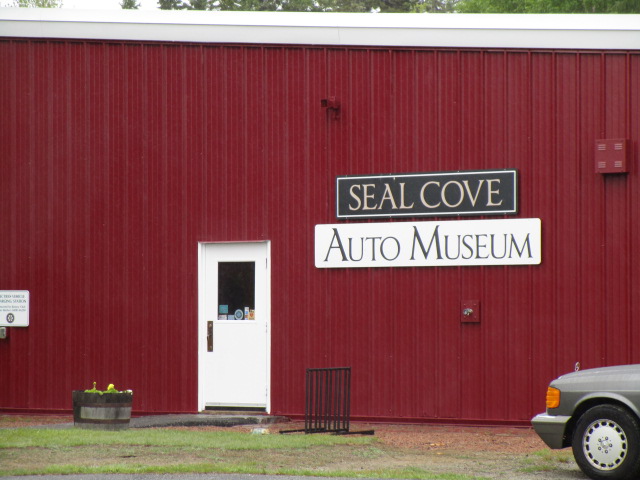
We’re going back to the Seal Cove Auto Museum for what is called Cars & Coffee which is an opportunity for drivers to show off their own special cars, and for all auto

entrance sign

enthusiasts to congregate to kick tires, peer under hoods, and enjoy coffee with their fellow car-lovers. The June Cars & Coffee will feature steam cars! The Cars & Coffee in the morning will be followed by steam demonstrations in the afternoon, and rides in the museum’s cars, weather permitting.

We also are planning to visit the Maine Granite Industry Historical Society Museum. Not only does the museum provide great exhibits to view, but there is also the opportunity for

Related image

visitors to learn how granite was quarried, cut, and processed long before we had the large equipment that is available to us today.

Enough for now.  The day is long gone and night is once more all around us.  It’s been a great day of doing almost nothing that we absolutely enjoyed.  That’s the beauty of being on the road of retirement – you can pick and choose whatever you want to do in any given day and not feel guilty about it.  We hope your day was a rewarding one as well, no matter what you had to do.  In closing, I leave you with this thought:

Image result for inspiring quotes retirement

As always,  if you are coming to the end of your day with concerns and worries, let me suggest that you turn them over to God.  After all, He is going to be up all night so why not let him handle them for you.

Time now for our evening prayers and eventually some shut-eye.  Till tomorrow.

These are the voyages of  Graybeard and it’s occupants, four paws and two humans.  Our continuing mission: to explore as many new states as possible, to seek out new acquaintances and make new friends, to boldly go where we have not been before


June 7th, Wednesday – Maine Sculpture Trail, Caterpillar Hill, America’s Cup, Greatest American Naval Defeat before Pearl Harbor

They promised us a warm, clear day.  Well, someone got it wrong.  It was still only in the 50’s and it remained cloudy all day.  At least we didn’t have any rain although it threatened all day.  However, that didn’t stop us.  It was time to go find more sculptures and whatever else we might happen upon along the way.

So off we went.  We were in quest of several more sculptures that make up the Maine Sculpture Trail.  You would not know it by looking at the towering sculptures created through the organization’s efforts, that the whole idea was started by Jesse Salisbury who grew up in the very rural town of Steuben, Maine. Supported by friends, family and partnering communities, Jesse Salisbury’s vision resulted in the Schoodic International Sculpture Symposium.

From 2007 to 2014, Maine’s Schoodic International Sculpture Symposium drew artists from all over the globe who participated in five summer sessions.  Using locally quarried granite and basalt, the sculptors who hailed from 16 nations created various sculptures.  The resulting Maine Sculpture Trail  is a  34 piece outdoor exhibit spanning over 200 miles along the coastal region of Downeast Maine.  It winds through Hancock and Washington counties and includes pieces in Bangor, Orono and Old Town. The Maine trail also is linked to a similar project — Sculpture Saint John — across the border in Canada’s New Brunswick Province.

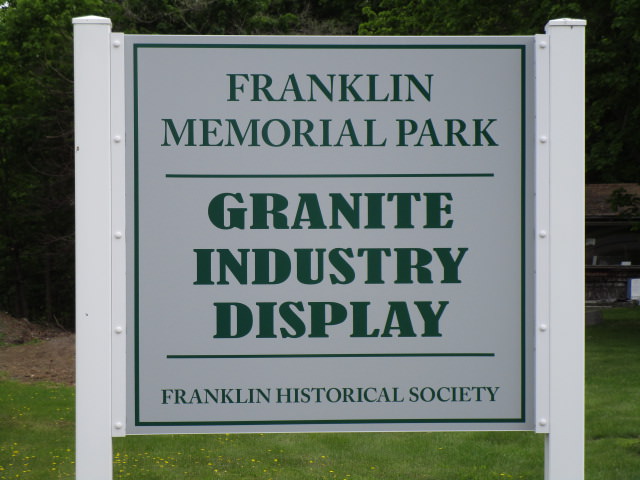
We have already shared some of the sculptures with you and we want now to share some more that we found today.  The first one we went to today is placed in the Franklin Memorial Park that also featured a Granite Industry Display (more about this in the future).

Franklin granite display sign

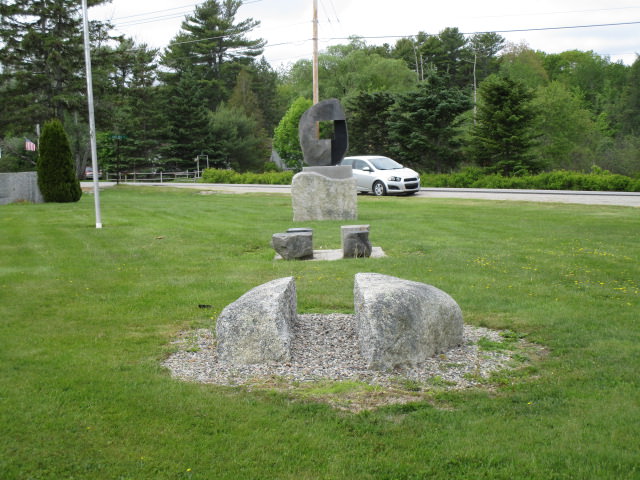
The sculpture residing here was entitled Recurrent Journey.  The artist who created this

Franklin Recurrent Journey better

was Mark Herrington who is from Maine.  He explained his sculpture this way:  There are many things we do that seem to be built within patterns we establish.  We walk down many paths again and again.  This sculpture reflects that journey.

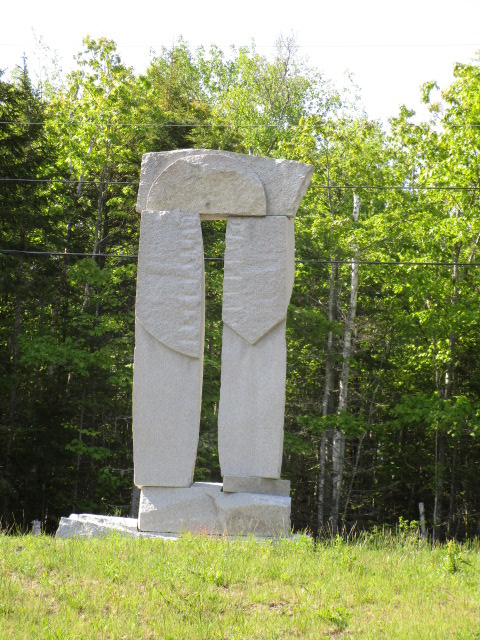
Moving on, we next went to Sorrento where we located this sculpture entitled Gate of the Sun.  This sculpture was created by Jog Plickat from Germany.  He explained his sculpture

Sorrento Gate of the Sun 6-7 (2)

this way:  The sculpture is directed to the north so that the sun will pass behind the sculpture during the day.  From ancient times you find ritual gates in all cultures of the world.  

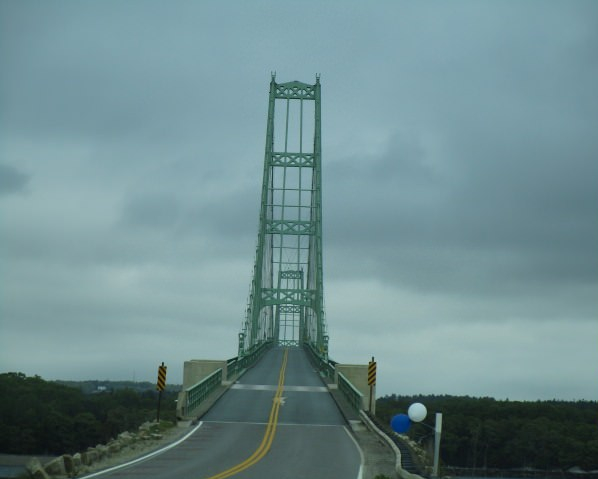
Back on the road again, we made our way to Little Deer Isle which required a trip over

deer-isle-bridge-best.jpg

this bridge and then yet another causeway to Deer Isle.  Eventually we arrived at the park on Deer Isle were the sculpture was located.  The sculpture located here was entitled Deer Isle Project and was created by Attila Rath Geber from Hungary.  

deer isle deer isle project 6-7 best

He explained his sculpture this way:  I wanted to reflect the natural elements.  I kept the natural aspects of the stone in a form such as could be found in nature, and in this context lies the subtle influence indicative of the creator’s presence.

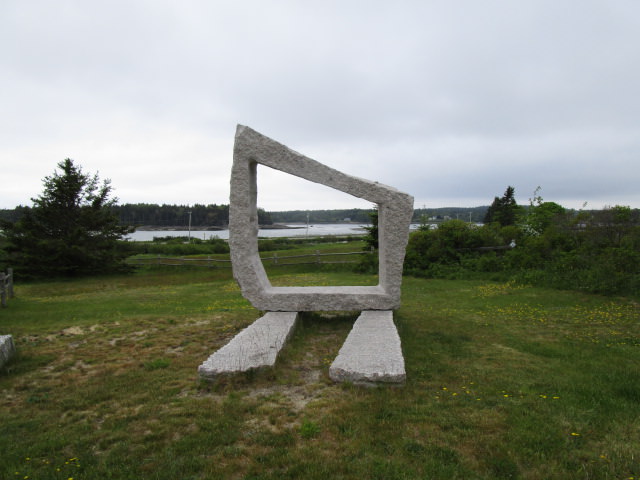
We still were not finished for the day.  Working our way back from Deer Isle, we next went to Blue Hill where we located this sculpture entitled The Window of the Sea Wind.

blue hill the window of the sea wind 6-7 best

This sculpture was created by Hitoshi Tanaka from Japan.  The artist explained the sculpture in this way:  The light and wind will pass through this window.  So the hearts of the people will also journey through this window.  This sculpture made of stone is Blue Hill’s Welcoming Window.  Both Barbara and I agreed this was one of our favorites.

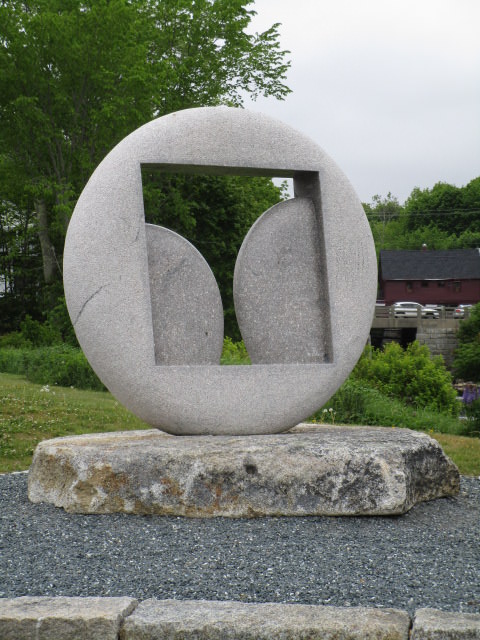
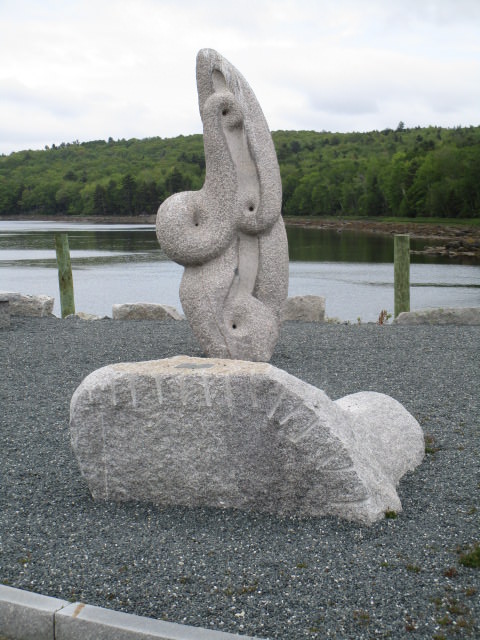
Continuing on we worked our way to the town of Surry.  Here we discovered the sculpture entitled Wave Sounds.  This sculpture was created by Bertha Shotiss from Switzerland who explained her work this way:  My sculpture is dedicated to the ocean, the power and movement of water and the sound of the waves clashing on the stones of the coast.

Surry Wave Sounds 6-7 close up

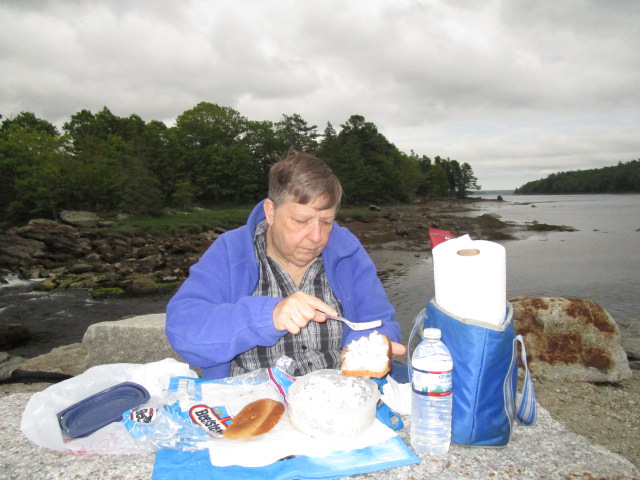
Before getting back on the road, we decided it was time for a lunch break.  Just adjacent

surry barb making lunch rock table

to the sculpture was a nice rock table with small benches on either side.  A nice place for a picnic lunch, so here is Barbara getting things ready for a delicious lunch for two.

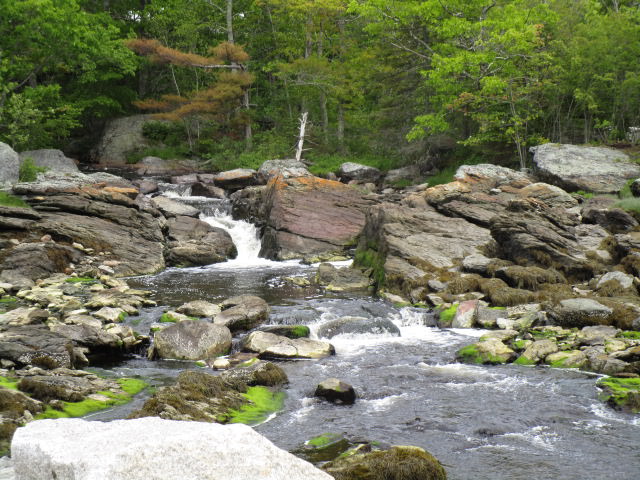
Add to this a small but beautiful waterfall just off to the side of the table and it was the perfect place for a picnic for two.  What a beautiful world God has created for us to enjoy.

surry water fall good

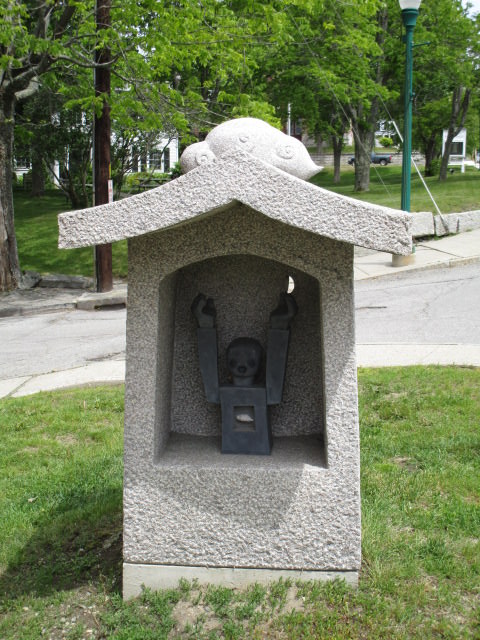
Almost finished for the day, just one more stop to make in the town of Ellsworth.  There we found this sculpture, perhaps the smallest to date, and one that I truly just don’t get at all.  But then again I was never, ever into art, abstract or otherwise.  Take a look.

Ellsworth I want to ride a cloiud 6-7 best

This sculpture is entitled I Want To Ride A Cloud and was created by Narihiro Uemura from Japan.  The artist explained the sculpture in this way:  if you look at my sculpture from the perspective of the planet, it is merely a chip of stone, but I hope it will become an image that lives on in the minds of the people.

That’s it for sculptures today.  During our travels we also discovered a really neat little turnout on Route 15.  We later discovered that it was called Caterpillar Hill.  It offered a sweeping vista across blueberry fields to Penobscot Bay and Camden in the west, south to Isle au Haut, and east to Jericho Bay.  You can, also if you look close, see the bridge to Deer Isle somewhat in the middle of the picture.

Caterpillar Hill, Sedgwick, Maine

There were also several plaques displayed here with facts of interest.  For example,

cat-hill-defender-americas-cup.jpg

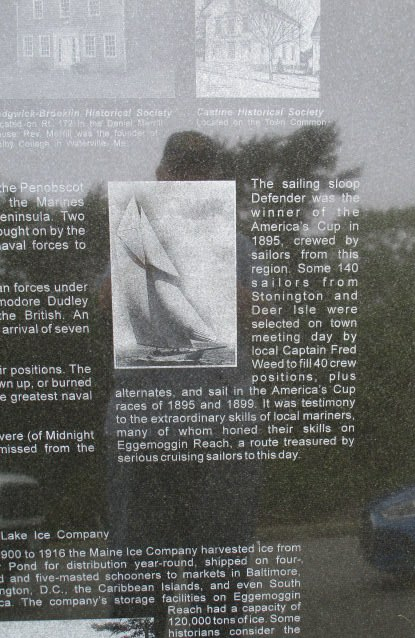
this plaque tells the story of the sailing sloop Defender that was the winner of the America’s Cup in 1895 and was crewed by sailors from this region.  Some 140 sailors from Stonington and Deer Isle applied and 40 were chosen to fill crew positions.

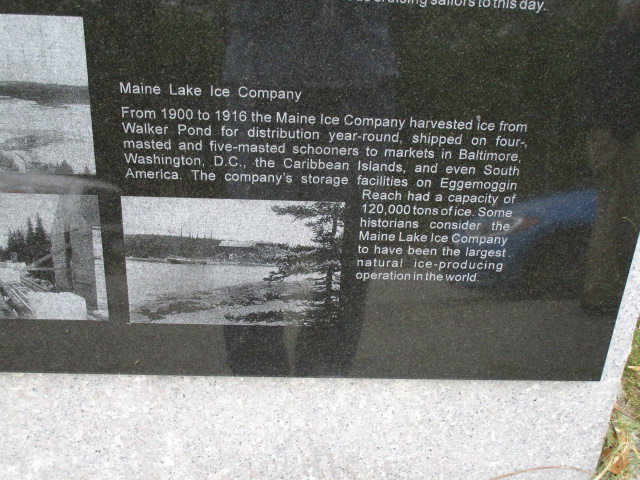
This plaque tells the story of the Maine Lake Ice Company which some historians consider the largest natural ice-producing operation in the world off of Walker Pond.  At its peak of operations, the Maine Lake Ice Company boasted a complex structure of conveyor tracks with cogwheels powered by steam-driven engines and four giant ice-storage sheds, two on the ridge near the Herrick Road and two down the hill by the granite wharf jutting out into the Punch Cat hill maine lake ice company

Bowl on Eggemoggin Reach.  Over 120,000 tons of ice were shipped yearly on large four- or five-masted schooners to Baltimore, Washington DC, the Caribbean, and South America.  It’s been written that one shipment of ice, insulated with sawdust, made
it to Calcutta, India.   The very first load of ice was shipped in the schooner Albert T. Stearns, with Captain Chase, to Baltimore. All year-long, shipments left once or
twice a week, frequently on the five-masted Mary F. Barrett, Gardiner Deering, and Fannie Palmer.   With the invention of refrigeration and the spread of electricity, the ice
business as a large operation on Walker’s Pond came to an end in 1916.

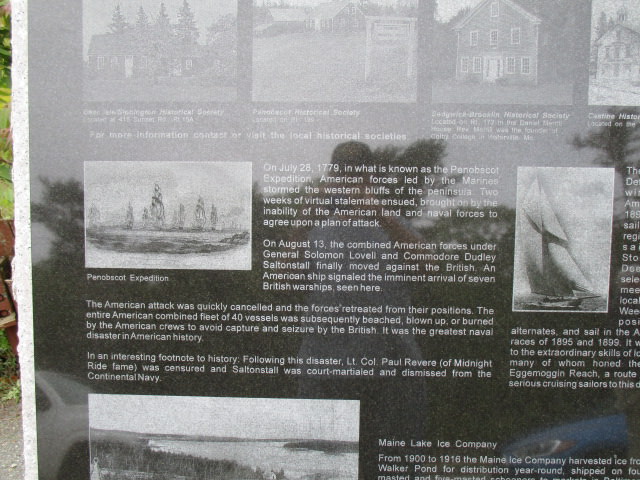
Then, there was this plaque which really attracted my attention.  It tells of the single greatest defeat of the early American Navy.  The Penobscot Expedition during the American Revolution was the worst naval disaster in American history until  Pearl Harbor. That a huge force of men, ships and guns failed to take a small British fort in Maine has been largely forgotten. The Penobscot Expedition included 40 vessels, nearly

Cat hill greatest american navel defeat

2,000 seamen and marines, 100 artillerymen, 870 militia and 350 guns.  The shortcoming of the whole expedition was simply that it was planned by civilians with little military input and carried out by badly trained part-time soldiers.  The officers in charge bickered among themselves and could not agree on a coordinated plan of attack.  While they argued and quarreled among themselves the British reinforced their position and brought in reinforcements.  The Americans attack was soon cancelled and the Americans burned and sank their ships and disappeared into the woods, heading for home. In the end, all the American ships were destroyed except one, which was captured by the British. The Americans lost 470 men; the British only 13.

Now it was time to finally head for home.  We again covered a lot of territory, discovered some more sculptures and learned some fascinating facts about Maine around the area of Caterpillar Hill.  Once again, the day was made even better by the fact that we did it together, traveling along, singing our song, side by side.  We wouldn’t have it any other way.

Returning home we discovered that for some reason the refrigerator had shut down.  We couldn’t discover either why when it failed on electric it didn’t switch automatically to propane.  Thankfully, we didn’t lose any food.  We just have a mystery to solve.  I’m wondering if our friendly ghost is back.  Makes perfect sense to me.  Time will tell.

In closing, just a simple thought for the night:  when I was young a nap was viewed as a form of punishment – now I view it as a mini-vacation!

As always,  if you are coming to the end of your day with concerns and worries, let me suggest that you turn them over to God.  After all, He is going to be up all night so why not let him handle them for you.

Time now for our evening prayers and eventually some shut-eye.  Till tomorrow.

These are the voyages of  Graybeard and it’s occupants, four paws and two humans.  Our continuing mission: to explore as many new states as possible, to seek out new acquaintances and make new friends, to boldly go where we have not been before


June 6th, Wednesday – Seal Cove Auto Museum, Wayne Carini of Chasing Classic Cars

This is really getting old.  We awoke to another cold, dreary, rainy day.  Oh where, oh where is springtime.  Hopefully, just around the corner.  So the question now was, do we stay home or take a chance that the weather will improve and head out?  In the end we chose to stay put and give our aching knees time to recover from yesterday.  Tomorrow, though, we know we will be out and about.

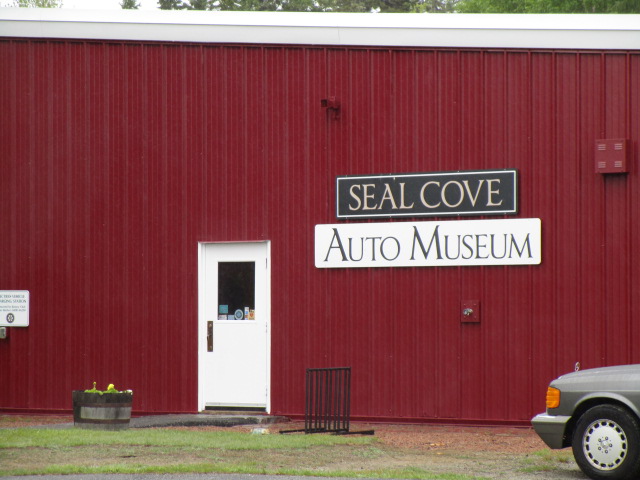
So let’s go back now to the Seal Cove Auto Museum located in Seal Cove, Maine.  This is an absolutely fascinating place that our friends Hoag and Max mentioned to us.  I am so glad they did.  This is not to be missed, especially if you are into all things automotive.  What a wonderful treat indeed.
entrance sign

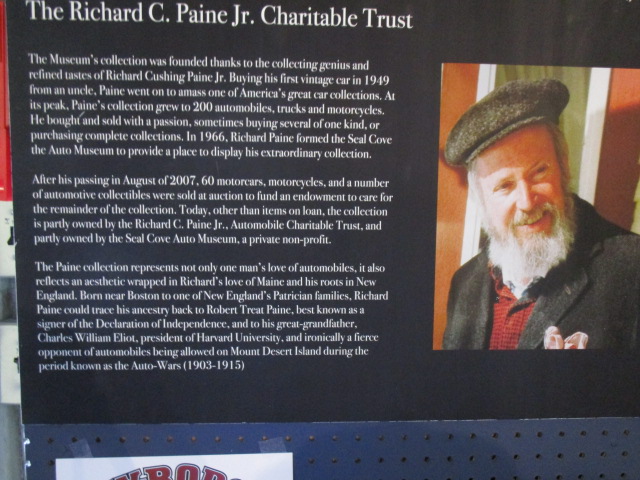
The Seal Cove Auto Museum is a not-for-profit 501(c)(3) organization, housing a collection of vehicles, automotive items, and other objects that tell the story of innovation and ingenuity in New England and America through the early development of the auto. The Museum was originally founded by Richard C. Paine, Jr. as a place to keep and display his personal automotive collection.
richard c paine founder best

In the mid-50s, Richard operated the Seal Cove Garage selling everything from Mercedes-Benz to Saabs and even Borgwards and Porsche diesel tractors.

His favorite car back then was the Mercedes 300 SL ‘Gull Wing’ Coupe, as testified by a sales slip with a penciled in note reading, “RCP’s private car.”  It cost him $8,175 new then but after his death it was valued at $1,500,000.

During his lifetime Richard formed the nonprofit Seal Cove Auto Museum to provide a place to keep and display his extraordinary collection. Although he donated a few cars to the Museum outright, the bulk of the collection on display remained in a personal Trust until the time of his death.  Richard alone ran the museum at that time and the following is part of a story of an individual who visited it during the 80’s.

We were driving to the Bass Harbor lighthouse and spotted the “auto museum” sign from the road, not really expecting much. When we entered and I saw rows of truly the best of the best cars ever made, I was just “sucked in,” walking right by the cash register. By the way, I’m a car guy. There were a couple of times I came back to the front to ask more car questions. My enthusiasm was infectious.  Later Richard joined us and answered more questions and told us some stories.  We went from car to car, Richard telling me how he had gotten this one or maybe going over the ropes to point out something unique about that one.  What a great man.

After his death a new board was chosen for the Museum with a mission to preserve Richard’s core collection, and to keep the Paine Legacy alive. Talking with the museum’s chief mechanic Peter yesterday, I was told that when they first entered the warehouse that housed the original collection it was so full of cars that you could barely walk among them.

The new board worked with the Trust, which owns most of the cars, to find a way to continue to make the core of the Paine collection accessible to the public.  Ultimately, some duplicate cars, motorcycles, and automobile memorabilia were sold by Bonhams at an auction on September 25-26, 2008 that attracted the attention of collectors from around the world.  When all was said and done the total raised was nearly $8,500,000.

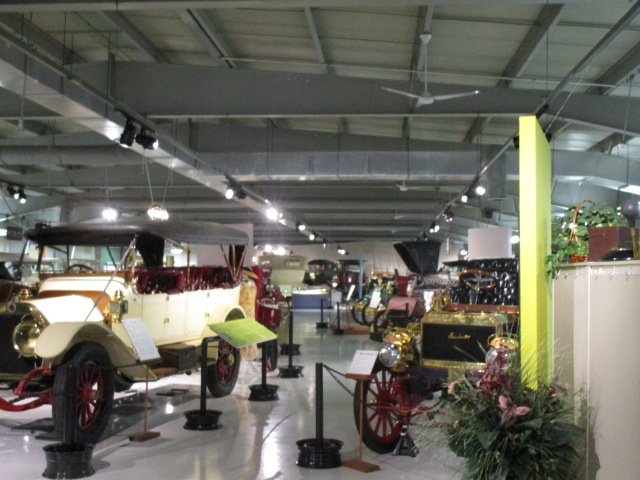
Today The Seal Cove Auto Museum which is tucked away in a metal building on a back road of Mount Desert Island, Maine, displays automobiles representing the technology, design aesthetic, and lifestyle of the years between 1895-1917.  This is usually referred to as the Brass Era.  Again the museum’s chief mechanic Peter shared with me that every Saturday a woman comes in – as she has for the past twenty or more years – to polish all the brass on the cars.  Trust me, she has her hands full.

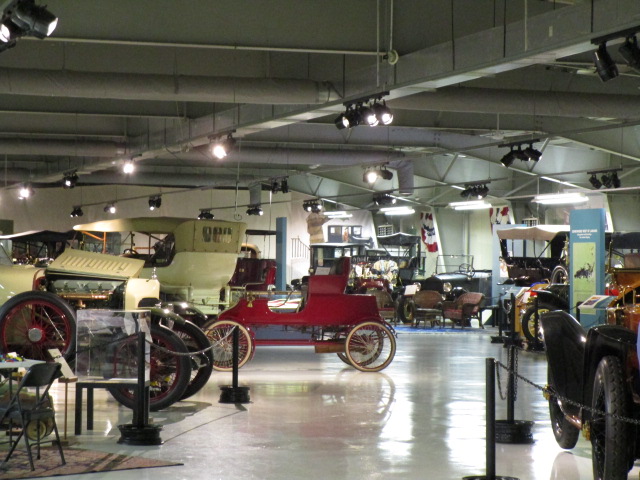
So let’s go inside.  These are two pictures of the overall view of the museum as you first enter.
general view


general view 3

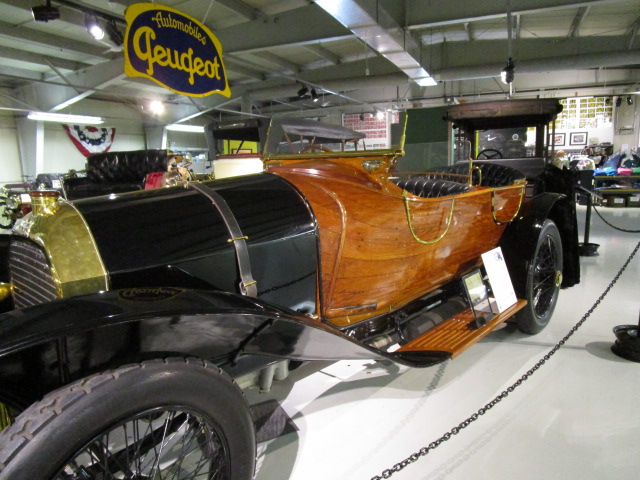
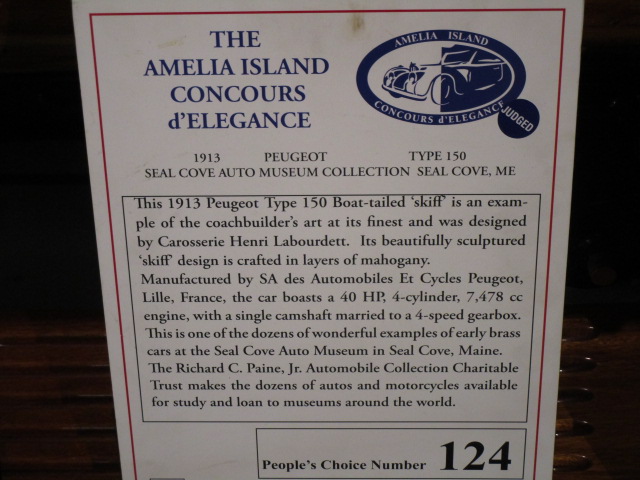
This is a picture of a 1913 Peugot type 150 on display that is considered priceless.  
1913 peugot

1913 peugot 1

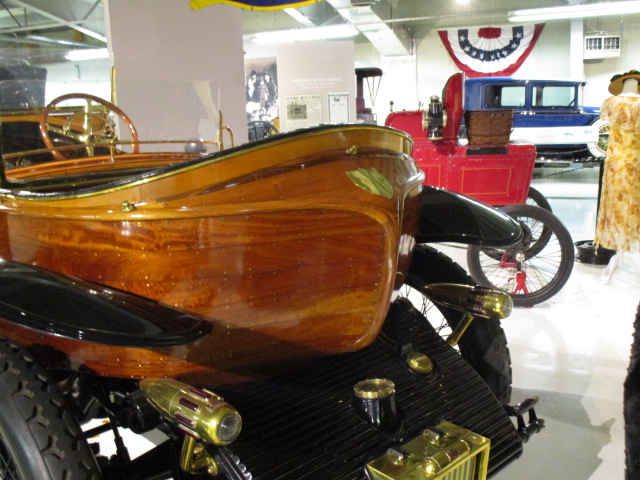
1913 peugot 6 rear

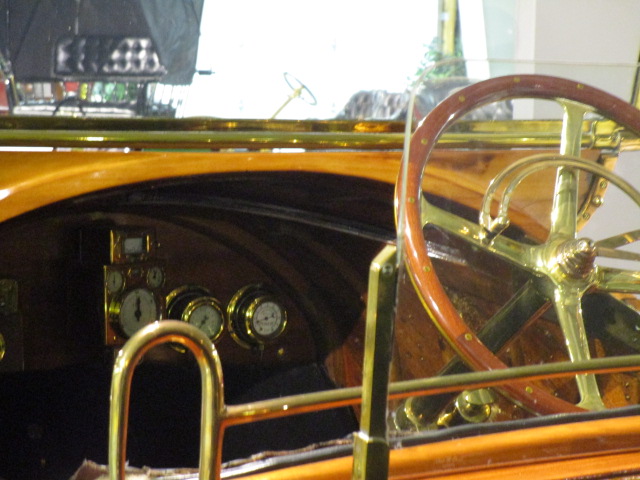
1913 peugot 5 inside dash wheel better

This is what is called a skiff body and is created in triple layers of mahogany planking, riveted on a frame of ash. Between the second and third plies there is a layer of canvas, which assured great rigidity.  ‘The resulting design was little short of revolutionary at the time.  Today critics consider it to be one of the most beautiful automobiles ever, a masterpiece of the art of bodybuilding.

To appreciate the impact of the skiff, one must see it in the context of its contemporaries. Most designs of that era were characterized by a ‘box’ which covered the engine, terminating with a break at the windshield, and behind this, a bulky upholstered body for the passengers. At the very rear the fuel tank was slung between the frame rails.   In contrast the skiff  combined graceful transitions and elegant curving lines. The engine hood flared up to a low, slanting windshield and the gas tank was hidden behind the front seat to expose the rounded, voluptuous tail.

In any case, the skiff idea took hold and soon skiff bodies were being built on many different chassis. For more information and better pictures of this incredible car go to the following link https://www.sealcoveautomuseum.org/collection-test/1913-peugeot/

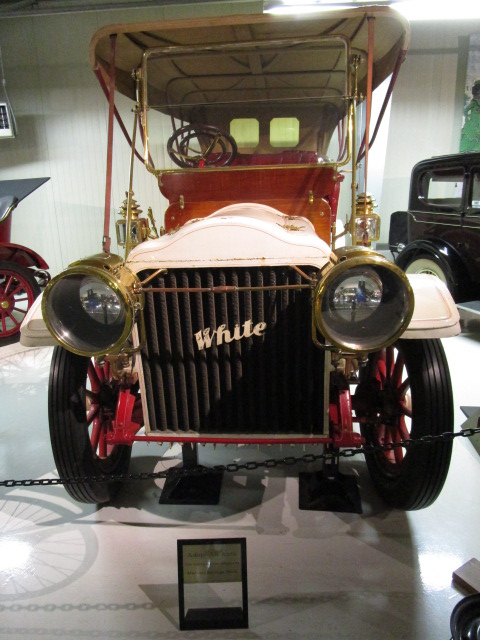
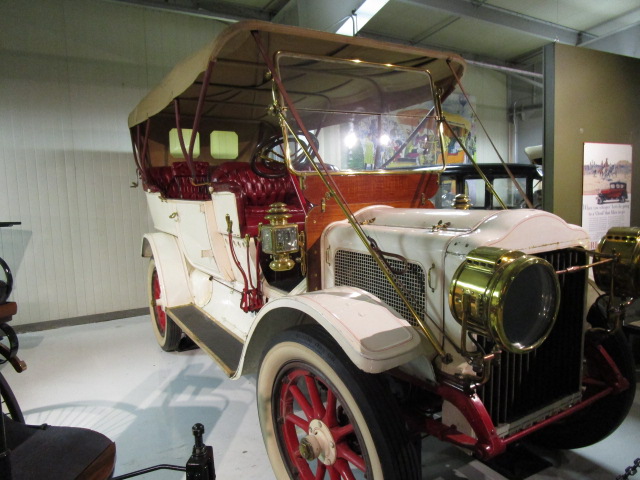
Next is a car that Jay Leno has been trying to buy in order to add to his considerable collection of steam cars.  The answer though is always not for sale.  The car is 1910 White Steamer.
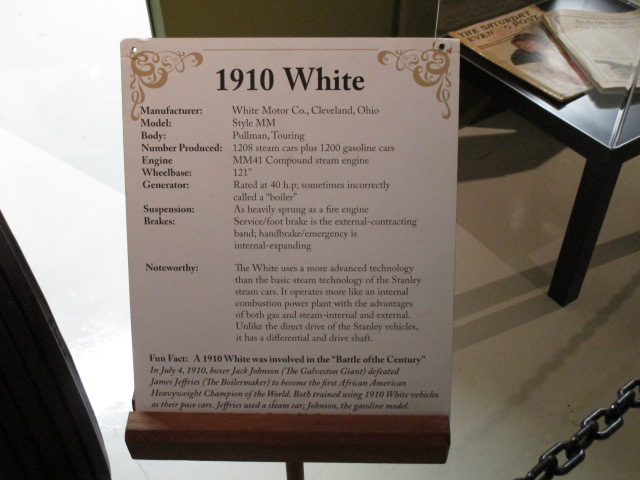
1910 white

1910 white picture 1

1910 white picture 2

In 1858, at the age of 22, Thomas White began manufacturing New England-type sewing machines which he sold for $10 apiece. The first machines were manufactured at the small Wilkinson Machine Shop in Templeton, Massachusetts.

In the late 1890s, the company diversified its operation and began manufacturing items such as roller skates, bicycles, kerosene lamps, lathes, and screw machines. In 1901, the company produced its first automobile. Thomas White, still president of the company, gave control of vehicle production to his three sons, Windsor, Rollin, and Walter. All were all auto enthusiasts, and helped get the company into the automobile industry.

In November, 1906, the auto making part of the business split off into a separate company, named the White Company. After 1911, the company stopped making Steamers and focused on producing gasoline driven engines. Over the course of their steam-making career, the company produced 9,122 White Steamers.

President Taft threw his considerable weight behind the infant U.S. auto industry when he rode in the 40-horsepower White Model M for his inauguration in 1909. Taft’s White was used for more formal functions around Washington. It was the first presidential limousine, replacing the horse-drawn carriages that had served every president from George Washington to Teddy Roosevelt, Taft’s predecessor.

“William Howard Taft brought this car into the White House, and because of that act, the automobile industry, American political culture, road building and the whole economy… changed to be the way it is today,” said Michael L. Bromley, author of “Taft and the First Motoring Presidency.”

For more information on White Steamers this link will take you to an excellent piece presented by Jay Leno:  https://www.youtube.com/watch?v=wKX1KgIkBwg

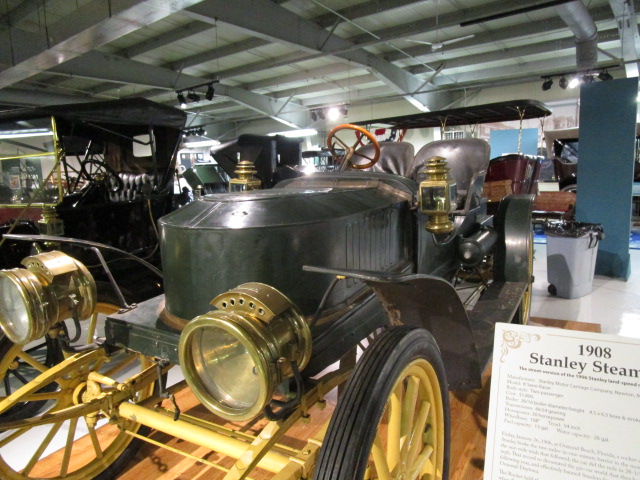
Next is a 1908 Stanley Steamer called the Rocket which was considered the fastest car in the world between 1906 to 1910.
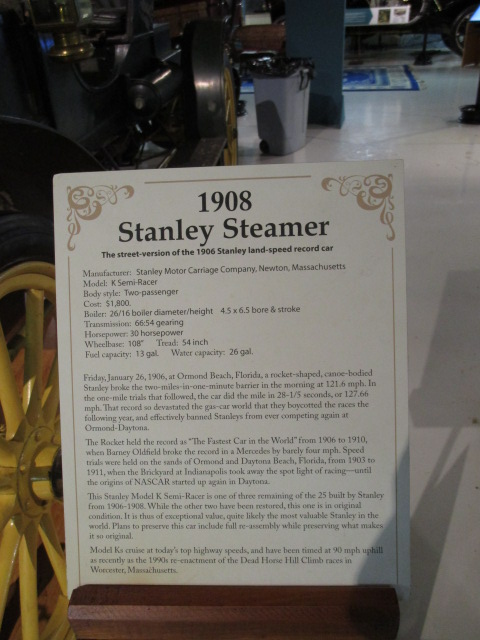
1908 stanley steamer

1908 stanley steamer picture

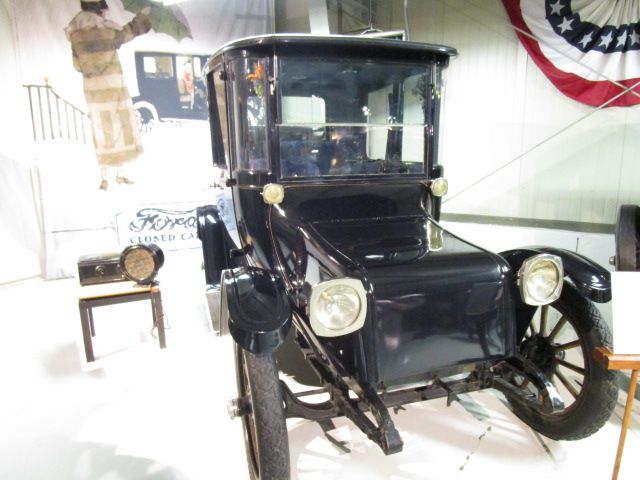
This is an example of an early electric car, a 1922 Detroit Electric.  It was rated at 80 miles per charge but recorded over 211 miles on a single charge.  Henry Ford purchased one for his wife since she refused to drive a gasoline powered car.
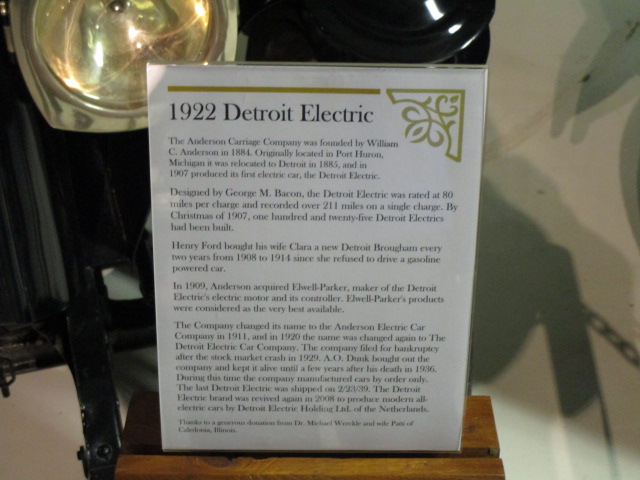
1922 detroit electric

1922 detroit electric picture

Next up is 1904 Curved Dash Olds.  This was the first high-volume produced automobile.  It was introduced by the Olds company in 1901 and produced through 1907.
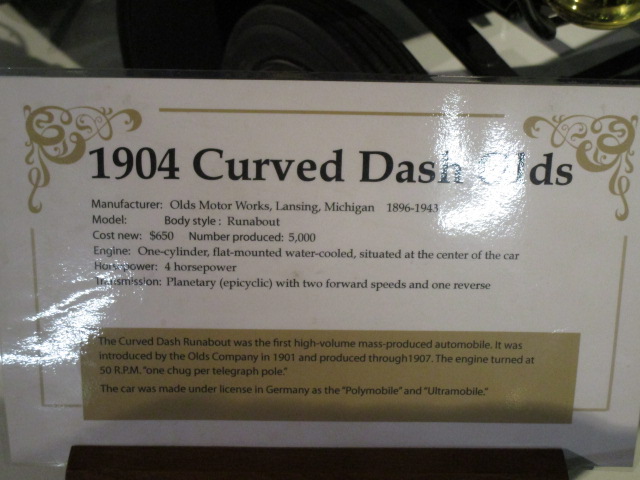
1904 curved dash olds

1904 curved dash olds picture

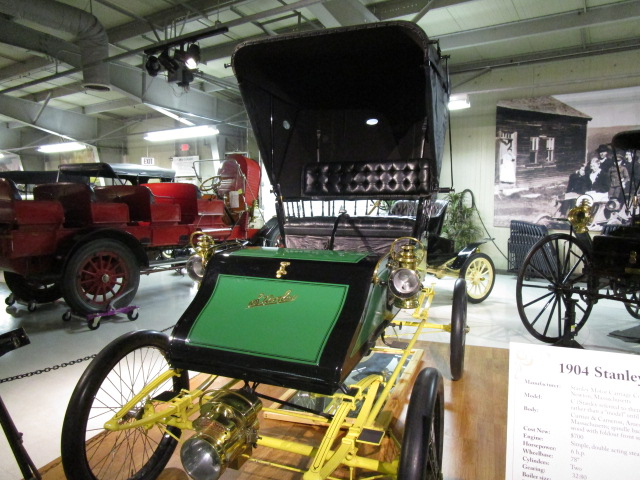
Next is a 1904 Stanley Steamer which used a tiller (like the Olds above) instead of a steering wheel since most people of that time had no idea what a steering wheel was..
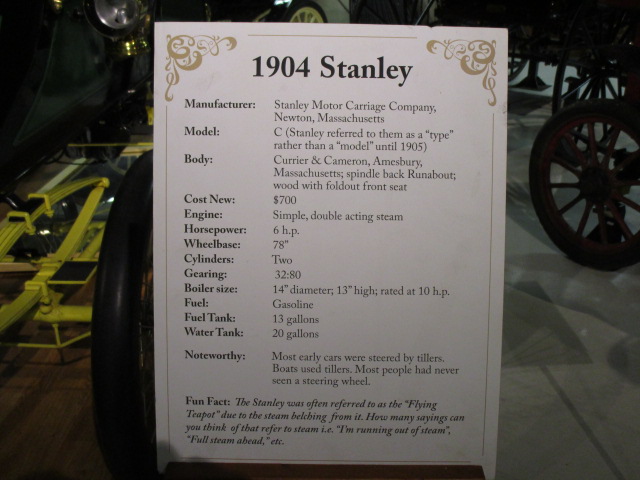
1904 stanley

1904 stanley picture

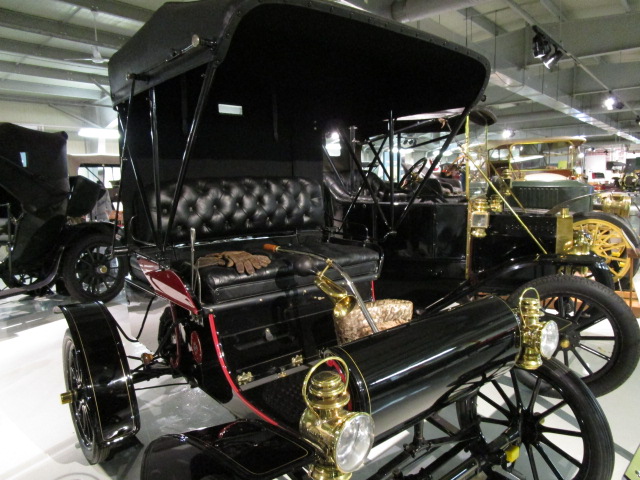
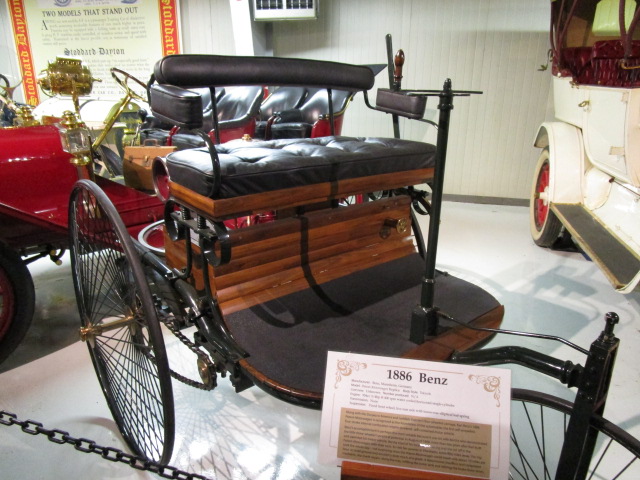
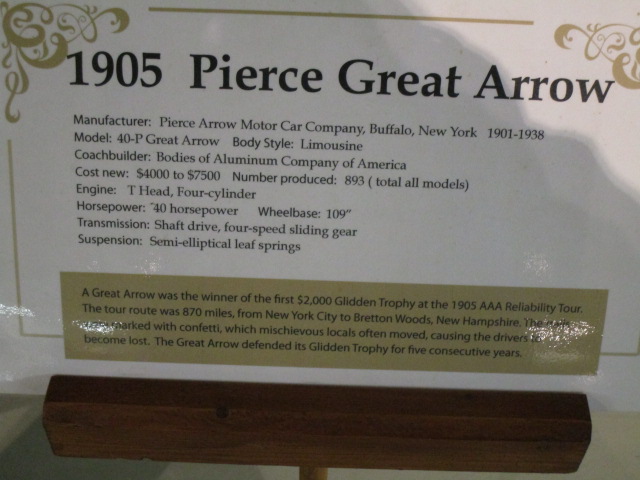
Continuing, here are some more pictures of the cars now on display.  Unfortunately, space does not permit showing all of them.
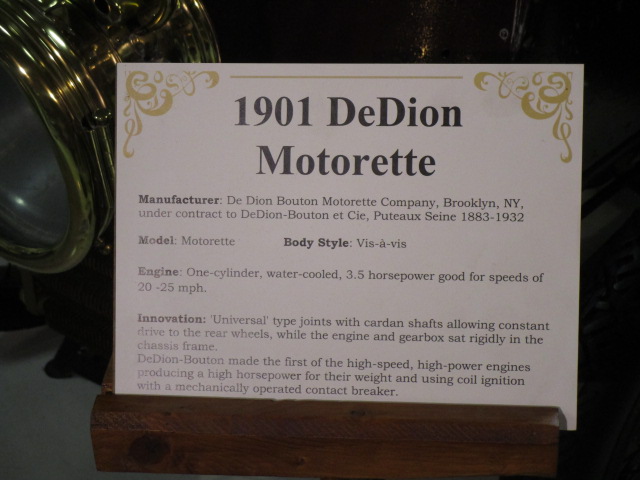
1901 DeDion

1886 benz picture

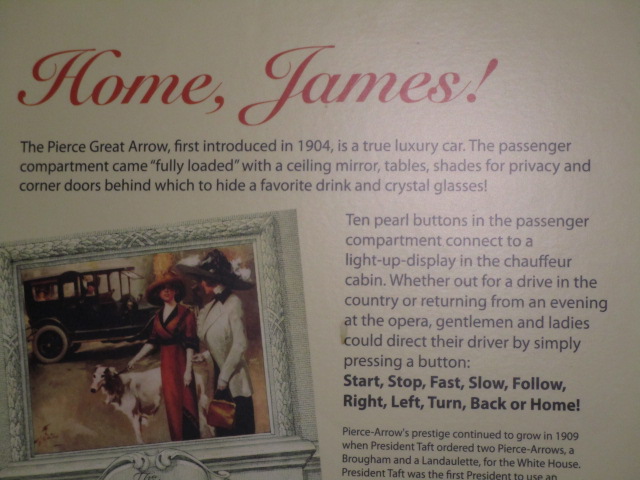
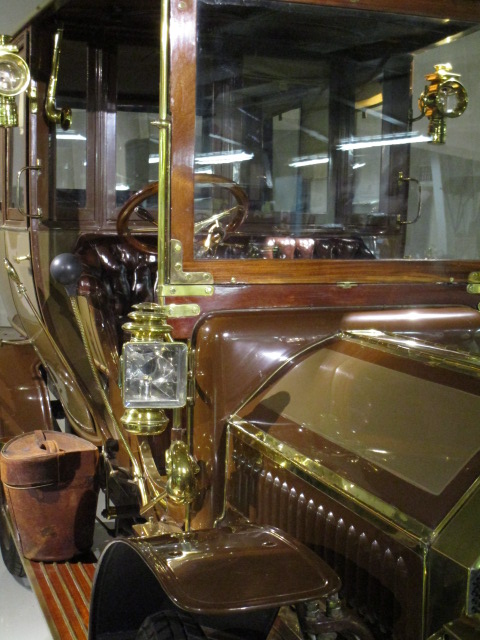
1905 pierce great arrow


1905 pierce great arrow picture 4 home james best

1905 pierce great arrow picture 1

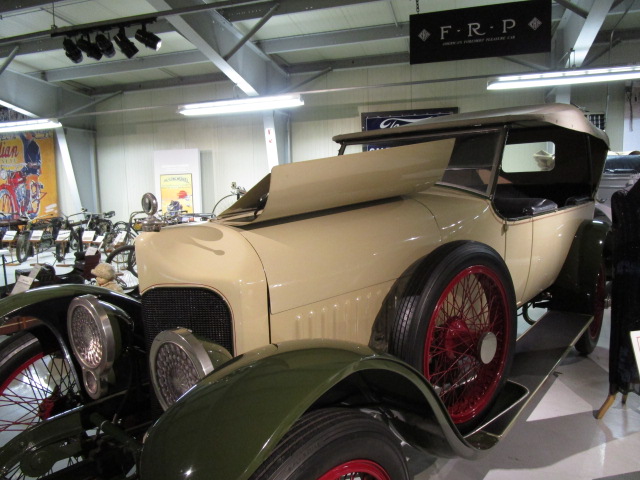
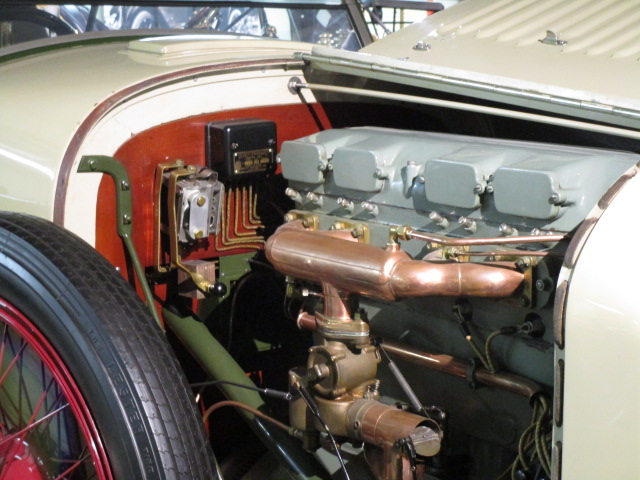
1915 E.R.P. Series B Touring Car.
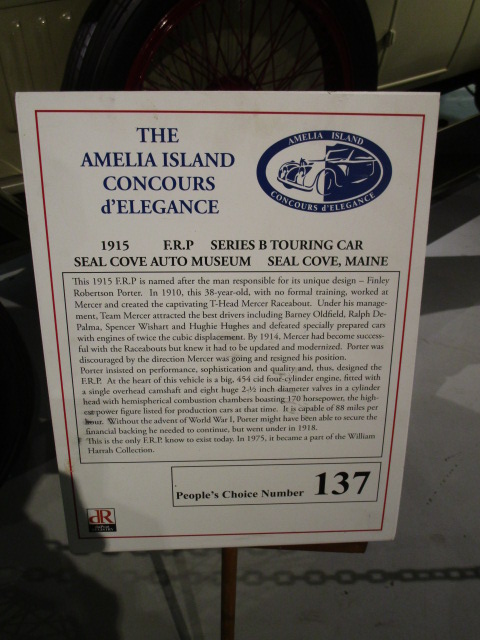
1915 series b touring car

1915 series b touring car picture

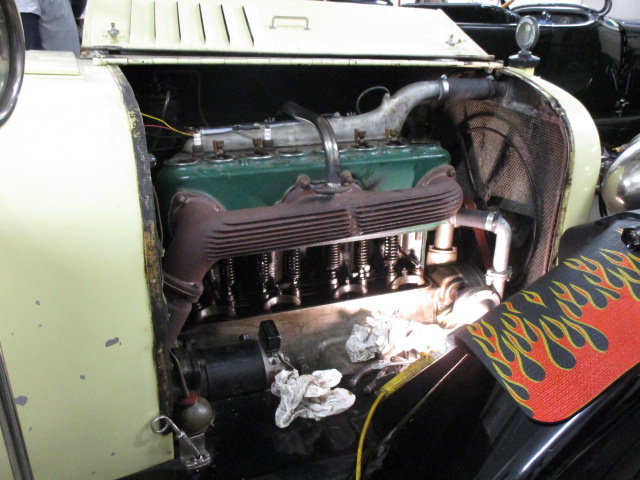
1915 series b touring car picture engine

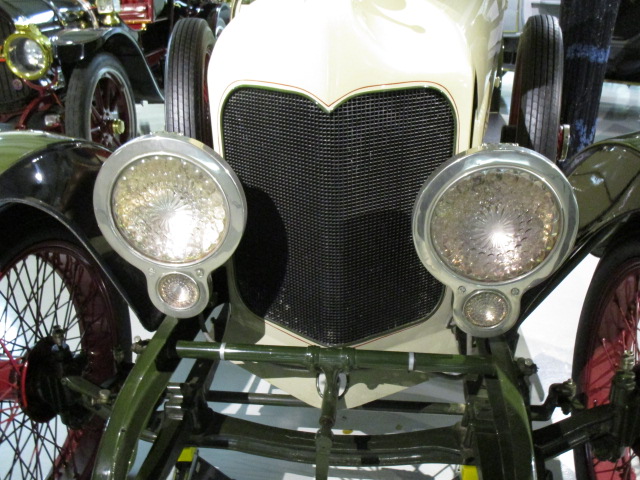
1915 series b touring car picture headlights

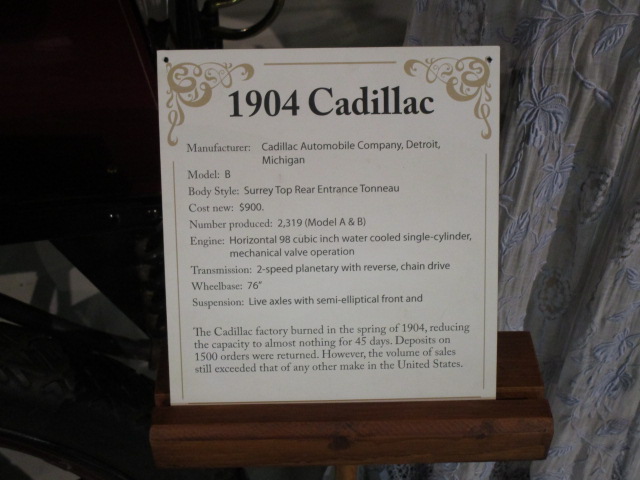
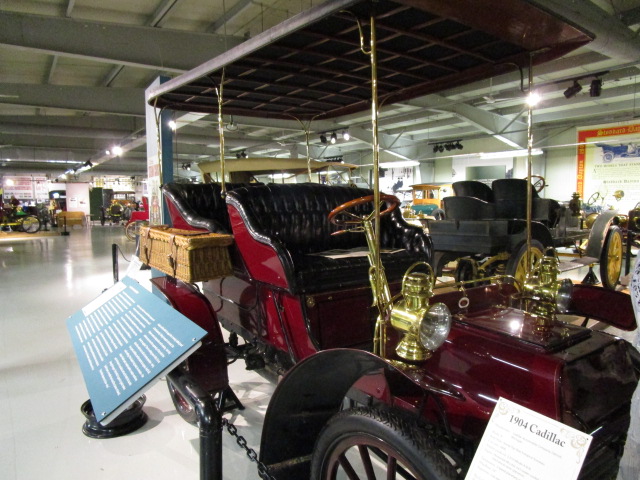
1904 Cadillac

1904 Cadillac

1904 Cadillac picture

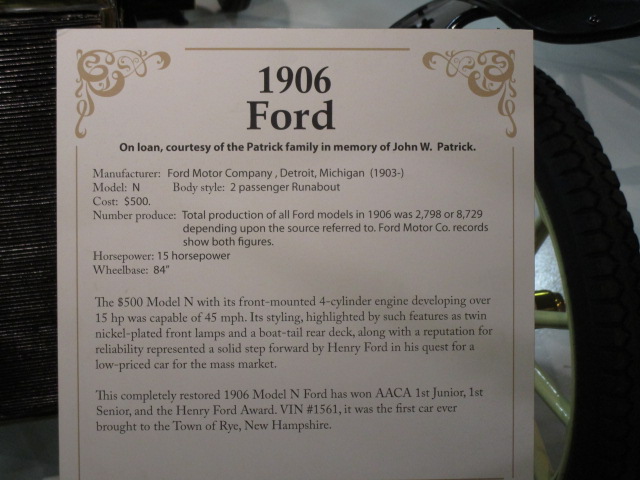
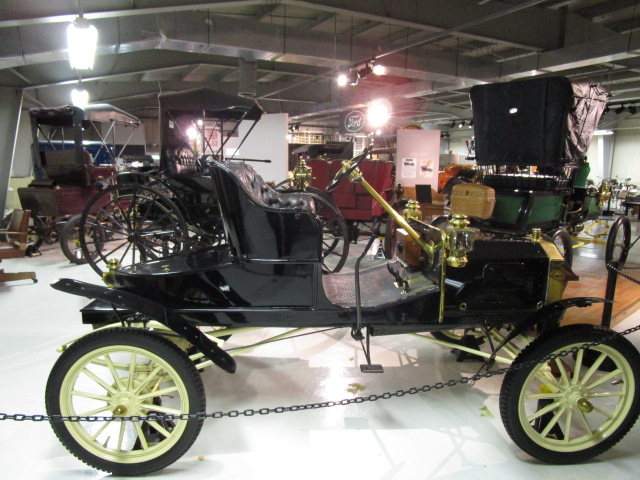
1906 Ford 

1906 ford

1906 ford picture 1

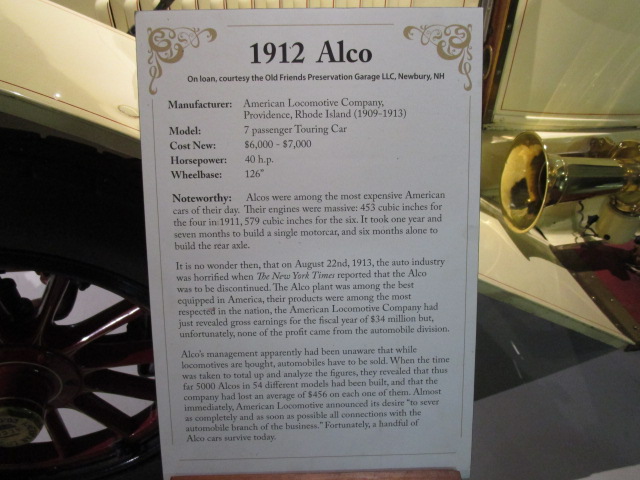
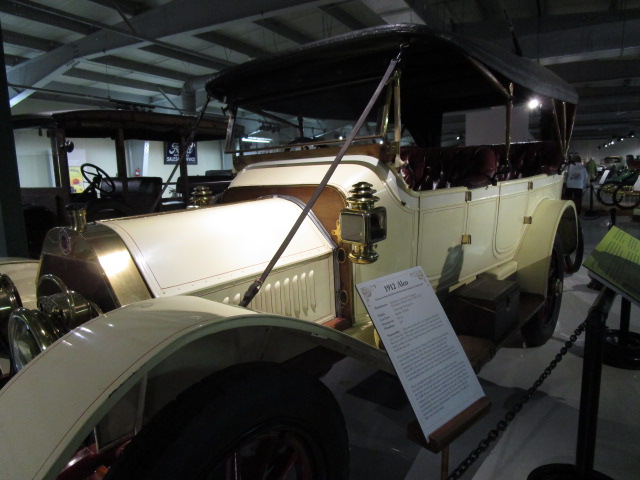
1912 Alco

1912 Alco

1912 Alco picture

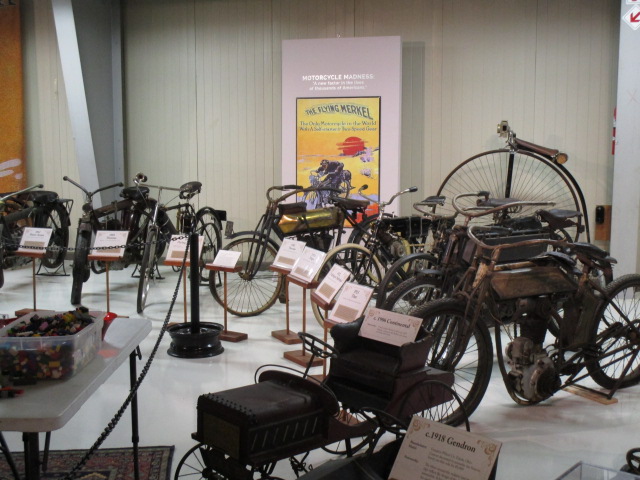
Yes, there were motorcycles.

motorcycles


Now we come to Wayne Carini of Chasing Classic Car fame.  Or is it?  Take a look.
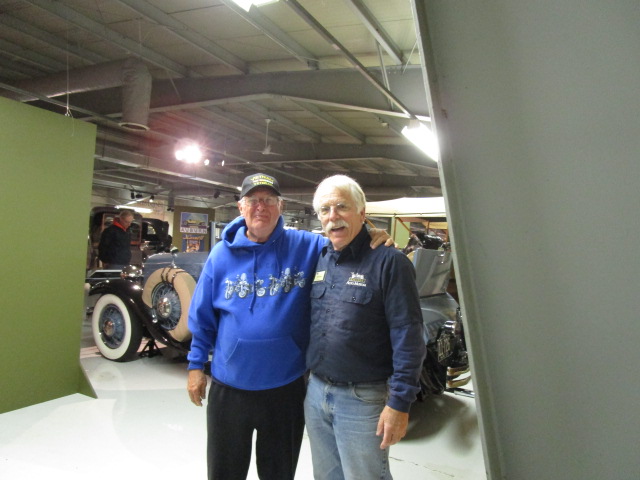
alpha mechanic peter wayne me

Actually this is The Museum’s Head Mechanic, Peter Brown, who has been mistakenly identified many times as the famous Wayne Carini.  Peter was gracious enough to take Barbara and myself behind the curtain to view some of the cars that have not yet been restored and may never be.  Here they are, this first one is yet to be identified as to make and model.
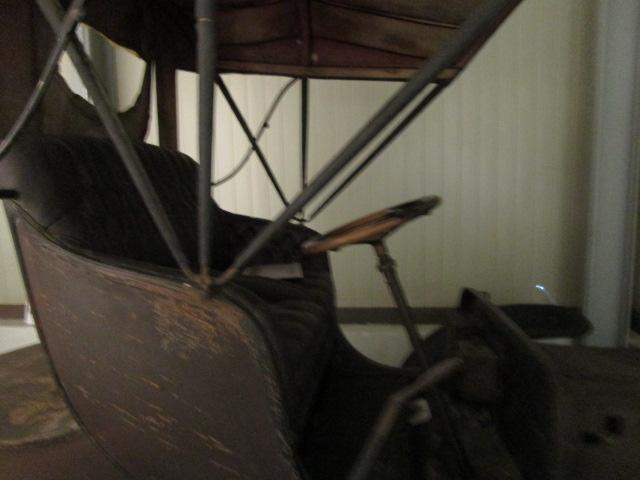
behind the curtain 1

This one is called the mystery truck since no one has an idea what it is or who produced it or even if it was originally a pickup truck or later converted to one.  It has an air-cooled two-cylinder engine with the fuel tank under the seat.  It has a storage box mounted to the frame in the rear.  There are no plaques or other identifying marks that would help to identify the maker or the model or the year.  Peter stated so far no one has been able to figure out who made it or when or why.
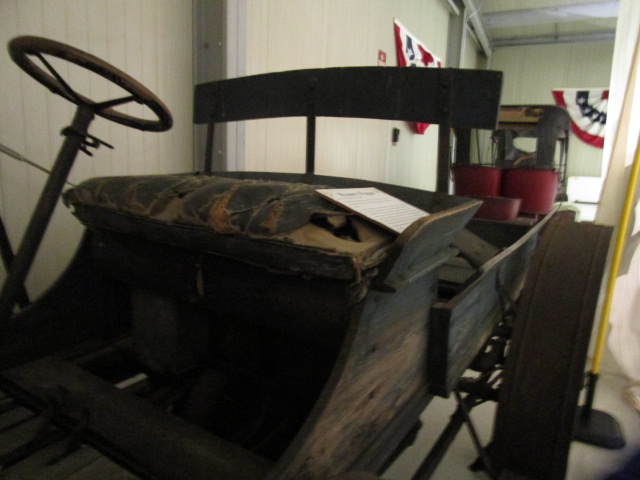
behind the curtain mystery wagon picture

Peter, we discovered, will be participating in this years Great Race.  Ten days, 17 cities, and over 2,000 miles.  The 2018 Hemmings Motor News Great Race is an intense competition for vintage cars, and it is coming to the Seal Cove Auto Museum this June. In its 35th year, this long-distance, time-speed-endurance rally tests the abilities of 120 racers and their pre-1972 cars.

This race is not a test of top speed. Instead, it tests teams’ abilities to follow a precise course, using only a set of instructions (no maps allowed) indicating every turn, speed change, and stop, with the goal of arriving at each designated checkpoint at exactly the right time. Any technologies such as GPS or electronic odometers are prohibited; only analog odometers and stop-watches may be used.

Peter will drive a 1930 Ford Model A boat-tailed speedster owned by Ford Reiche.

The Great Race Coming to the Seal Cove Auto Museum –  Museum’s Mechanic Will Compete

Reiche will act as navigator, a challenging role, as he will have to determine the exact speeds to travel every minute of the route, described in a list of detailed instructions given to the team on the morning of each day of the race.

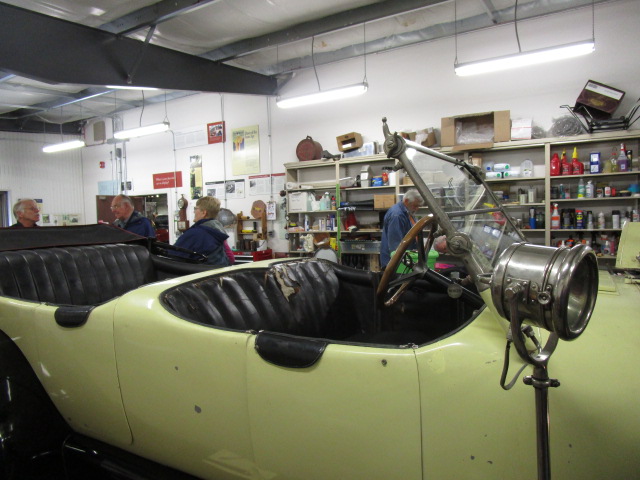
Then it was time to visit the garage.  Yes, they let you right in where they work and restore the vehicles on display.  Here we see a group of volunteer mechanics trying to get what they call the community car (because it is frequently taken out on runs in the community) running again.  Seems there was no compression on cylinder number one.
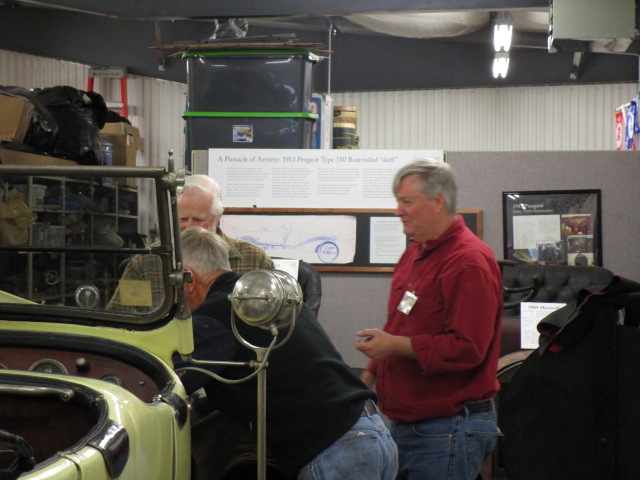
in the gargage the whole gang

in the garage engine working on

in the garage car working on

I had a wonderful time just talking and sharing with all of the volunteers.  One was from New Jersey, name of Jim, but they call him papa smurf.  He grew up in the same northern area of New Jersey where I was born and raised.  Small world.  All of these guys come north, when the museum is open, to volunteer their time and mechanical skills.  A great bunch of guys that I had the pleasure of hanging out with for about an hour.
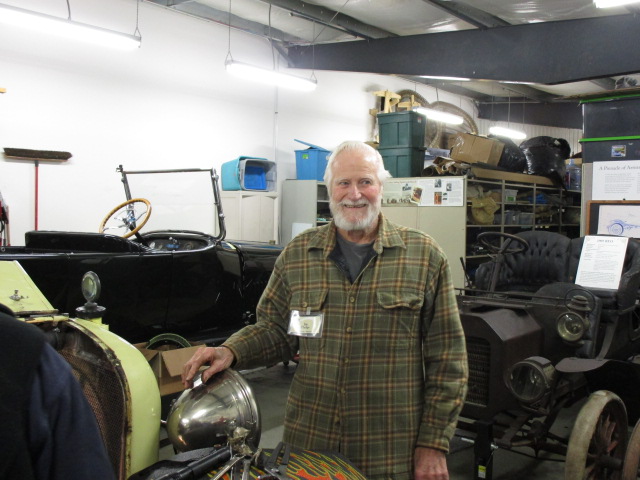
in the garage engine jim volunteer papa smurf

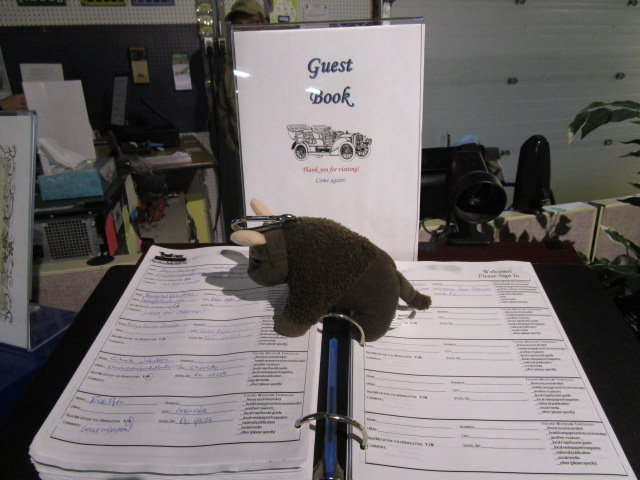
Finally, it was time to go but before we did we were asked to sign the guest book.  But guess who beat us to it?  Yep, our good friend and sight-seeing companion, Benny the Bison.  Let me again say, if you are ever up in this neck of the woods, this is one place you just have to get to.  What a wonderful, fascinating collection of priceless automobiles, as well as, a volunteer staff that goes the extra mile to make your visit special in every way.  Don’t miss it.
guest book and benny

So our day was spent inside catching up on the blog and taking naps.  Did the sun ever come out?  You bet!  Just in time for it to go down for the night.  Go figure.  But no complaints from us, we had another great day spent together doing whatever we felt like doing.  How neat is that.  Try telling your boss you want a day like that.

Time now to wrap things up and prepare for tomorrow.  Tomorrow we’re going to chase down some more sculptures, visit the chiropractor again, and who knows what else.  Before leaving, a thought for each of us:

Image result for Those who love deeply never grow old; they may die of old age, but they die young.

As always,  if you are coming to the end of your day with concerns and worries, let me suggest that you turn them over to God.  After all, He is going to be up all night so why not let him handle them for you.

Time now for our evening prayers and eventually some shut-eye.  Till tomorrow.

These are the voyages of  Graybeard and it’s occupants, four paws and two humans.  Our continuing mission: to explore as many new states as possible, to seek out new acquaintances and make new friends, to boldly go where we have not been before


June 5th, Tuesday – Maine Sculpture Trail, Hulls Cove Visitor Center, Bass Harbor Head Lighthouse

Once again we awoke to a cold, dreary, rainy day.   What to do?  Of course, not getting up at all was one option.  Another was to stay home and play dominoes and nap off and on.  Then, too, we could perhaps find some type of attraction that would permit us to stay indoors.  One definite goal we had been getting more stamps for Barbara’s National Passport Book.  So the last option won out.  We would drive over to the Hulls Cove Visitor Center and then go to the Seal Cove Auto Museum.  Indoors all the way.

Since we were only going to two places, we were in no rush to get going.  After all we figured we would be home by early afternoon no matter what.  Yea.  To make a long story short we left at around 11 am and did not get home until after 6 pm.  In addition, we covered we figured conservatively speaking some 150 miles.  How?

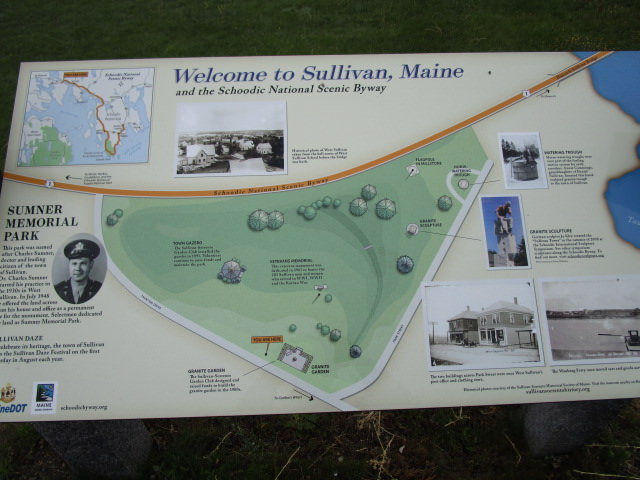
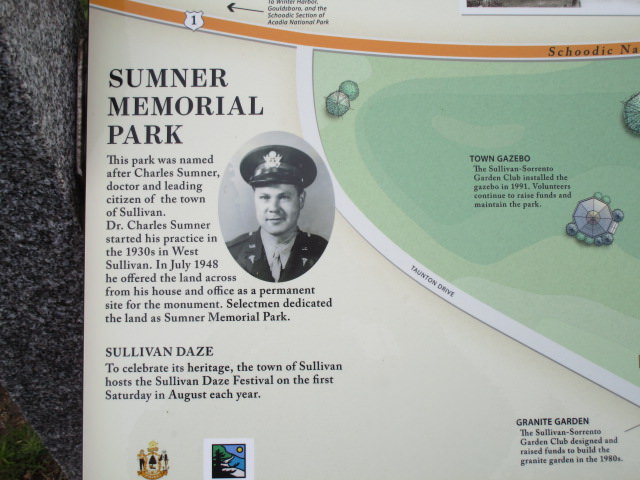
Here we go.  On the way over, we knew of another sculpture that was on the way so we decided to make that our first stop.  This sculpture was located at Sumner Memorial Park which is located on the Schoodic National Scenic Byway.  The park itself is named

Sullivan Park Board Explained

after Charles Sumner who had been a doctor and leading citizen of the town of Sullivan.

Sullivan Park Board named after

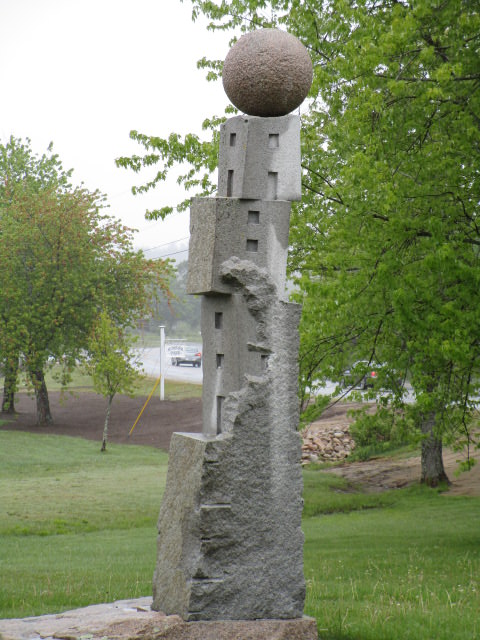
The sculpture located here is entitled Sullivan Tower and was created by Jo Kley from Germany.  His explanation of his work is:  I chose the shape of a tower as it is a universal icon that is understood by any society and race.  I may not understand


Sullivan Sullivan Tower 3

nor see exactly what the artist sees, but since chasing these pieces down I’ve begun somehow to gain a new appreciation for art.  The time and labor that went into these sculptures, the craftsmanship that is evident, the way that the granite has been worked is really quite amazing.

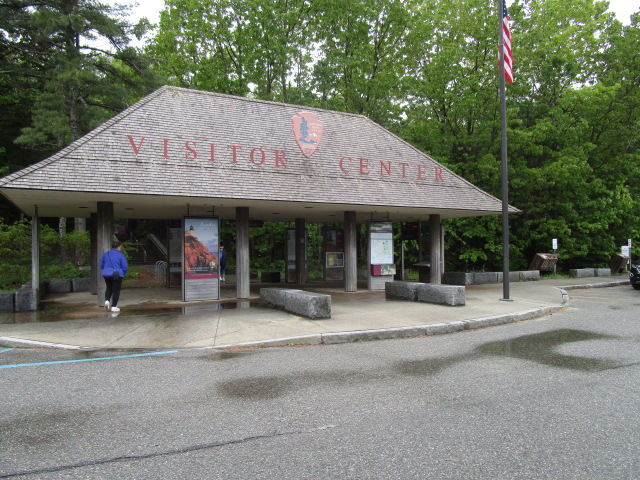
We were back on the road again and now heading toward Acadia National Park.  Our

hulls cover vistor center 2

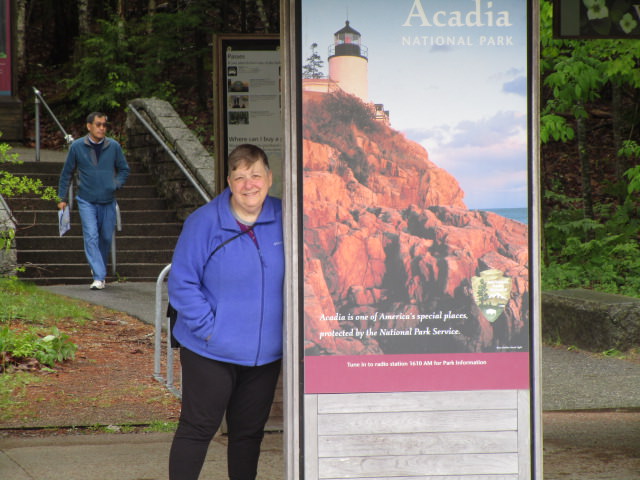
destination was the Hulls Cove Visitor Center which is at the beginning of the 27 mile Park Loop Road.  Here is Barbara at the entrance before we actually began the climb to the visitor’s center.
hulls cover vistor center barb

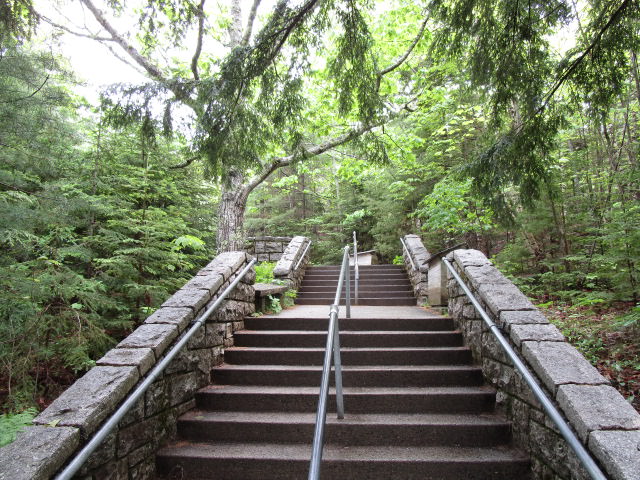
Now for some the following would present no problem but for the two of us with our bad knees, this was just a bit daunting.  But you say, only two levels?  Oh no, multiply this times 6!  First up, then of course you have to come back down.  But we did it.

hulls cover vistor center stairs leading up

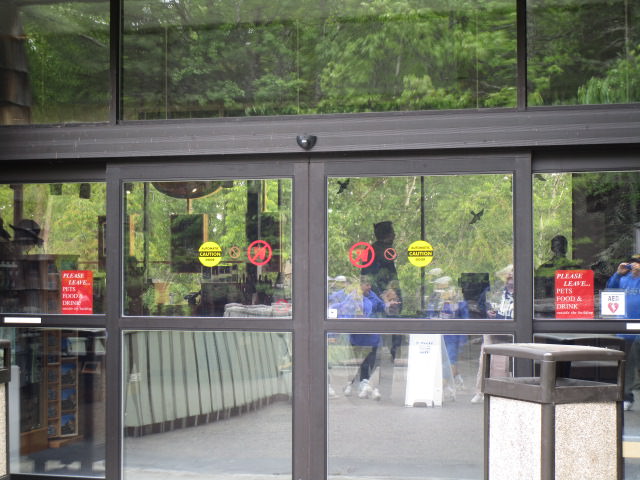
This was our destination the visitor center itself just inside these doors.

hulls cover vistor center cairn explained visotor center entrance

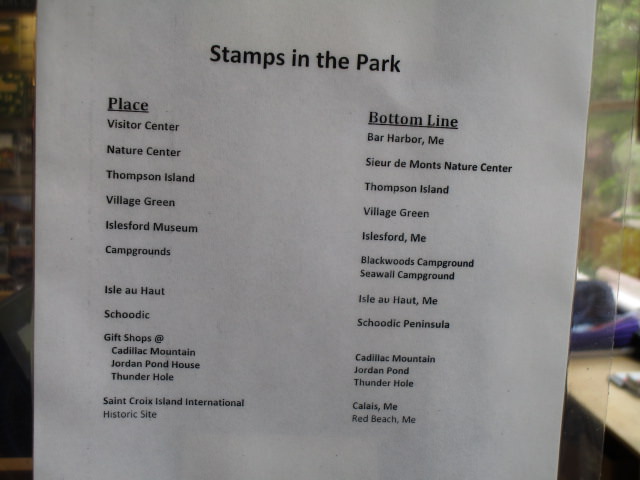
Once inside this was what we were interested in, additional stamps for Barbara’s National Passport Book.  There are many, many stamps to be collected and entered, some of which we know we will not get to.  But we are going to get as many as we can while we are here.  Of course, it means another trip along the 27 mile Park Loop Road.  But not today, it is just too miserable and the visibility is zero.  Another day.

hulls cover vistor center stamps to be collected

This then was our second stop.  After this we were back on the road and headed for a local attraction that friends of ours had mentioned as not be missed no matter what.

Seal Cove Auto Museum

However, this is going to have to wait till tomorrow because there are just too many pictures and too many stories to tell of our visit here.  So join us tomorrow as we bring you the story and pictures of this absolutely fascinating place.

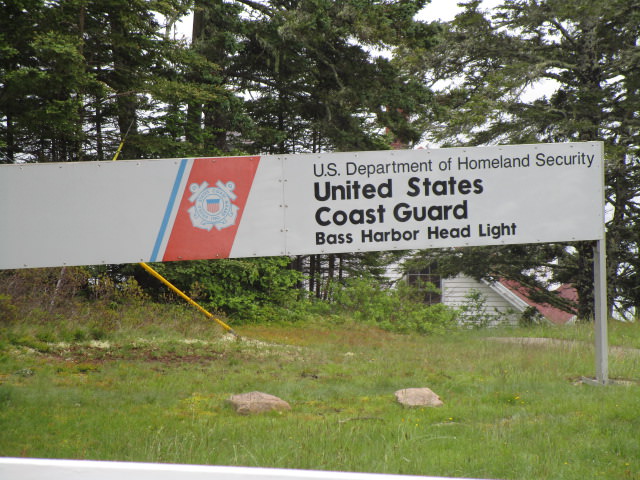
Wait, though, we’re not finished.  Oh no.  We had heard that there was a really neat lighthouse out this way, so let’s go find it.  It took awhile and what seemed forever to locate it but in due time we were there.  Where being the Bass Harbor Head Lighthouse.

bass harbor entrance sign

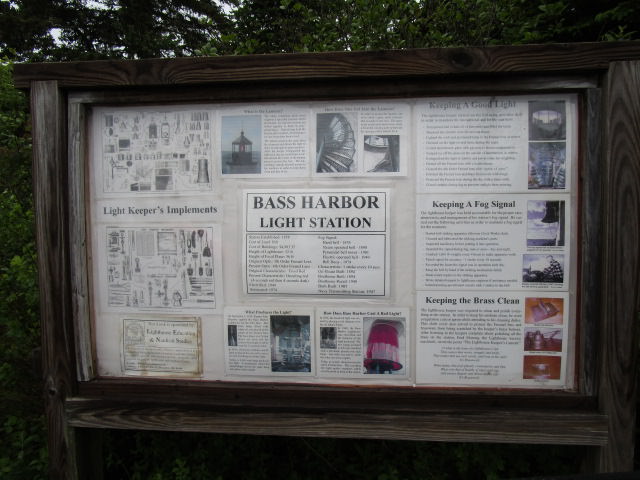
bass harbor board

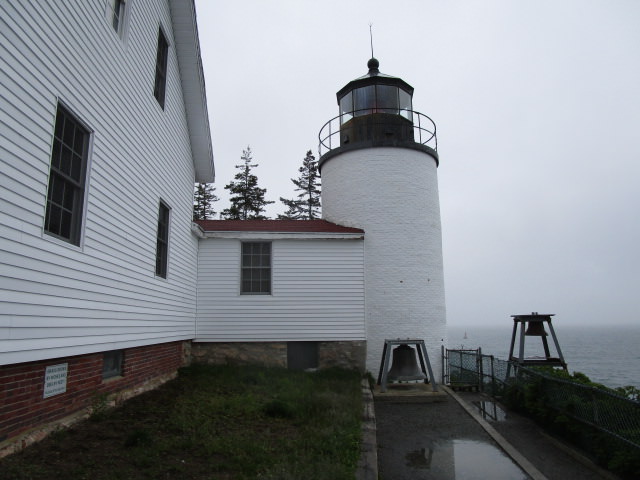
Marking the entrance to Bass Harbor as well as Blue Hill Bay, the Bass Harbor Lighthouse on Mount Desert Island in Tremont, Maine was built in 1858. A fog bell and tower were added in 1876.  The lighthouse, situated on Acadia National Park land, stands 56 feet above mean high water.


bass harbor light tower best

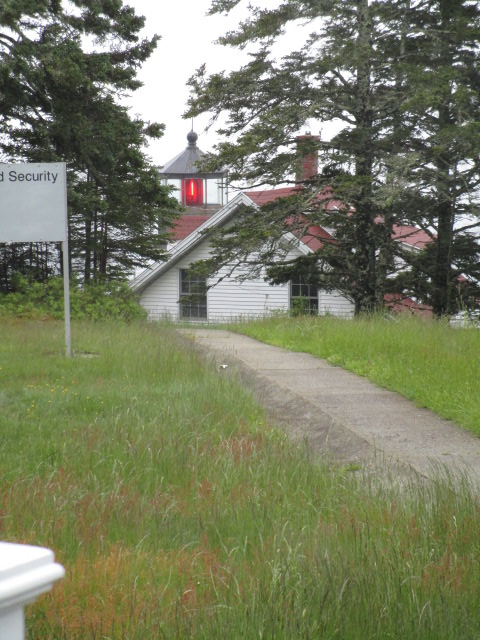
The lighthouse is now automated and remains an active aid to navigation.

bass harbor light tower beacon working

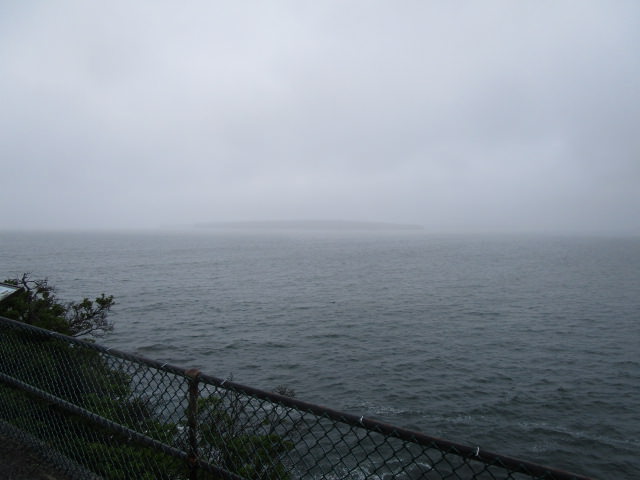
Today was an excellent example of why the lighthouse is still needed.  Take a look at the fog that was like a thick blanket across the whole harbor.  Hard to see anything out there.

bass harbor light tower why needed fog

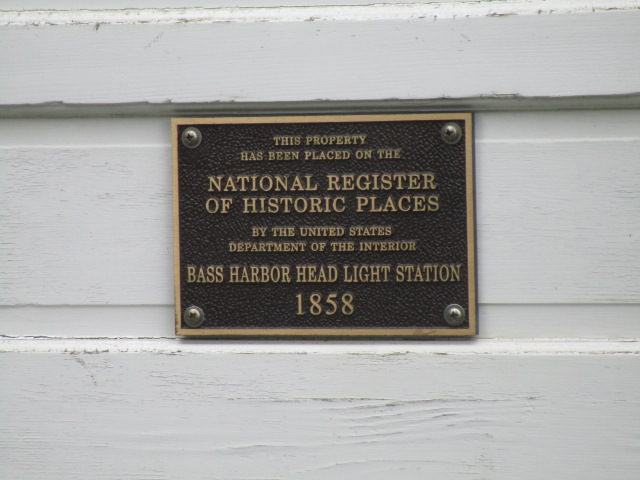
On January 21, 1988, the lighthouse was added to the National Register of Historic Places, reference number 87002273, under the title of Bass Harbor Head Light Station.

bass harbor light tower national registery

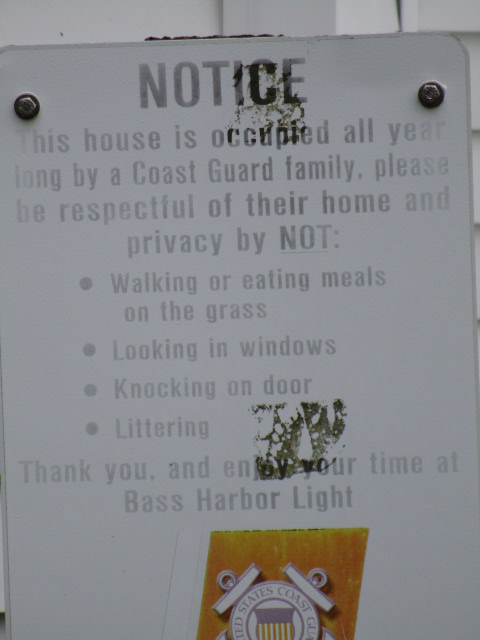
The keeper’s house is currently being used for Coast Guard housing.  I read this and well the imp in me wanted to knock on the door to see if it was really true.  But I didn’t.

bass harbor light tower occupied

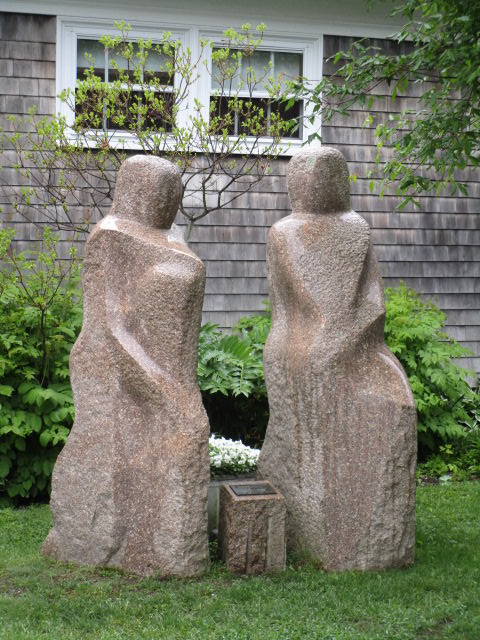
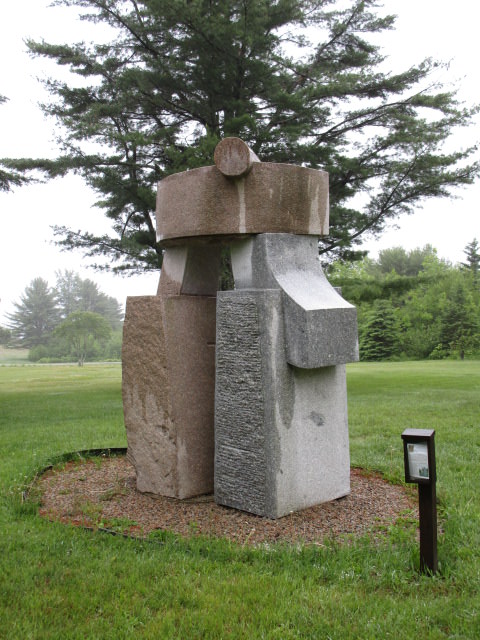
Onward.  The day was still not over.  Nope.  We knew of two more sculptures that were on our way home, so we decided to see if we could find them.  The first one we found was in the town of Southwest Harbor and is called Sisters.
SouthWest Harbor Sisters best

The artist who sculptured this work is named Roy Patterson who is from Maine.  His explanation of his work is:  the intention was to create a presence in space, a sense of being that merges with the primal presence of the stone.  

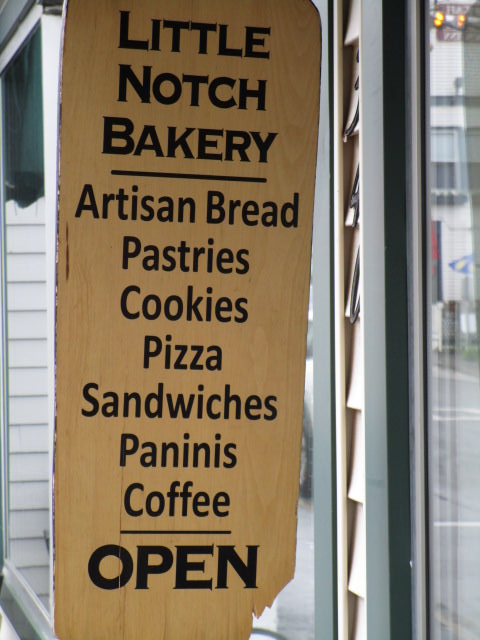
At this point it was getting late in the afternoon, real late, and we had not yet had anything for lunch.  Not to worry.  Right next to the above sculpture we found this neat little local spot where we were able to get a bite to eat.  We find that it is fun and interesting to try to stop at local shops whenever possible.  Glad we stopped here.

little notch bakery outside menu

Guess what?  Not finished just yet.  We had one more sculpture to locate.  So off we went in quest of it.  Yes, we found it.  It was located at Lamoine State Park.  Lamoine State Park is a nice 55 acre park for those who want to escape the crowds on Mount Desert Island. It has an oceanside setting with picnic and campsite areas, hot showers, a dock, boat access, a pebble beach and allows fishing.   The sculpture we located here is called Dialog and was created by artist Roland Mayer from Germany.


Lamoine Dialog 3

HIs explanation of his work is as follows:  The play of forms of load-bearing parts, the treatment of the diverse surfaces – from the split to the drilled and from the brush-hammered to the polished surface – all this offers interesting activity and changing sights and views depending on the lighting conditions and the spectator’s position.  Unfortunately, today was not a day to see it with the sunlight on it for there was none.

Now we were ready to call it a day and so we headed toward home.  The hour was late, it was still raining, and our knees were sore and aching – because of the weather and the climbing and walking we had done all day.  But we did it!  Hand in hand, singing our song, traveling along.

Night is now here.  We’re ready for more bumps in the dark hours of this night.  Bumps?  Yup, have no idea what but every night it seems something is always out there running around and sounds like it is bumping into either Graybeard or Little Graybeard.  Sorry, I’m not really interested in knowing what it is!  Just as long as it is gone by dawns early light.  Despite the rain and the gloom we had another great day.  Don’t forget to come back tomorrow for the fascinating story of the Seal Cove Auto Museum.  And now a closing thought:

I still haven’t learned to act my age – and never hope to

As always,  if you are coming to the end of your day with concerns and worries let me suggest that you turn them over to God.  After all, He is going to be up all night so why not let him handle them for you.

Time now for our evening prayers and eventually some shut-eye.  Till tomorrow.

These are the voyages of  Graybeard and it’s occupants, four paws and two humans.  Our continuing mission: to explore as many new states as possible, to seek out new acquaintances and make new friends, to boldly go where we have not been before