As Gomer Pyle was so fond of saying, Well Golly! Yes, the part was in today and Little Graybeard is for the time being at 100%. For the time being because the history of this car is just when you begin to get comfortable with it and start to trust it, it will let you down in some way, shape or form. It is what it is.
So today was getting ready to move day. Yes, this time is the real deal. Inasmuch as tomorrow morning is supposed to be a rainy one, I wanted to get as much done today as possible. I removed the tire covers. Rolled up the patio awning. Put away the patio mat. The plaque, flowers and spinners were put away. Checked under the hood. Checked tire pressure. Dumped the tanks and put the sewer hose away. Barbara packed everything away inside so we are basically ready to go. Tomorrow its slides in, jacks up, disconnect electric and water and we’re rolling.
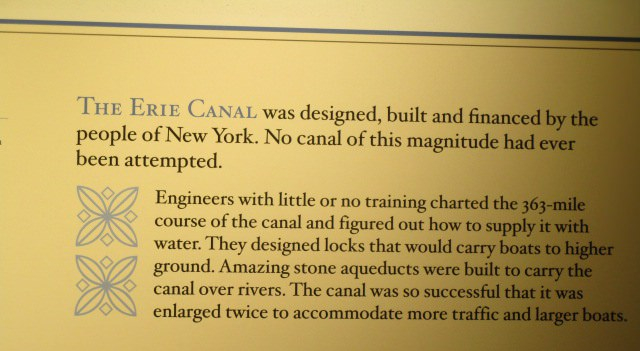
OK, so let’s go back to the Erie Canal and its actual construction. On April 15, 1817, the New York State legislature voted to build the Erie Canal and dignitaries turned the first shovel of dirt on July 4th of that year in Rome, NY Because of President Jefferson’s resistance to the canal it was designed, built and financed by the people of New York.
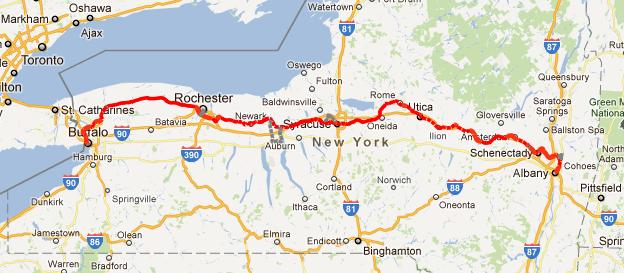
The route that had been chosen, remember, was the inland route
They chose to first build the middle section between Utica and the Seneca River. This 96 mile middle stretch was relatively flat and would require fewer locks.
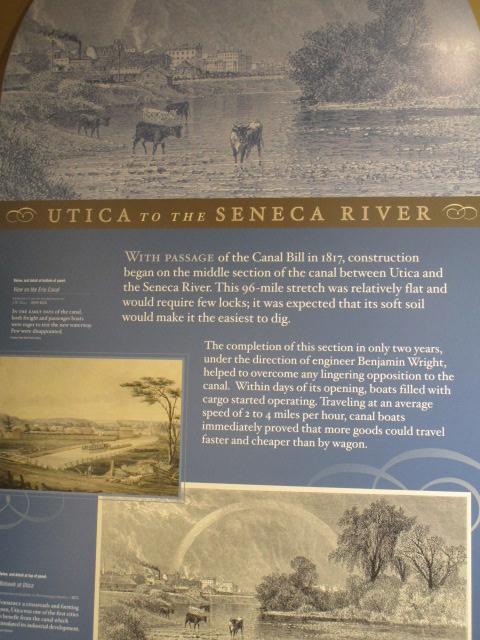
The completion of this section in two years helped to overcome the last of lingering opposition to the canal.
One of the greatest challenges in building the canal in this middle section was crossing the Montezuma Marshes near the Seneca River.
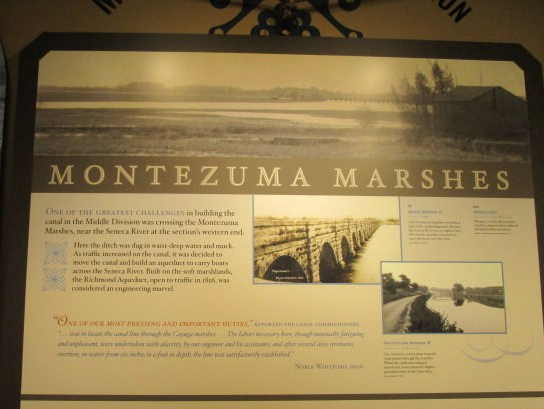
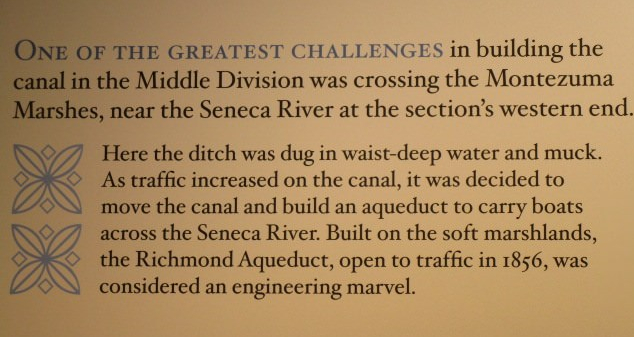
This is all that is left of the Richmond Aqueduct today.

The next section to be tackled was the Western Division, from the Senica River to Buffalo. It presented the greatest engineering challenges of the entire Erie Canal.
Near Rochester, the canal had to first cross the low-lying Irondequoit Valley.
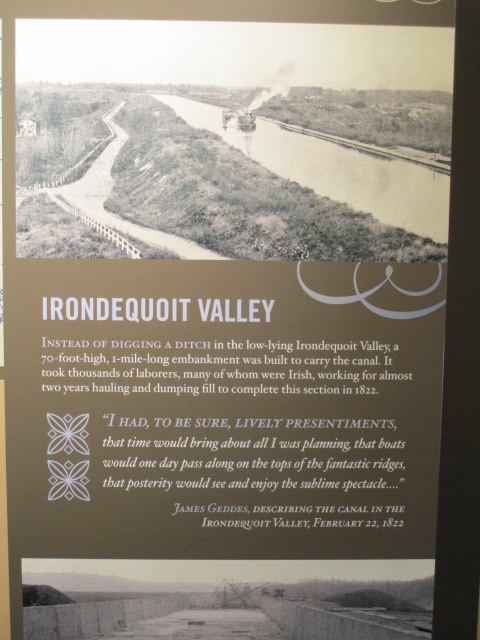
In the end, instead of digging a ditch a 70 foot high, 1 mile long embankment was was built to carry the canal.
The next challenge that faced the builders of the canal moving west was how to get across the Genesee River Rapids.
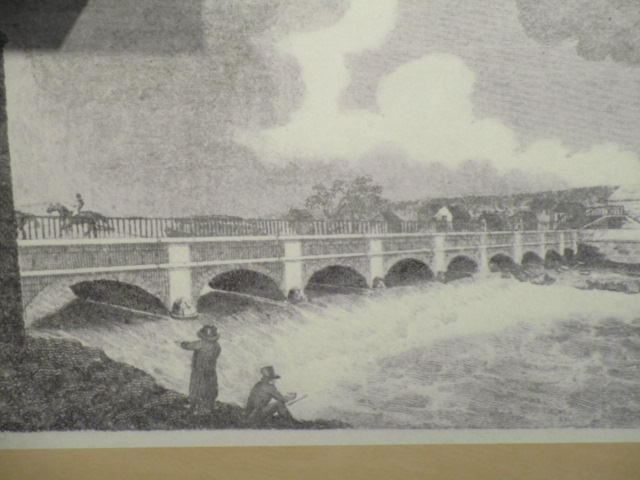
The answer was another aqueduct built with nine stone arches. When completed it was declared the most stupendous and strongest work in America.
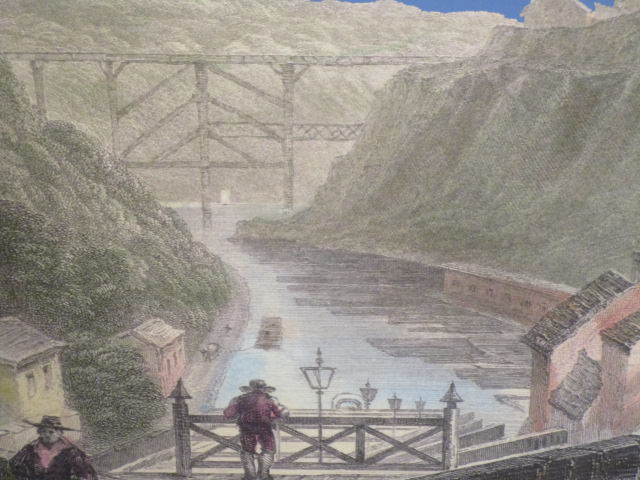
The last major challenge on the Western End was how to get the canal to the top of the Niagara escarpment – the rock ridge that produces Niagara Falls – so that it would reach Lake Erie. This was accomplished with the construction of a flight of five double locks.
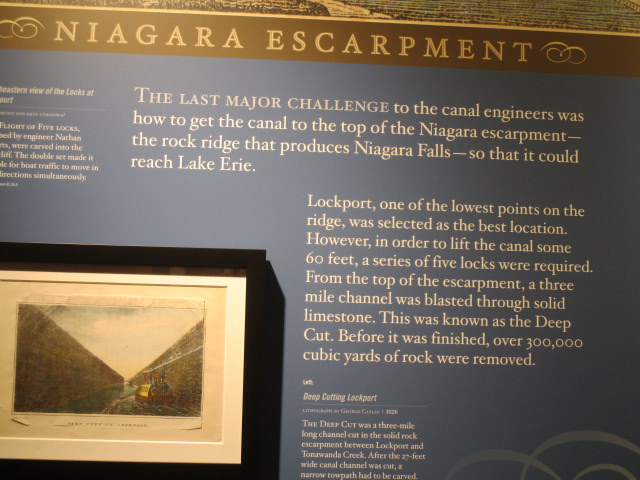
In addition a three mile channel had to be cut in the rock in order for the water to flow from Lake Erie into the canal. .
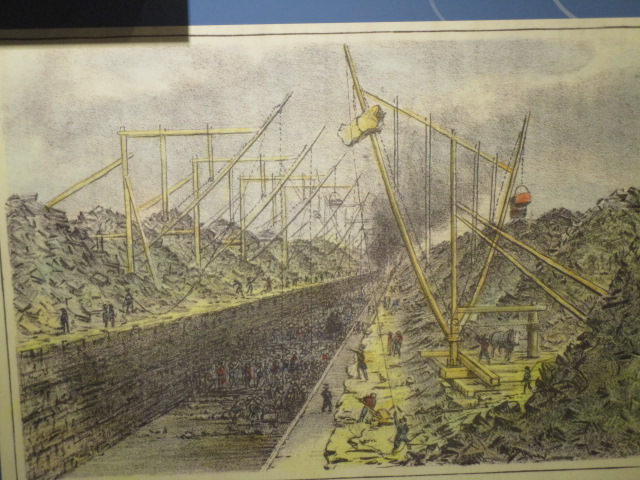
Excavating rock was one of the most dangerous and difficult jobs of building the canal. With the invention of a crane and bucket device, the rubble created from blasting the rock was more easily removed.
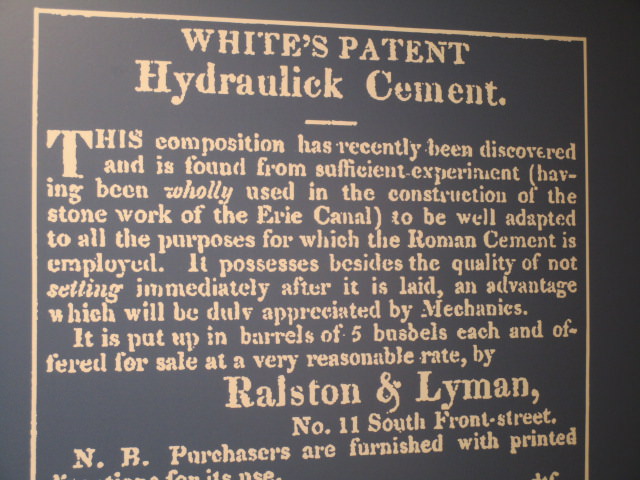
A continuing challenge that faced the builders of the canal no matter the section was finding a way to line the stonework in the canal to prevent leaks. Most clay-type materials they first used, disintegrated when it got wet. Fortunately, a type of limestone was discovered near Syracuse that hardened when it got wet.
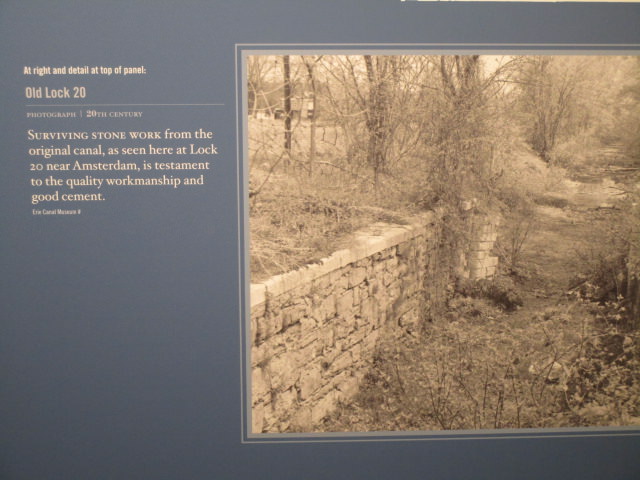
Surviving stone work from the original canal is testament to the quality workmanship and good cement.
We turn now to the Eastern Division, a 126 mile stretch from Utica to Albany. The Mohawk River rushed eastward toward the Hudson River through narrow passageways and over steep precipices created by rock formations at Cohoes and Little Falls.
At Schenectady, the Mohawk River Valley narrows as the river begins a steep drop. The question facing the engineers was how best to navigate the irregular, narrow and steep terrain. The decision was to build two aqueducts.
To cross the Mohawk River near Schenectady the Rexford or Upper Mohawak Aqueduct was built. It was supported by 14 stone arches that spanned 45 feet to carry the canal over the Mohawk River.
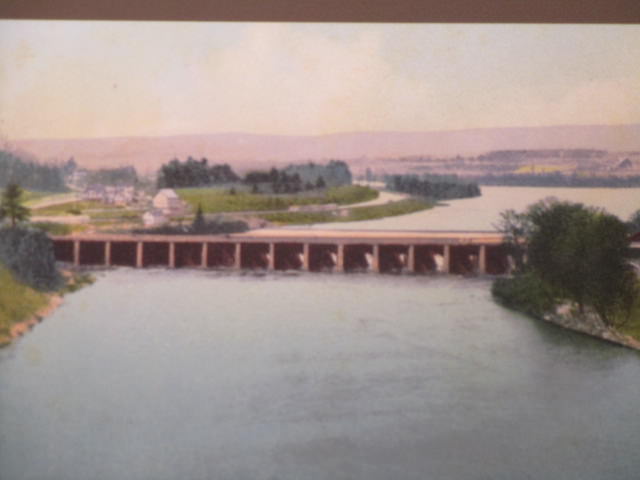
Four miles later the Crescent Aqueduct crossed back over the river just above the Cohoes Falls.

The next challenge was how to deal with the Cohoes Falls.
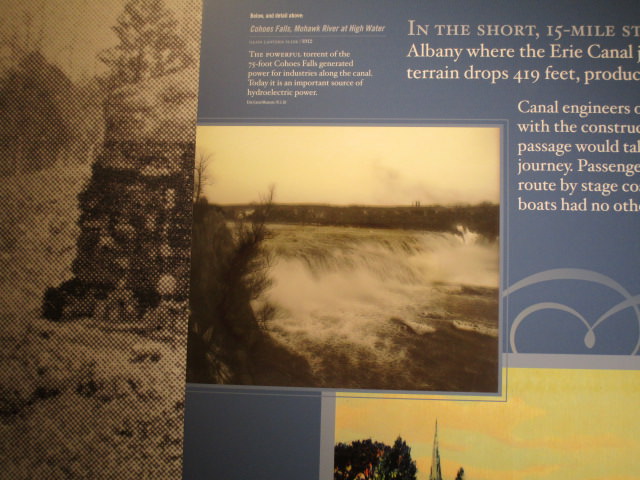
From Schenectady to Albany where the Canal joins the Hudson river the terrain drops 419 feet. Canal engineers overcame this formidable barrier with the construction of 27 locks.
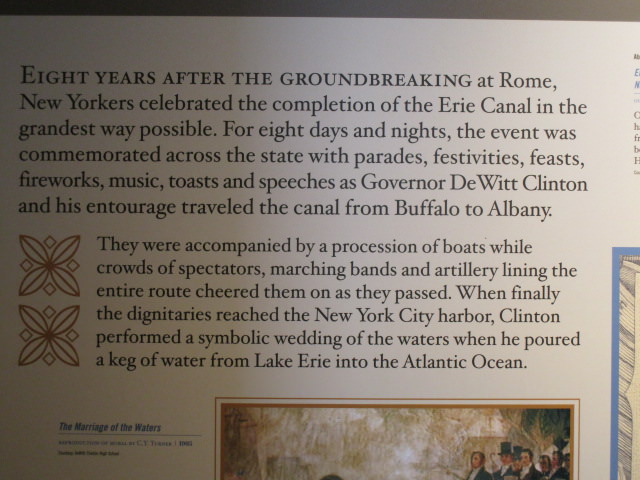
Eight years after the groundbreaking at Rome the Canal was finished. New Yorkers celebrated the completion of the Erie Canal in the grandest way possible.
Building the tow path canal cost over $7 million. From the outset the Canal Commission had decided the cost of building and maintaining the canal would be financed by tolls.
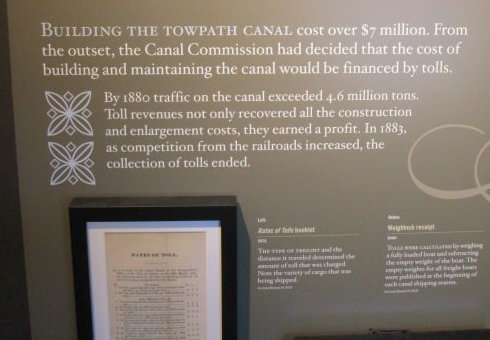
By 1880 toll revenues not only recovered all the construction and enlargement costs, they earned a profit. Facing stiff competition from the railroads tolls ceased in 1883.
The opening of the Erie Canal ushered in a new era of national commerce and urban growth. The waterway teemed with freight boat traffic as well as packet boats carrying tourists and other travelers.
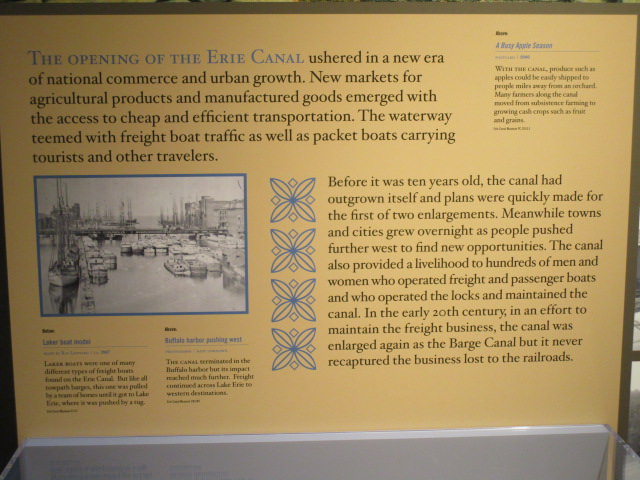
Since its grand opening in 1825, the canal has been enlarged several times to accommodate larger boats and more traffic. In 1838 it was enlarged from its original 40 foot wide, 4 foot deep ditch to a full 70 foot wide, 7 foot deep waterway.
One of the boats used frequently on the Canal was a Laker Boat. It was a freight boat
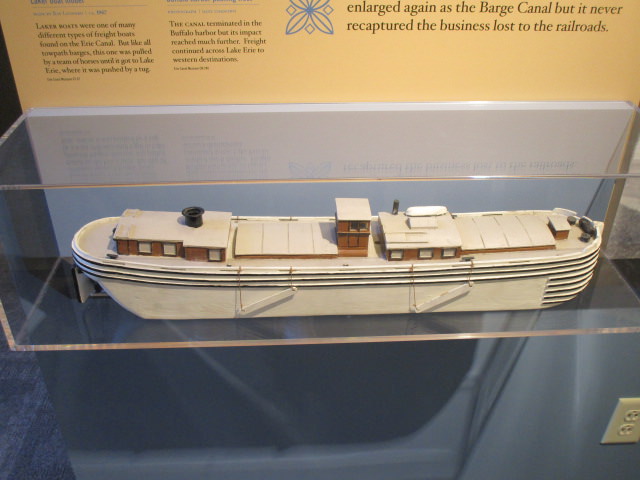
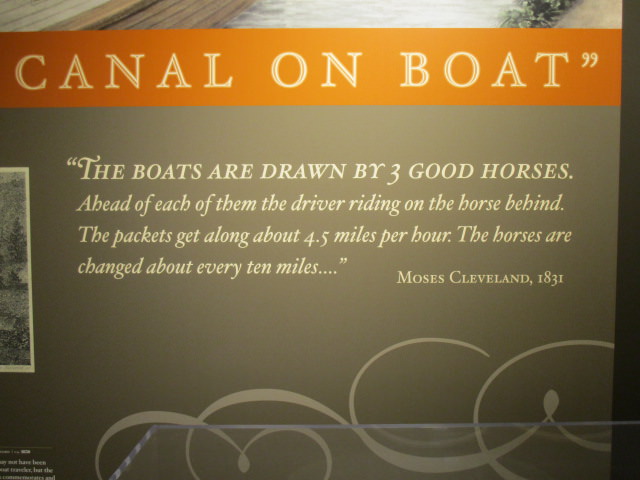
pulled by a team of horses or mules through the Canal.
The most recent enlargement was completed in 1918 at which time the state rebranded the Erie Canal as the Barge Canal to reflect a new age of commerce, distinct from the days of mule-driven canal boats. With the opening of the Barge Canal, many of the sights
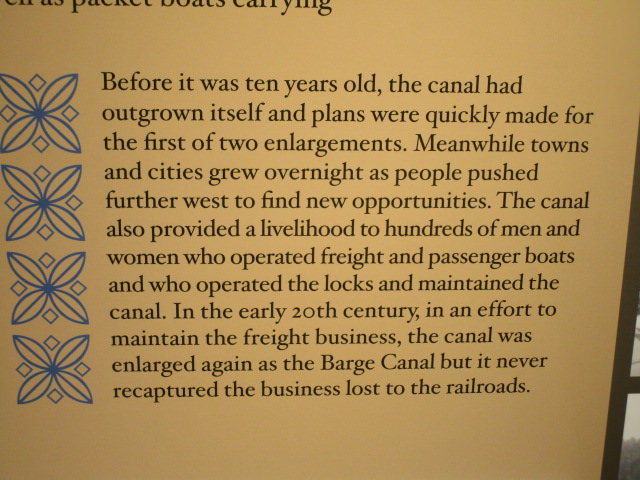
and sounds of the towpath canal disappeared. Towpath freight boats were no longer pulled by horses or mules rather they were pulled or pushed along to their destination by powerful tugboats.
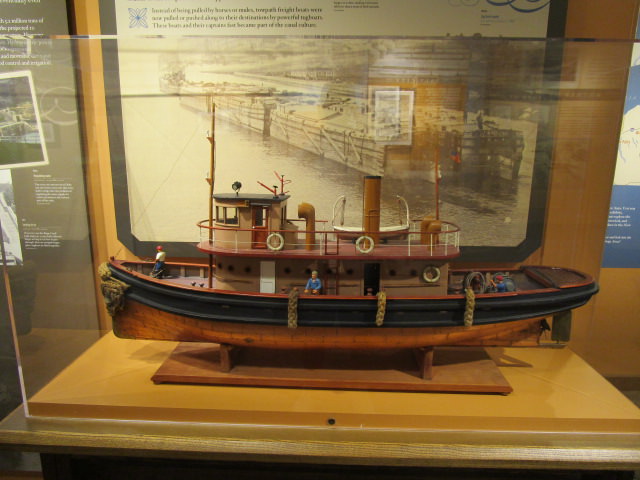
In its first 40 years of operation, the Barge Canal teemed with traffic. Traffic peaked in 1951 with 5.2 million tons of freight, but it never did reach the projected 10 million tons hoped for by its supporters.
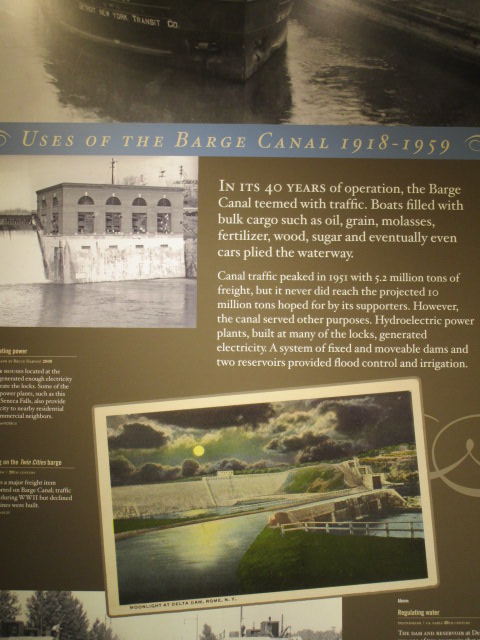
In the 1990’s the name changed again to the New York State Canal System. The system today is made up of the Erie, Champlain, Oswego and Cayuga-Seneca Canals.
This then is just a brief, and I mean really brief, overview of the Erie Canal. I could spend probably a month or more in this area and still not be able to see all there is that is related to this famous Canal. Maybe, just maybe, one day we’ll be back to this area and plan on spending a good two months visiting all of the historical sights associated with the Erie Canal.
After our museum we next went in search of a working lock. We were in luck in that Lock 24 of the Cayuga-Seneca Canal was only 15 minutes away.
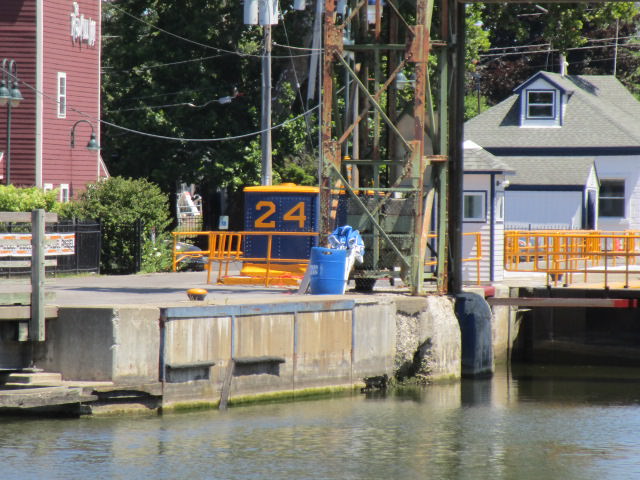
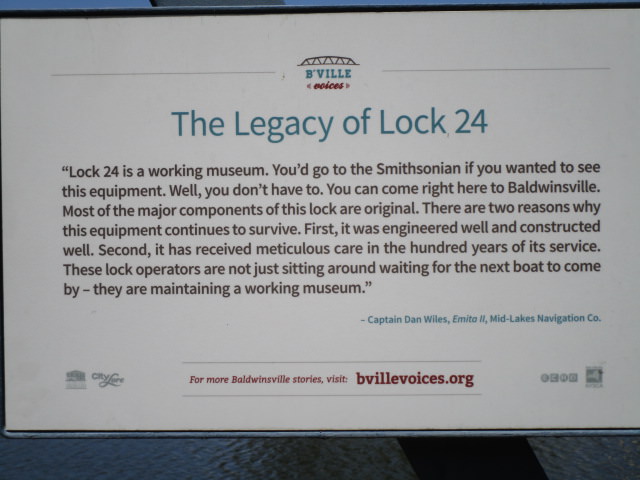
When we arrived there was a boater waiting to lock through. We struck up a conversation with this group and discovered that they had left Lake Cayuga earlier in the day. They were going to make their way up the Oswego Canal to Lake Ontario and then on to the Thousand Islands.
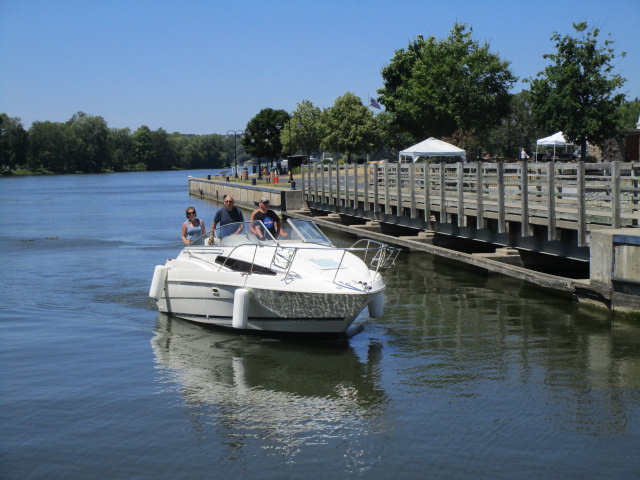
After a brief wait for the lock to fill the upper doors opened and allowed them to enter
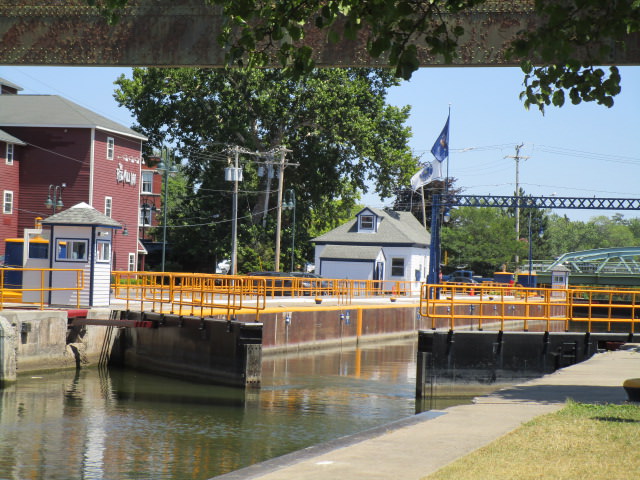
the lock. Once inside the lock the door would again close, the water would be pumped
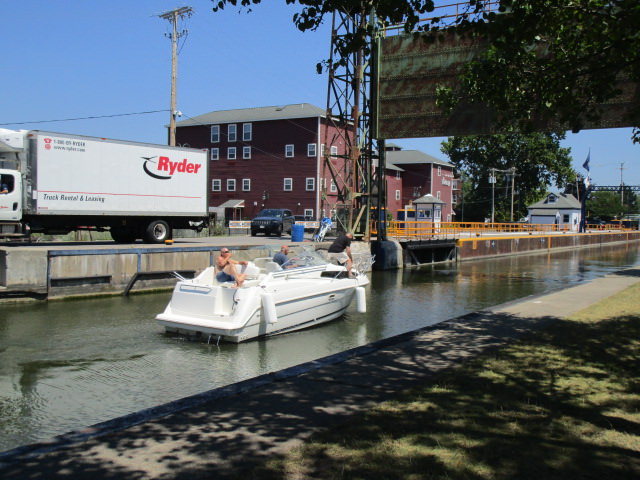
out and the boat would descend to the level of the river outside the other lock door. The far end lock door would open and then they would be on their way.
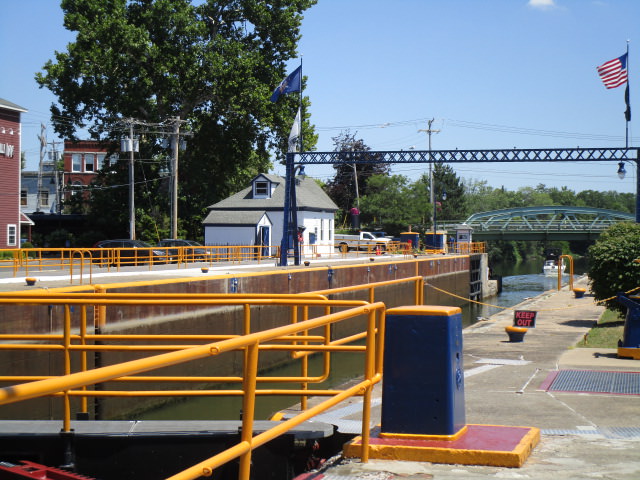
So now we are all caught up and it’s time for me to pack up the computer room in preparation for tomorrow’s move. Thanks again for joining us today and we hope you enjoyed our tour of the Erie Canal Museum. In closing here is a thought for each of us to consider:

As always, if you are coming to the end of your day with concerns and worries, let me suggest that you turn them over to God. After all, He is going to be up all night so why not let him handle them for you.
Time now for our evening prayers and eventually some shut-eye. Till tomorrow.
These are the voyages of Graybeard and it’s occupants, four paws and two humans. Our continuing mission: to explore as many new states as possible, to seek out new acquaintances and make new friends, to boldly go where we have not been before

 "On The Road of Retirement"