June 27th, Wednesday – The Healing Center; Marshfield, VT; Coming Attractions Yet to Visit

So today was another appointment day.  Slowly, ever so slowly I’m coming around.  I’m just, now, beginning to get feeling back in my left foot, I’m finally able to sit for more than 10 minutes at a time, and I’m once again beginning to feel sort of like my old self.  Still a long way to go but I’m getting there.  Thanks, of course, to my wonderful wife who is the best caregiver in the world – at least in my humble opinion.

Thanks also to the Healing Center and Dr. Pamela Milosevich who is a holistic chiropractor.  So once again off we went to see the good doctor.  This is the entrance

to her office and here is a picture of the doctor herself, who came in today on her day off to treat me.  She is adamant about getting me back to health before we leave this area.

Her approach to treatment is a holistic one.  That means according to her:  The word holistic stems from the Greek word holism, which means total, entire or all – when applied to the practice of chiropractic care, a holistic healer will always seek to treat the human body (and mind) as a whole organism that is far greater than the sum of its parts.  Suffice to say, whatever she is doing it is beginning to work and I can’t thank her enough!

Since we haven’t been able to do any sightseeing, how about a little history regarding Marshfield where the Meadowcrest Campground is located.  After that I’ll give you an idea of some the local attractions we’ll be going to within real soon – hopefully.

Image result for marshfield vermont

The independent Republic of Vermont chartered the Town of Marshfield in 1790 and named it for Isaac Marsh, one year before Vermont became the 14th state to join the United States of America. Located in the northeast part of Washington County, the 44 square mile town of Marshfield is bisected by the fertile valley of the Winooski River on its 88-mile run to Lake Champlain.

A village center evolved where the stagecoach roads to Cabot, Danville, and Montpelier converged with the small industries along the falls of the Winooski River. A network of roads linked the widely dispersed farms to water-powered grist, saw and wool mills in the village center.

In the early 20th century the old stagecoach road along the Winooski River, known as the River Road, was paved in 1932 between Plainfield and Marshfield and given the designation U. S. Route 2. Automobile travelers vacationed overnight at five private tourist cabin locations along the highway. Electric lines reached local houses and barns in the late 1930s, and in the early 1950s bulk milk tanks were introduced to the dairy farms. The bulk tanks, milking machines and pasteurizing equipment led to the demise of many marginal farms that could not afford the new technologies.

The fires of 1905 and 1909 destroyed many buildings in the village, the devastating flood of the Winooski River in 1927 and the national depression of the 1930s made it difficult for the town to recover economically. Later in the 1960s, the population began to increase with a back-to-the-land movement that attracted new residents from urban and suburban living to Marshfield’s countryside.

Marshfield has evolved over time from an almost self-sufficient agricultural and small manufacturing economy to a more complex mixture of economic activity. The town in the 70’s introduced zoning and planning to encourage responsible growth while maintaining the historic rural character of the community.   The town of Marshfield today is a small, rural, primarily residential community characterized by a population that is both economically and demographically diverse.

OK, upcoming attractions.  Before we leave this area we hope to visit the following:

  • Rock of Ages – guided quarry tour takes you to an overlook of the Smith Quarry. At nearly 600 feet deep, it is the largest operating deep-hole, dimension granite quarry in the world.
  • Hope Cemetery – a cemetery in Barre, Vermont. The city calls itself the “Granite Capital of the World”, and the cemetery is known for the superb granite craftsmanship on its memorials and tombstones.  They are awesome!
  • Goodrich Maple Farm – can you say Pure Maple Syrup!  All Natural, No Preservatives, No Additives
  • Cabot Creamery – a video tour of the cheesemaking area, (actually MORE up close than the walking tour!), as well as a look at the history of the co-op.  Time also to sample cheese, and chat with the wonderful staff.
  • Braggs Farm – our visit will include a free guided tour of the family operated maple farm, where traditional sap buckets and wood fires are still used to make 100% pure maple syrup. And if we are up to it, we can even walk through the nearby wood where they hang our 2000 buckets to collect the raw sap!

So, we may be down but not out.  For whatever reason, the good Lord has seen fit to slow us down a bit.  He has His reasons.  We just need to keep the faith and we’ll be back at it soon enough. Most importantly, we’re still even in slow motion traveling along, singing our song, side by side.

I’ll say good night for now.  The rain has started and promises to keep coming through the night and tomorrow.  As always though Graybeard is keeping us warm and dry.  We thank you for sharing our day with us.  We trust your day was a good one.  In closing, a thought for all of us as we awake to a new day tomorrow:

Image result for inspiring quotes eleanor roosevelt

As always,  if you are coming to the end of your day with concerns and worries, let me suggest that you turn them over to God.  After all, He is going to be up all night so why not let him handle them for you.

Time now for our evening prayers and eventually some shut-eye.  Till tomorrow.

These are the voyages of  Graybeard and it’s occupants, four paws and two humans.  Our continuing mission: to explore as many new states as possible, to seek out new acquaintances and make new friends, to boldly go where we have not been before

June 26th, Tuesday – Bump in the Retirement Road, Medical Issues


Image result for bump in the road

We were up at 6 am this morning because I had a 7:15 am chiropractor appointment about 20 to 30 minutes away.  By no means our usual waking hour that is for sure.  But finding a chiropractor who will see you when traveling is no easy feat so you take what you get in terms of appointment times.   So we were up and out of the house by 6:30 am with a packet of forms already filled out.

We made it on time and I ended up staying there for over 2 hours and came away with my wallet considerably lighter than when I went in.  Nope, this chiropractor does not work with medicare nor supplemental insurance.  They will fill out and submit the forms for you but you are on the hook until reimbursement comes.  I have visits each day this week also out of our own pockets.  Now if she worked a miracle and I could say I was 100% better, I don’t think I would be so upset.  Unfortunately, I am only so so, I still have my good moments and my really bad moments.  Time will tell.

What really has me discouraged is that I’m not allowed to do a thing for the next couple of days.  I can’t do maintenance, clean the windshield, wash the bugs off the front, check tire pressure, clean the lockers, vacuum – absolutely nothing.  It is not in my nature to just lie around all day reading books and watching movies on Amazon Prime.  We can’t even go sight-seeing because I still can’t sit for long periods of time.  Oh yea, I’m about ready to flip out.  Or scream.  Maybe both.  The only one keeping me grounded right now is my loving wife.  Without Barbara helping me get through this I would be absolutely miserable.

However, for the next couple of days I’ll keep up the blog.  I have some notes about this area, its history, etc.  that I’ll share with everyone.  There will, though, be nothing big and earth shattering in terms of discoveries.

For now I’ll call it a day.  I hope everyone is having a great week and having no major issues.  Let me leave you with this thought that is now ever so much on my mind:


Image result for bump in the road

As always,  if you are coming to the end of your day with concerns and worries, let me suggest that you turn them over to God.  After all, He is going to be up all night so why not let him handle them for you.

Time now for our evening prayers and eventually some shut-eye.  Till tomorrow.

These are the voyages of  Graybeard and it’s occupants, four paws and two humans.  Our continuing mission: to explore as many new states as possible, to seek out new acquaintances and make new friends, to boldly go where we have not been before

June 25th, Ben and Jerry’s Ice Cream – Yum!

The rain came down, but thankfully the flood didn’t go up.  Last night it was the constant pitter patter of rain on the roof, which I admit I sort of like, as it puts me to sleep.  Today dawned windy, plenty of sunshine, and patchy clouds overhead.  A perfect day – if only I was fit enough to travel.  There may be some things worse than a back ache, yes, I know there are, but this is getting ridiculous.   I believe I know what brought this latest episode on, thus I will be a bit more careful in the future.  Ah well, in time I’m sure this too will pass.  Just have to hang in there a bit longer.

Today was spent just allowing myself to heal one more day. Tomorrow off to the chiropractor and then a couple of more days and I should be fit as a fiddle.  I know this, I’m not going to sit around and do nothing much longer.  There are maintenance items that need to be addressed and there are a number of places we still want to see before we leave here.

OK, let’s go back again to Friday and the last place that we visited that day.  Remember the old saying there is always room for ice cream?  So off we went to the world famous Ben and Jerry’s Ice Cream Factory for a factory tour and hopefully some fun taste tasting.

This was the first sign that we were on the right track and almost there.

Image result for ben and jerry's factory tour

A quick turn into the driveway, up the hill, around the corner and there we where!  This is a picture of the factory minus, of course, lots of people.

Image result for ben and jerry's factory tour

So up the walkway to the factory and store itself.
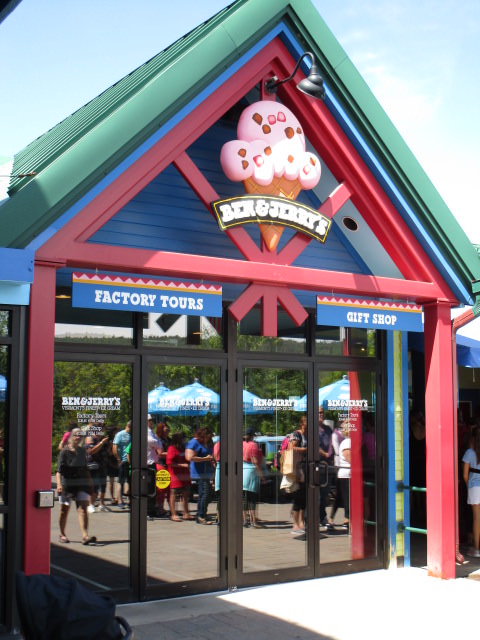
Ben and Jerry entrance to factory and store best

And this is what it looked like the day we were there.  Oh yea, Friday, tourist season was in full swing!  We sort of forgot about that.
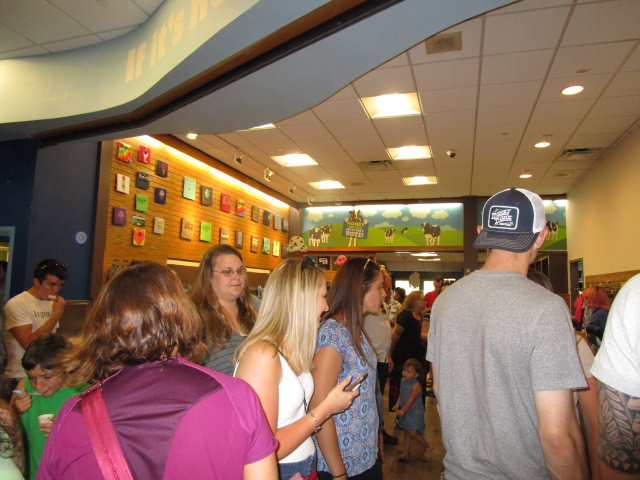
Ben and Jerry summer crowds

One of the first things that I noticed inside was this neat display of ice cream scoops.
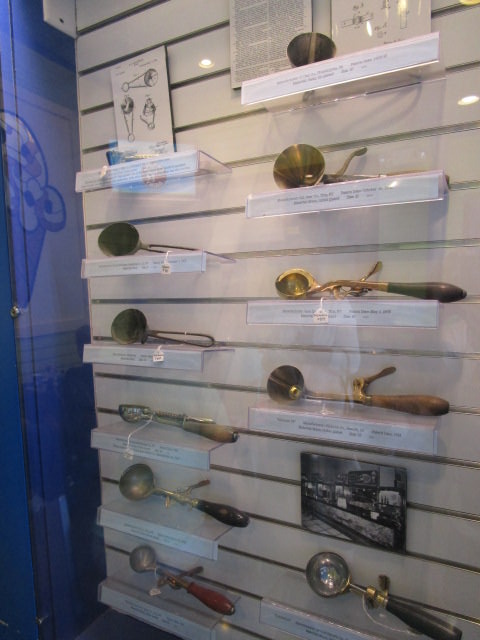
Ben and Jerry ice cream scoops

But do you know who invented the ice cream scoop and why?  Here’s the scoop on this invention.  Alfred L. Cralle was an African American who worked as a porter at a drugstore and at a hotel. While working at the hotel, he developed the idea of the ice cream scoop.  It came to him when he noticed ice cream servers having difficulty trying to get the popular confection desired by the customer into the cone they were usually holding. The ice cream tended to stick to spoons and ladles, usually requiring the server to use two hands and at least two separate implements to serve customers.

Cralle responded to that problem by creating a mechanical device now known as the ice cream scoop. He applied for and received a patent on February 2, 1897. The thirty-year-old was granted U.S. Patent #576395.

Cralle’s invention, originally called an Ice Cream Mold and Disher, was designed to be able to keep ice cream and other foods from sticking. It was easy to operate with one hand. Since the Mold and Disher was strong and durable, effective, and inexpensive, it could be constructed in almost any desired shape, such as cone or a mound, with no delicate parts that could break or malfunction.  So now we all know.

Time now for the real reason for our visit – besides eating ice cream – the factory tour.
Ben and Jerry factory tour start

Tours start every 10 minutes and there were crowds waiting each and every time.  In due time it was our turn and off we went.  First, it was the Ben and Jerry’s Movie Theater to learn a bit about the company and how it got started.

We learned that It all started with a guy named Ben and a guy named Jerry. The year was 1978, and the guys decided they wanted to start a company. They briefly considered bagels, but the equipment was too expensive.  With a $5 correspondence course in ice cream-making from Penn State and a $12,000 investment ($4,000 of it borrowed) on May 15, 1978 the two guys opened an ice cream shop in a converted gas station in Vermont.

The first Ben & Jerry's ice cream shop

As the story goes, they only rented one bay and the office, the adjoining bay was occupied by a local farmer who sold his produce next to the guys selling ice cream.  I wonder who helped who in terms of bringing in the crowds?  Back then, the ice cream was made in a four-and-a-half gallon White Mountain rock-salt and ice freezer.   A far cry from how it is made today as we shall discover in a minute.  From those humble beginnings we learn that today Ben & Jerry’s products are distributed nationwide and around-the-globe in supermarkets, grocery stores, convenience stores, restaurants, cinemas and other ice-cream-friendly venues.

Next, we were taken for a through the window tour of the factory and an overview of how their ice cream is made.  We learned that it all starts, of course, with the cow. Not just one, but tens of thousands of them – from the hundreds of local farms that sell their raw milk to the St. Albans Cooperative Creamery in St. Albans, Vermont. At the Co-op , the milk is separated into heavy cream and condensed skim milk, then shipped by tanker truck to their St. Albans and Waterbury Vermont factories.Image result for ben and jerrys cows

When the trucks arrive at the factory, the milk and cream are pumped into four
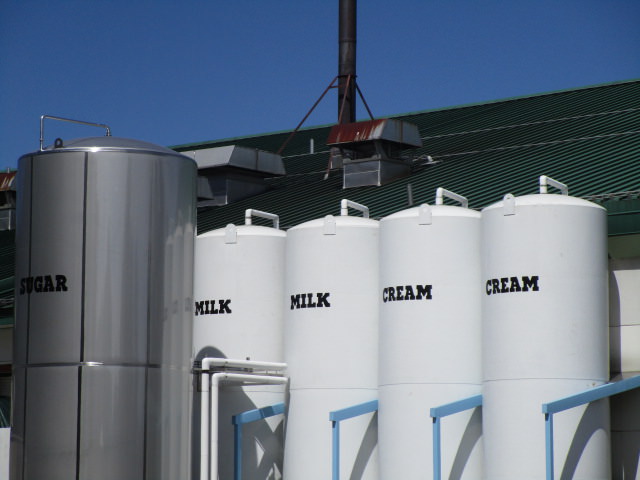
Ben and Jerry tanks

6,000-gallon storage silos, and kept cool at 36 degrees until they’re ready to convert them into Ben & Jerry’s ice cream and frozen yogurt.

Next is the blend tank. In the overall ice cream production scheme of things, making the mix is perhaps the most important part of the whole process. A very skilled and

image - blendtank-alt.jpg

experienced person known as the Mix Master performs mix-making procedures at the Blend Tank, a 1000-gallon stainless steel mega-blender. A batch of ice cream mix starts with heavy cream, condensed skim milk, and liquid cane sugar. To these ingredients the Mix Master also adds egg yolks, cocoa powder for the chocolate flavors, and natural stabilizers which help prevent heat shock and formation of ice crystals.

After ice cream mix is blended, it’s ready to be pasteurized and homogenized. Pasteurization is the process of heating the mix in order to kill harmful bacteria. The Pasteurizer is made up of a series of very thin stainless steel tubes and plates.

image - pastuerize2.jpg

Hot water (182 degrees) flows on one side of the plates, and as cold mix (36 degrees)  is pumped through on the other side of the plates, heat from the hot water is transferred to the mix, heating it to 180 degrees.

Before the mix has a chance to cool down, it enters the Homogenizer. There, the mix is

image - homog.jpg

forced under high pressure (about 2000 lbs. per square inch) through a very small opening so that the fat particles from the cream are so finely divided and emulsified that they do not separate from the rest of the mix.

The cooled mix is then pumped over to the Tank Room (a 36-degree room with six 5000-gallon mix storage tanks), where it’s held for 4 to 8 hours to allow the ingredients to intermingle (it’s kinda like simmering a sauce or allowing a fine wine to breathe).

Once the mix has “simmered,” it’s pumped from the Tank Room to the Flavor Vats: a  series of stainless steel vats that each hold 500 gallons of mix. It’s here that they add an

flavor-vat600w.jpg

incredible range of flavorings, purees & extracts, like vanilla, pure peppermint, fruit extracts, banana puree, and even a few liqueurs from time to time.

Once the proper amount of flavoring is added, the mix is pumped to the Freezer. The freezers at the Waterbury plant uses liquid ammonia as a freezing agent (40 degrees below zero) and can freeze over 700 gallons of mix per hour.

image - freezer.jpg

Here’s how it works: the mix is pumped through a long, freezing cold cylinder known as the barrel. As the mix freezes to the wall of the barrel it is scraped away by revolving blades. When it gets to the front of the barrel it’s no longer mix – it’s ice cream!

After freezing the mix to a nice and creamy 22 degrees, it’s decision time –  if they’re just making chunkless flavors, like Vanilla or Chocolate, the ice cream is pumped directly to the pint-filling machinery, but if they’re making chunky flavors, the ice cream takes a turn through the Chunk Feeder.

image - feeder-brownies.jpg

Quite simply, the Chunk Feeder “feeds” chunks into the ice cream stream. Chunks are top-loaded into the Chunk Feeder hopper, at the bottom of which an auger regulates a steady chunk-flow into a star-wheel. As the star-wheel turns, it pushes the chunks into the stream of frozen ice cream flowing through the feeder. The be-chunked ice cream finally passes through a special blender attachment, which mixes the chunks throughout the stream of ice cream, ensuring an even ”chunk dispersal”.

After the chunks and the swirls are added,  the ice cream’s ready for dispensing into pint containers. This is done with a most amazing piece of machinery called the Automatic Filler. Not only does the Automatic Filler fill about 120 pints a minute, but it also performs pre-filling tasks, like dropping pint-cups two-by-two into perfect position so the filler-head can fill them.

image - filler-4up.jpg

In addition, after the cups are filled, the filler further facilitates them towards the lidder, which properly positions & pushes pint lids snugly on the cups.  Finally, a nifty pint-cup lifter frees the pints from the lidder, where a little lever waits to push them out and away on a conveyor belt to the next step in the process.

Before the packaged ice cream can be stored or shipped, it needs to be frozen further – from its semi-frozen temperature of 22 degrees above zero, to a fully-frozen-solid state of at least 10 degrees below zero. The process is called “hardening,” and it happens in the Spiral Hardener.

Related image

The actual temperature in the Spiral Hardening Tunnel is 30 degrees below zero, but huge fans blowing in the tunnel create a wind-chill temperature measuring 60 degrees below zero. In this totally polar environment, the pints travel up the slowly spiraling conveyor for three hours, and when they reach the top, their temperature has dropped from 22 degrees above zero (soft-serve consistency) to 10 degrees below zero (fully-frozen-solid consistency!)

After the pints are frozen solid they are wrapped for shipment.  First, an invertor flips every other pint upside down, and a freezer worker ensures that 8 pints (2 parallel rows of 4 pints, with every other pint inverted) are properly assembled to enter the Bundler

image - bundler.jpg

The Bundler is a heat-tunnel which shrink-wraps plastic around the bundle of 8 pints. The bundled 8-pack is called a “sleeve,” and each sleeve equals a gallon of ice cream. Freezer workers stack the sleeves on shipping pallets which are then stored in our 20-below-zero warehouse to await shipment.

Then it’s away it goes.  Ben & Jerry’s products are distributed nationwide and around-the-globe in supermarkets, grocery stores, convenience stores, restaurants, cinemas and other ice-cream-friendly venues.

One more stop in the tour and that was the taste tasting room.  Oh yea, this is the stop we all were waiting for.  I don’t believe a one of us was disappointed in the sample we received.  Absolutely delicious!

So that was how our day ended on Friday.  It was a wonderful day of travel and discovery and one we hope to repeat before the week is out.  Oh one silly fun fact, we discovered that the capital of Vermont which is Montpelier is the only state capital in the United States that does not and will not allow a McDonald’s franchise within city bounds.  Now how about that!

Though we’ve hit a small bump on the road of retirement in terms of my back, we know that this too shall pass.  Before long we’ll be out and about and enjoying the world that God has created and discovering new places and seeing new sights.

We hope that your week is off to a fantastic start and that you too are enjoying each day that God gives you to live.  A closing thought now for each of us to ponder:

Image result for inspiring quotes about setbacks in life

As always,  if you are coming to the end of your day with concerns and worries, let me suggest that you turn them over to God.  After all, He is going to be up all night so why not let him handle them for you.

Time now for our evening prayers and eventually some shut-eye.  Till tomorrow.

These are the voyages of  Graybeard and it’s occupants, four paws and two humans.  Our continuing mission: to explore as many new states as possible, to seek out new acquaintances and make new friends, to boldly go where we have not been before
June 24th, Sunday – Lake Champlain Chocolate Company

Today is another so-so weather day.  Overcast skies, some rain, and temperatures no higher than the mid 60’s.  We’re not really looking forward to moving further West into the heart of the heat that we’ve been hearing about but so be it.  Given the weather and the current state of my back, we’re going to stay put today and probably for the next couple of days.

We finally finished up the mini series The Adventures of Swiss Family Robinson.  By 11 pm last night, we still had several more episodes to go so we called it a night and picked

Image result for swiss family robinson tv series


up where we left off this morning.  What’s amazing is the fact that most campgrounds discourage those in the park from using their WiFi for streaming movies.  Yet, here they encourage it.  So we’re going to be streaming movies until we leave.

Let’s go back a couple of days now and get caught up on what we visited on Friday.  We’ve already covered The Vermont Teddy Bear Company so let’s go now to The Lake Champlain Chocolate Company in Shelburne, Vermont.

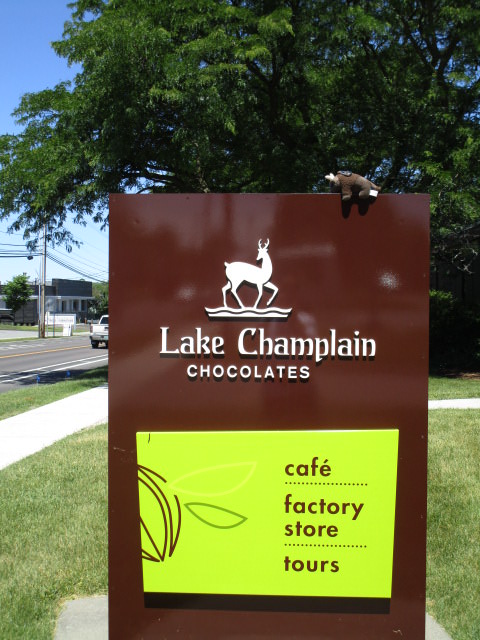
Lake Champ Chocolate entrance sign with benny

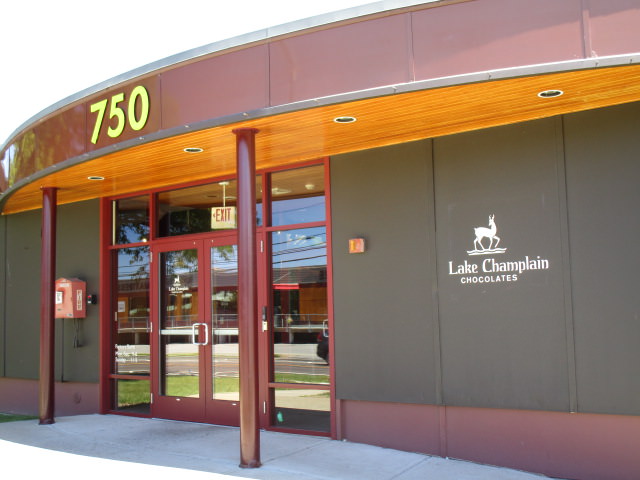
Once parked we made our way to the front door.

Lake Champ Chocolate entrance to store

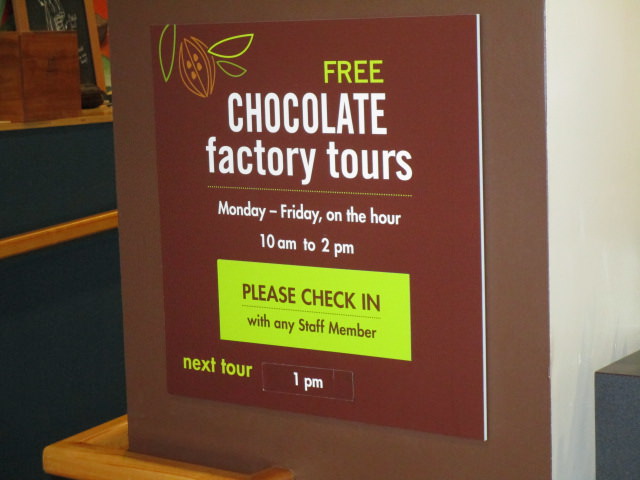
And then we got ready for the through the window factory tour. During the tour we got

Lake Champ Chocolate factory tour

a direct view of the factory floor as our tour guide explained the company’s history, the cacao-to-chocolate process, and what typically happens in the factory. The tour incorporates a slide show of images, props to pass around, a chocolate tasting, a short factory video, and, oh yea, a final chocolate sampling.  Delicious.

Image result for lake champlain chocolate company

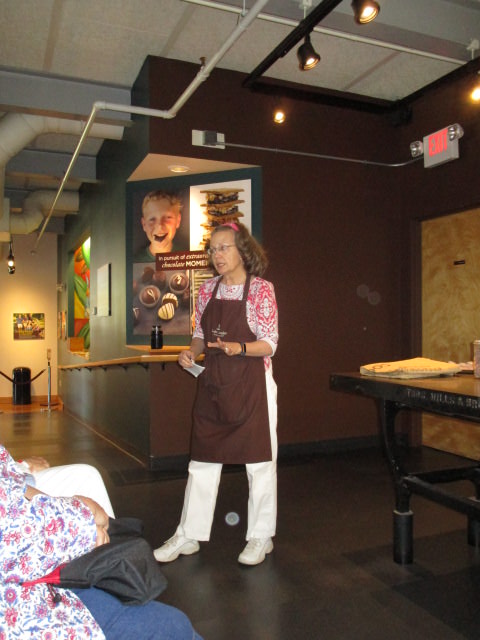
Our guide for the tour was Patty, a former college professor, and substitute kindergarten teacher.

Lake Champ Chocolate factory tour patty.

She started out by sharing with us that Lake Champlain Chocolate began in 1983 in the kitchen of the Ice House Restaurant, owned by Jim Lampman in Burlington, Vermont.

Image result for lake champlain chocolate company

At the holidays, Jim would buy fancy chocolates to give out to his staff. Until one Christmas, when his pastry chef confessed what he really thought of those chocolates. “All right, then you do better!” Jim replied. The result was a batch of hand-rolled truffles so smooth and creamy, so deep in pure chocolate flavor — after just one bite, Jim knew they were onto something. Within a year the restaurant was sold, Lake Champlain Chocolates was born, and a new era in American chocolate had begun.

Image result for lake champlain chocolate company truffles

At the start, Jim’s idea was to sell the truffles wholesale to just a few specialty stores. Tucked away in a tiny alley behind Floyd’s lawnmower service, the store was sort of difficult to find. And yet, there came a constant knocking at the door — chocolate lovers who had tracked the company down in search of truffles!

In 1998, a proper factory of 24,000 square-feet was built on Pine Street in Shelburne.  This is where they still make all their chocolates today. Lake Champlain Chocolates are now in 2,000 specialty stores across the US and through mail order and internet sales they continue to grow.

Image result for lake champlain chocolate company

These are pictures of the actual factory floor at the facility on Pine Street.


Where you might ask are all the employees?  Since this is the slow season, Patty explained, that they were given a three-day weekend.

As to how chocolate is actually made?  Chocolate begins with the cacao tree which grows within 20° north and south of the Equator and thrives on a mix of hot temperatures, rain, and shade.  Each tree bears oval fruits, or pods, which are about 5–12 inches long. Each pod contains 30–50 seeds, and it’s these seeds the world knows as cacao (or cocoa) beans.

Image result for cacao tree

From the cacao tree, the steps to an actual bar of chocolate are many and varied.  They include

  • Harvesting – Cacao pods are ripe when they turn a vibrant yellow/orange color. Hanging from the trunk and largest branches on small stems, the ripening pods are typically harvested twice per year
  • Fermentation – this occurs in one of two ways: the “heap method” is popular in Africa, where beans are heaped in piles on the ground; and in Latin America, a system of cascading boxes is favored. In both methods, beans are covered with banana leaves. During the 2–9 days of fermentation, beans begin to take on color and some of the flavors you would recognize as “chocolate.”
  • Drying & Shipping – Fermented beans must be carefully dried. They are placed either on wooden boards or bamboo mats for anywhere from 7 to 14 days under the hot sun and are continually raked and turned over for consistent drying. Once dried, the beans are graded, packed into sacks, bundled, and checked for quality. They are then shipped and traded on the international mark
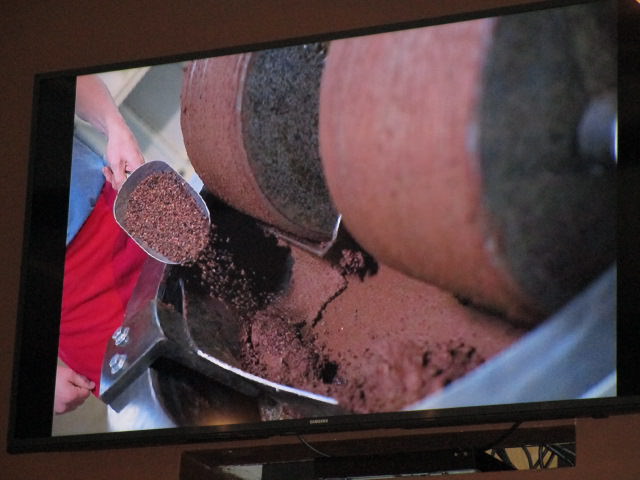
  • Producing Chocolate – Once received by the processor, beans are cleaned, then roasted at low temperatures to develop flavor. Shells are separated from the nibs (the “meat” of the bean) by a process called winnowing. Nibs are finely ground into cocoa mass
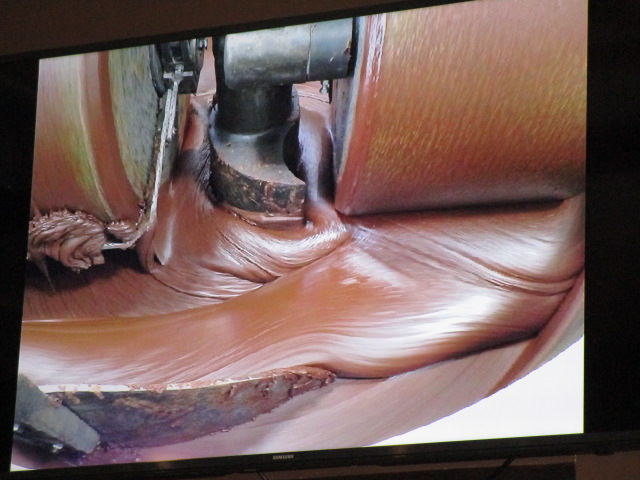
  • Conching – this is a careful process of rolling, kneading, heating, and aeration. A conche is a large agitator that stirs and smooths the mixture under heat. This is an important step in the process of producing consistent, pure, and delicious gourmet chocolate— and it is here that the final aroma and flavor are defined

Lake Champ roll

lake champ roll liquid

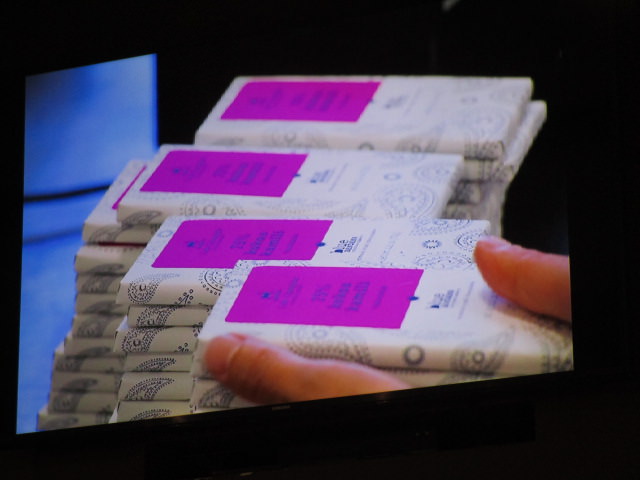
  • Tempering – The chocolate is now finished and ready for final processing. It is now put into small blocks ready to be delivered to companies around the world. Of course, the chocolate doesn’t stay in this form. Around the world, chocolatiers, bakers, chefs, and pastry experts use this highly versatile, delicious food in countless applications and preparations, from simple to elaborate.

lake champ blocks

That was our day at The Lake Champlain Chocolate Company.  Perhaps the best part was, of course, the samples.  Absolutely delicious!  We enjoyed every minute of our time there and every bite of every sample.

Overall, our day was a quiet one.  Time to rest, nap, read a book, finish our mini series and not much more.  Not that I’m complaining one bit.  A few more days like this and perhaps, just perhaps, I’ll be back in tip-top shape physically.  At least that’s my hope and prayer.

As the day now comes to a close, let me share a closing thought for all of us to ponder:

Image result for inspirational quotes

As always,  if you are coming to the end of your day with concerns and worries, let me suggest that you turn them over to God.  After all, He is going to be up all night so why not let him handle them for you.

Time now for our evening prayers and eventually some shut-eye.  Till tomorrow.

These are the voyages of  Graybeard and it’s occupants, four paws and two humans.  Our continuing mission: to explore as many new states as possible, to seek out new acquaintances and make new friends, to boldly go where we have not been before