April Rally, 2024, Encore Southern Palms, Eustis, Florida
Way back, like in December of 2023, we joined a group called the Florida Fun Seekers. This is a group made up of RV owners from our development and other parts of central Florida. All total, there are probably 40 members and 18 to 20 motorhomes of various classifications and sizes.
From December to April the group holds a Rally at a designated RV park for 4 days/5 nights. We’ve been able to participate in 5 of these Rally’s, this months being the last in the current cycle of Rally’s.
This month we were at Encore Southern Palms in Eustis, Florida.
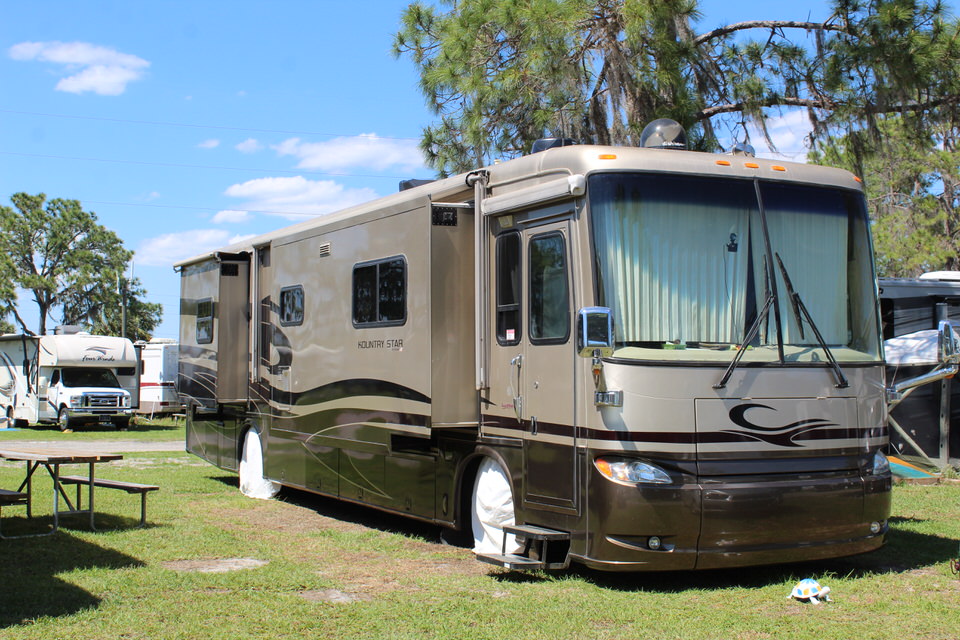
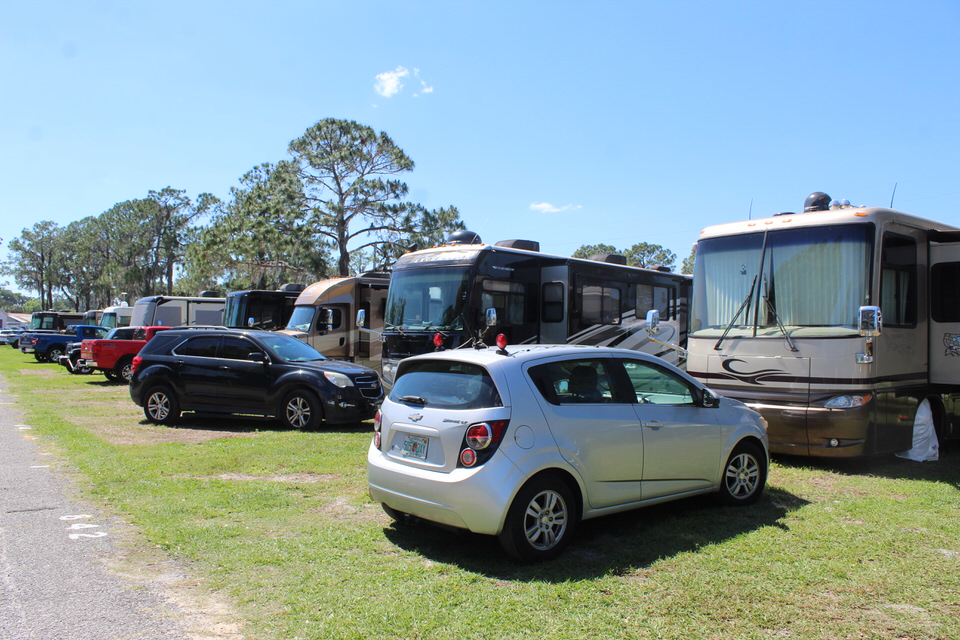
This is the first of two rows of rigs at this rally. All total we had 18 motorhomes in attendance.
So what does one do at a Fun Seekers Rally?
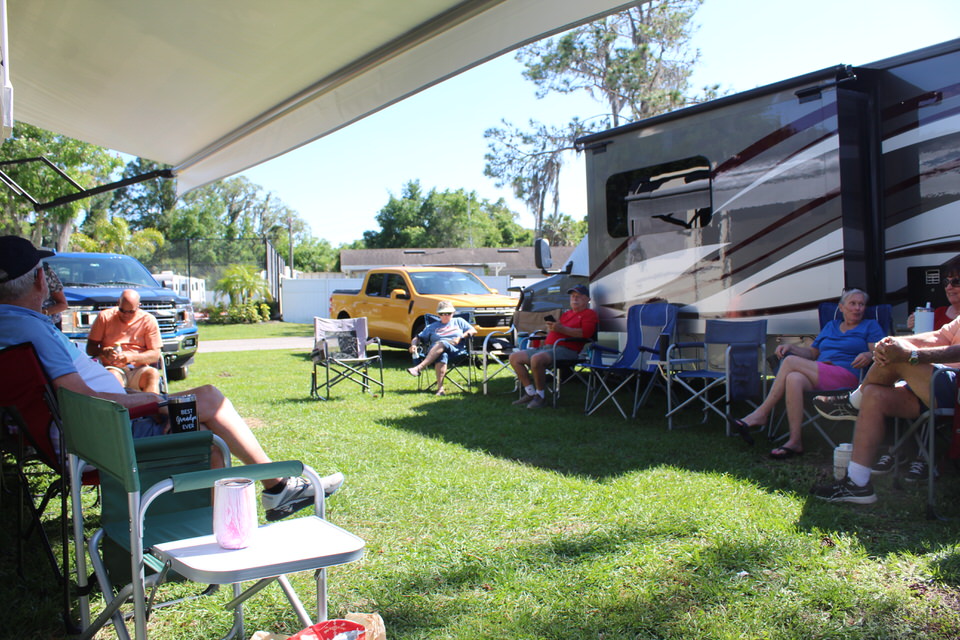
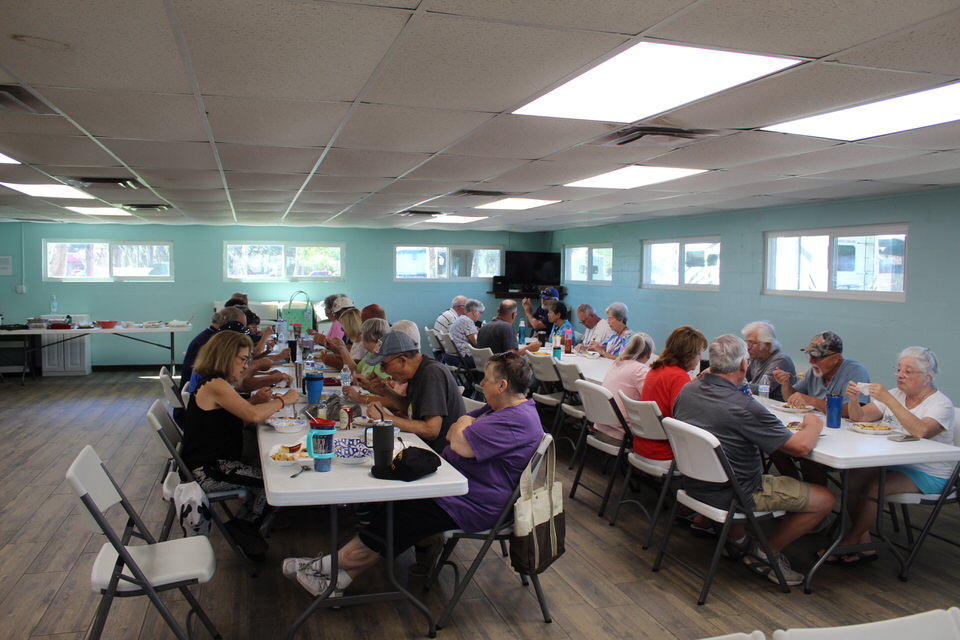
There is a Happy Hour each afternoon. People were just starting to gather when I took this picture.
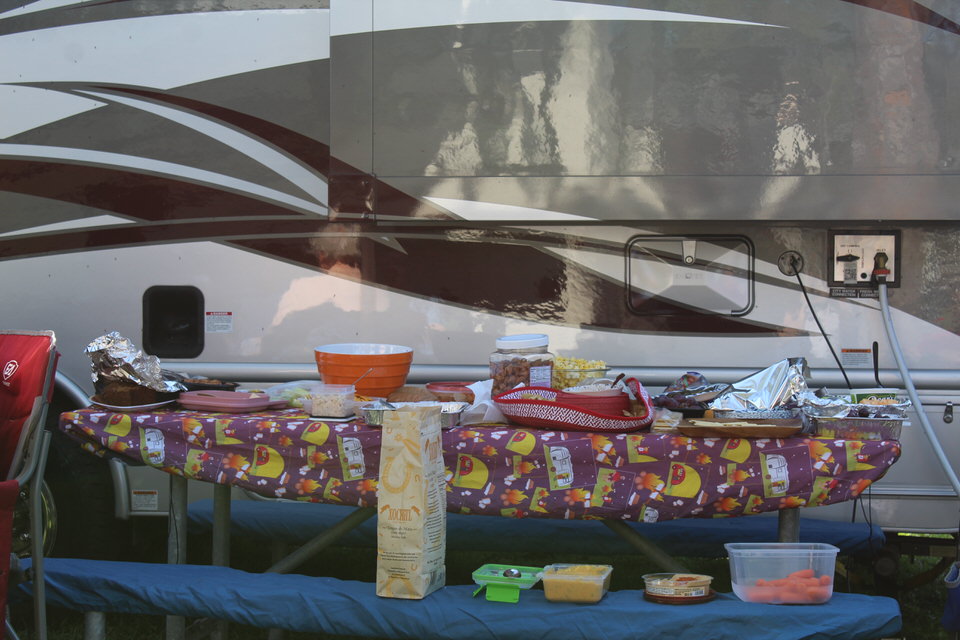
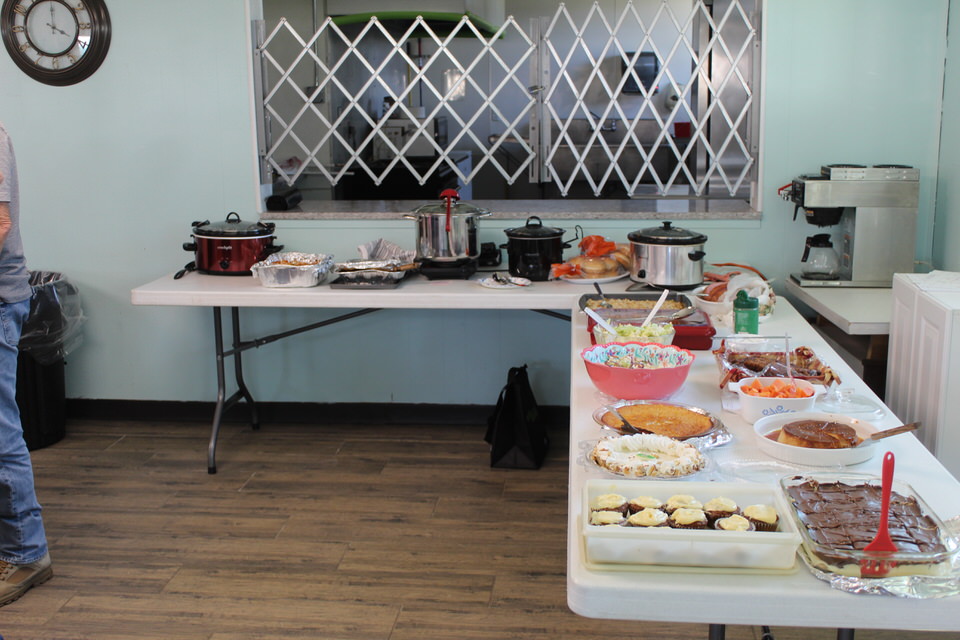
And the food put out is ample to say the least. .
There was a Pot Luck Supper on Friday night. Then a Pancake Breakfast on Saturday morning. And finally on Sunday morning we had breakfast. Breakfast was Egg in a Bag. Now, I had no idea what that was but I quickly found out how delicious it was. In essence you crack a couple of eggs into a plastic bag. Put in your fixings, things like mushrooms, onions, cheese or whatever you like. Seal the bag. Place the bag in a pot of boiling water. Cook for 13 minutes and your breakfast is ready! Let me tell you this is a group that likes to eat!
When we weren’t eating, we were sightseeing.
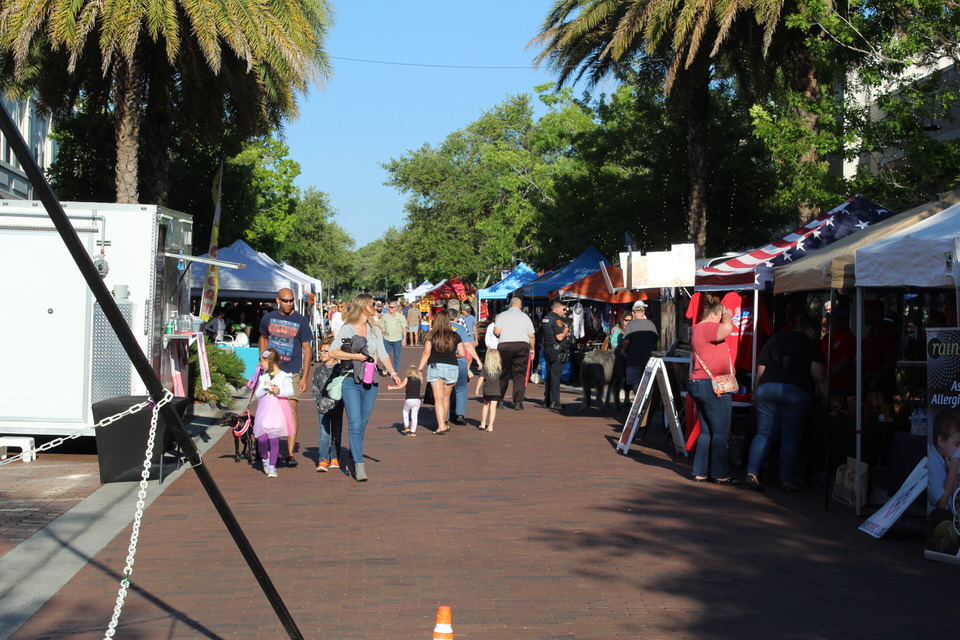
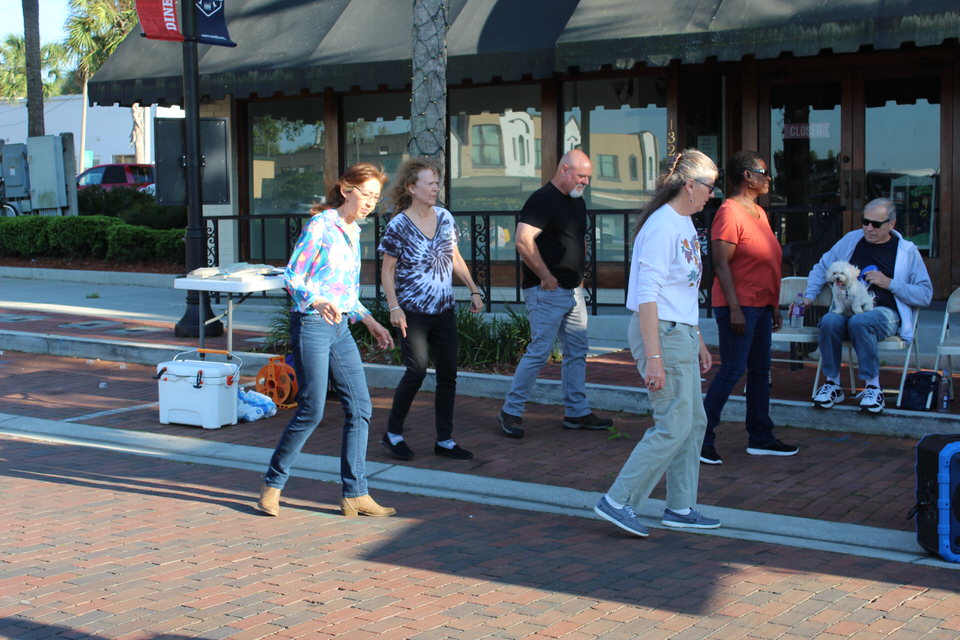
Friday night we went to the street fair in Eustis. There were all kinds of vendors as well as numerous groups doing such things as line dancing and so much more.
Monday, Barb and I went off on our own for a bit.
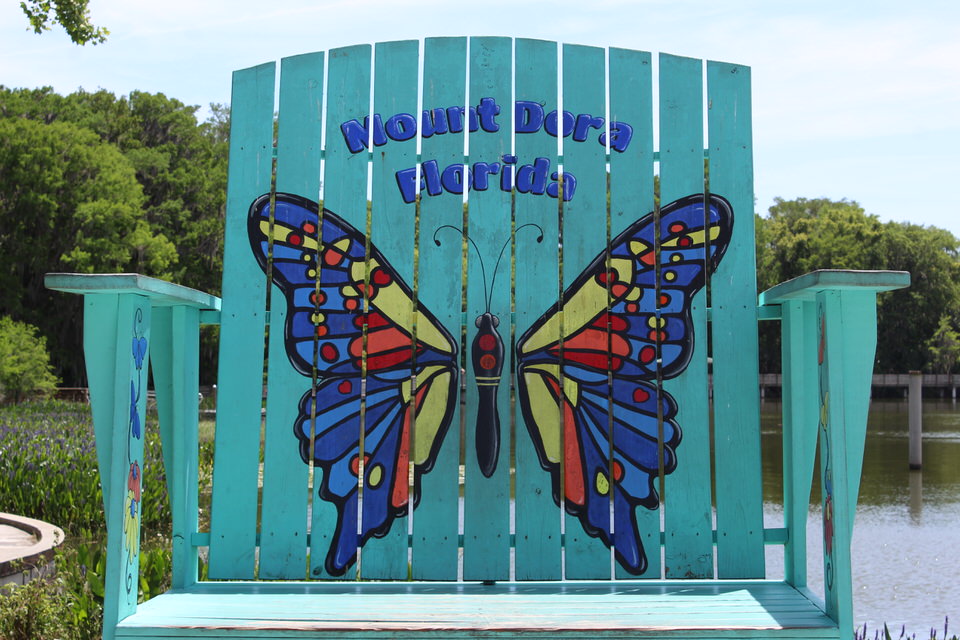
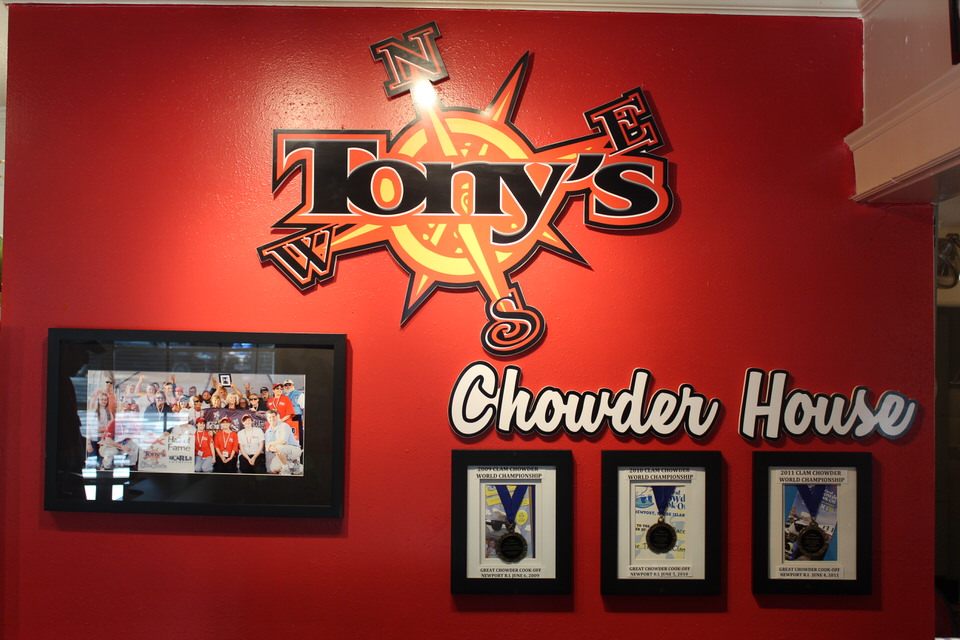
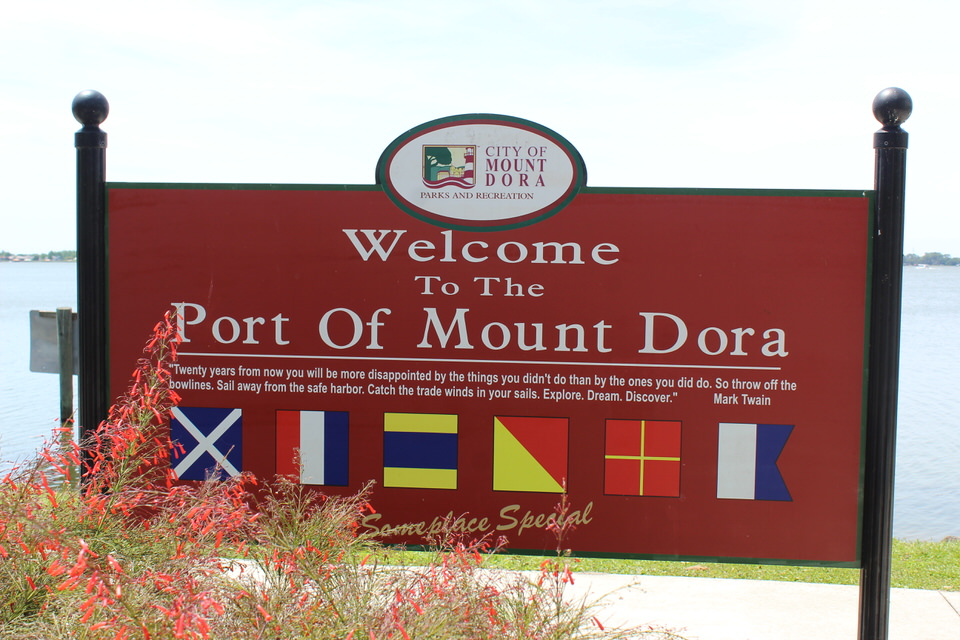
Our travels took us to a quaint, little village in Florida called Mount Dora. Our main reason for picking this village was because it is the location of
It seemed that everyone in our group knew of the excellent New England Clam Chowder available here, everyone except myself.
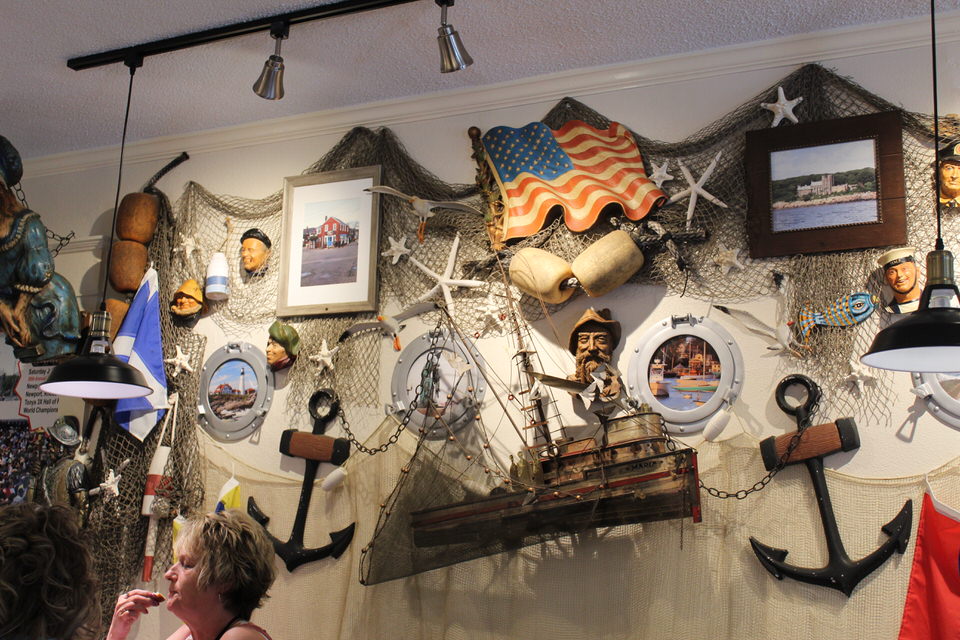
Some definite, interesting décor on the walls.
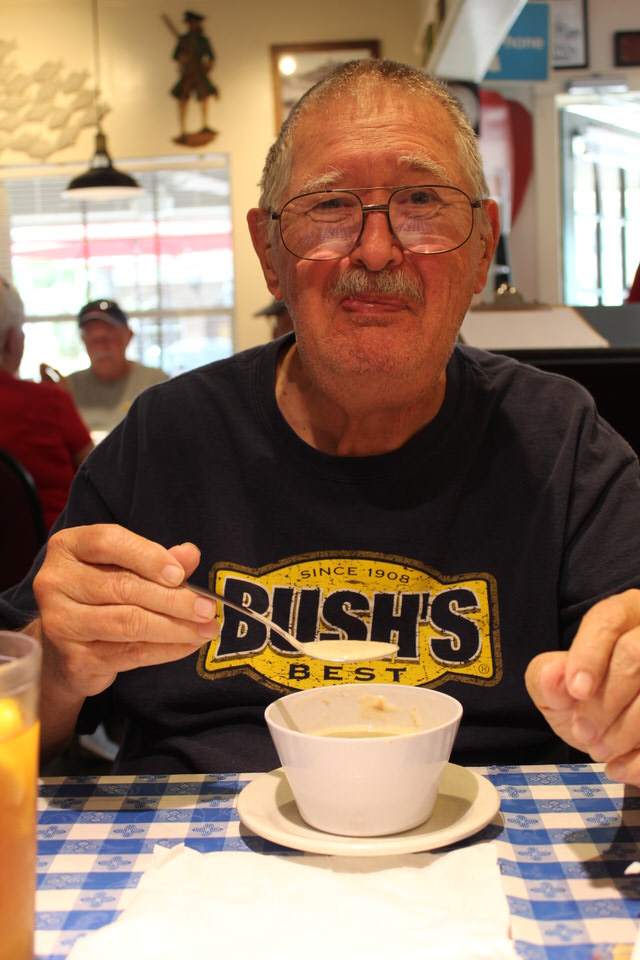
Now about the chowder. Yes, it was as good as everyone said it was. I will return some day for another bowl, that you can count on!
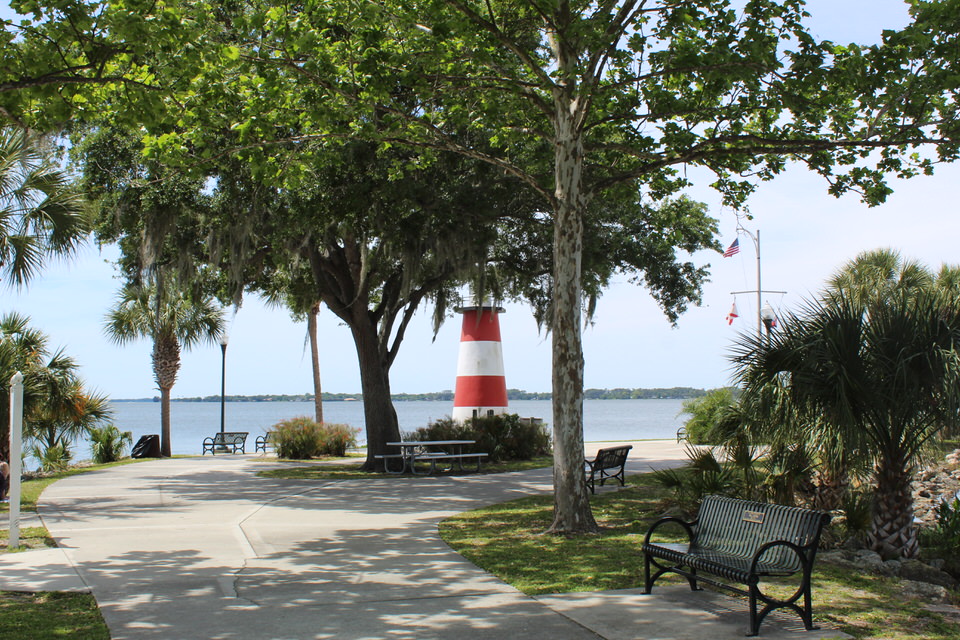
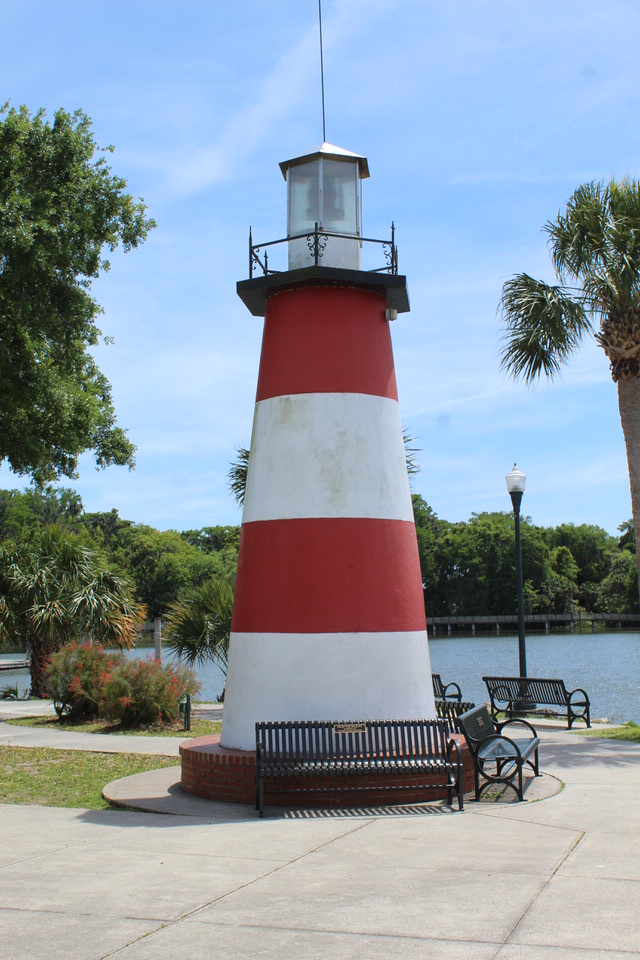
After lunch we decided to walk off our lunch and so made our way to
It was a quaint, little park on the shores of Lake Dora, and yes, the lighthouse is still in service. It was just such a beautiful day, with a nice breeze coming off the lake, and all kinds of birds calling out in so many different voices.
Later that day, in the early evening, we went across the street to the
We walked the mid-way, sampled a funnel cake and of course stayed to watch the pig races. All in all it was a perfect end to a perfect day.
Alas, all good things must come to an end. Come Tuesday morning we packed up, pulled in the slides, pulled up the jacks and rolled out of the park and headed home. Until later in the year the rally’s are over, but we’re all ready signed up for November and December of this year. And when it is determined where the others will be held, we’ll be part of them as well.
I’ve been wanting to visit this park for a long, long time. Well I finally got to check off another box of my want to visit attractions.
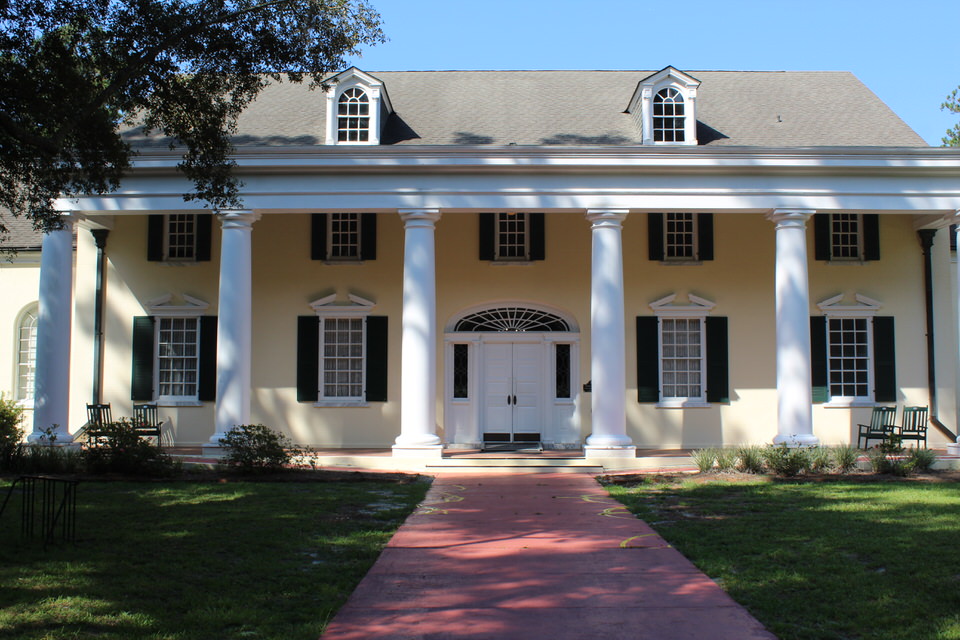
The Stephen Foster Folk Culture Center.
Here’s the odd thing about this center, Stephen Foster never set foot in the state of Florida. The closest he ever came to it was a visit during his lifetime to New Orleans. So why is this Center here in Florida?
I’m sure most are aware that Foster was a successful song writer. Moreover, most of his songs have the South as their theme. Yet, history tells us that he had little first hand knowledge of the actual South. He was born and raised in Pittsburgh, lived briefly in Cincinnati and at the time of his death was living in New York City. Considering that he had so little knowledge of the South, it is remarkable that his song’s portray that part of our nation with such accuracy and sympathy.
But back to our original question, Why is there a culture center in the state of Florida that honors Foster?
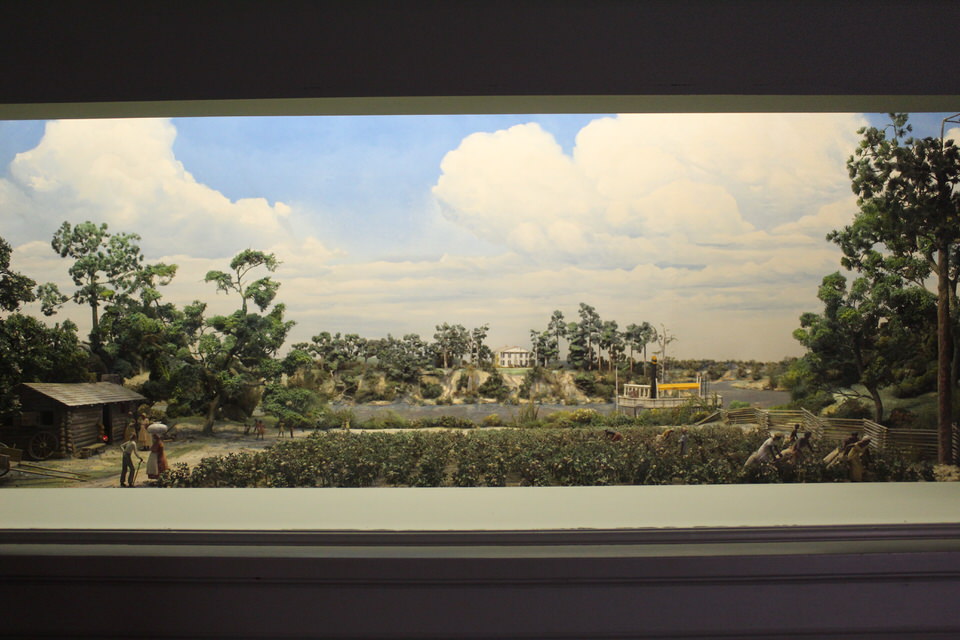
It’s because of the song depicted here in this Diorama entitled Old Folks at Home or also known as Way Down Upon The Swanee River.. There’s a verse in the song that goes like this: Way down upon de Swanee Rivr, Far, far away.
The reference in the song is to the Suwannee River that begins in the Okenfenokee Swamp in southern Georgia then flows southward through Florida into the The Gulf of Mexico.
How the Suwannee River ended up in the song is quite interesting. I’ve gleaned the following information from the phamphlet The Swannee River written by Fletcher Hodges, Jr.
It seems Foster was at his brothers home in Pittsburg and writing the before mentioned song. However, he was stumped as to the name of a river to use. The first draft of Old Folks at Home read: Way down upon de Pedee ribber. However, Foster was not satisfied with the name. His brother suggested The Yazoo River, also rejected by Foster. So, the two turned to a map of the United States and began searching for a Southern river with a musical, romantic name. His brother stumbled on the Suwannee River in Florida. That’s it, that’s it exactly, Foster exclaimed in delight. Foster then shortened the name to Swanee and changed the verse in the song to read: Way down upon de Swanee River. Thus Old Folks at Home was written.
According to Hodges: It (meaning the Suwannee River)has become a half -legendary stream, encircling the earth. It flows through the soul of humanity. It has become the symbol of all mankind’s vague, lost wordless dreams, of joys that have vanished, of untrainable longings. of homesickness and timesickness.
The song achieved immediate fame. Again, according to Hodges: . . .it was sung throughout the entire English-speaking world, and was translated into other languages.
It also brought fame to Florida. In gratitude the Florida Legislature in 1935 adopted Old Folks at Home as the State Song. Furthermore they established The Stephen Foster Folk Culture Center and Memorial Museum on the bank of the Suwannee River, The memorial was dedicated on October 4, 1950. It is the building in the picture above.
That is how, dear friends, The Center came about even though the man it lifts up never stepped a foot in Florida.
Now, let’s go inside and see what we can find.
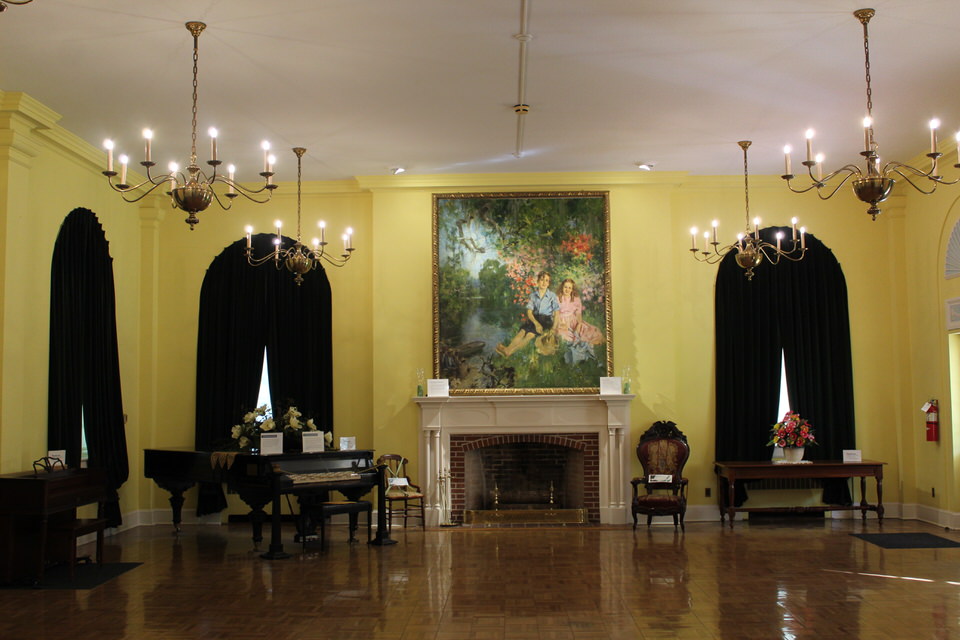
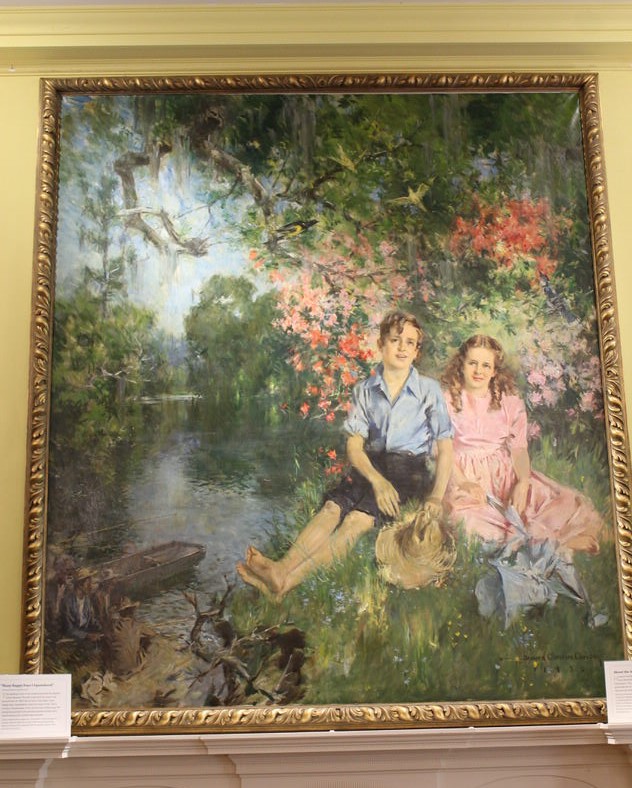
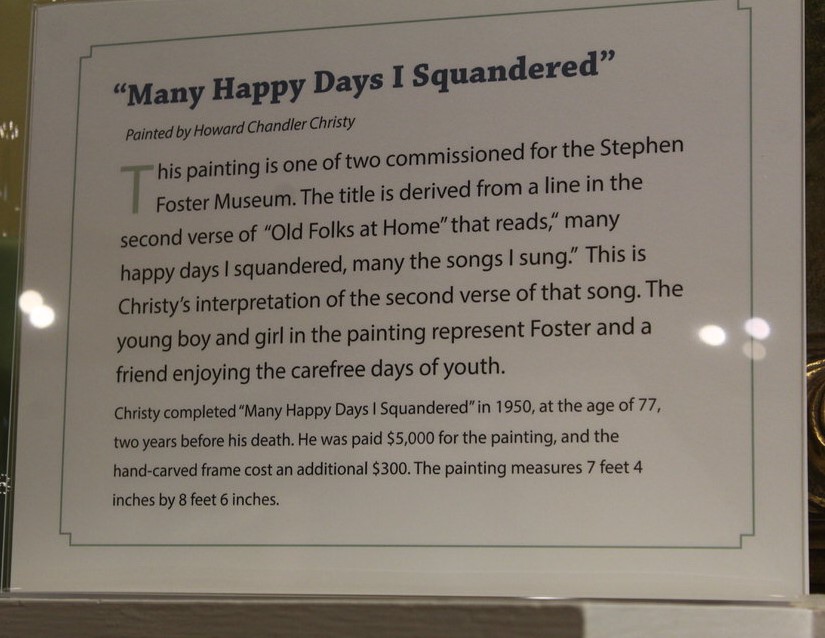
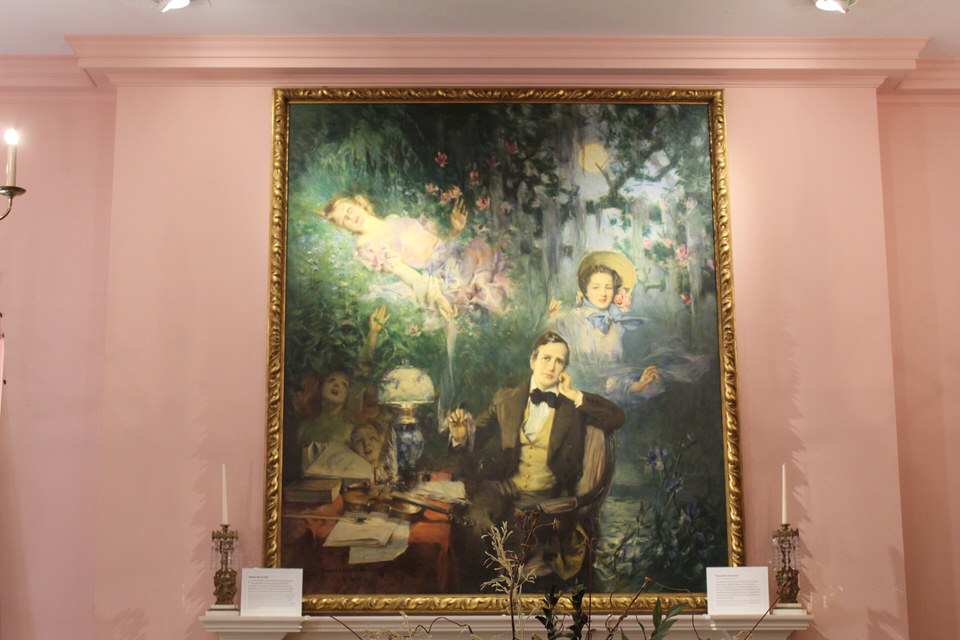
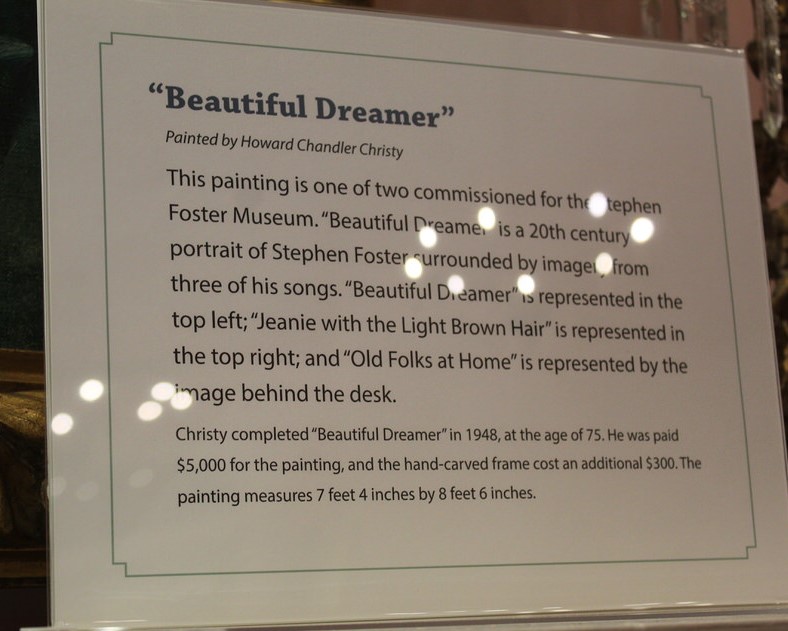
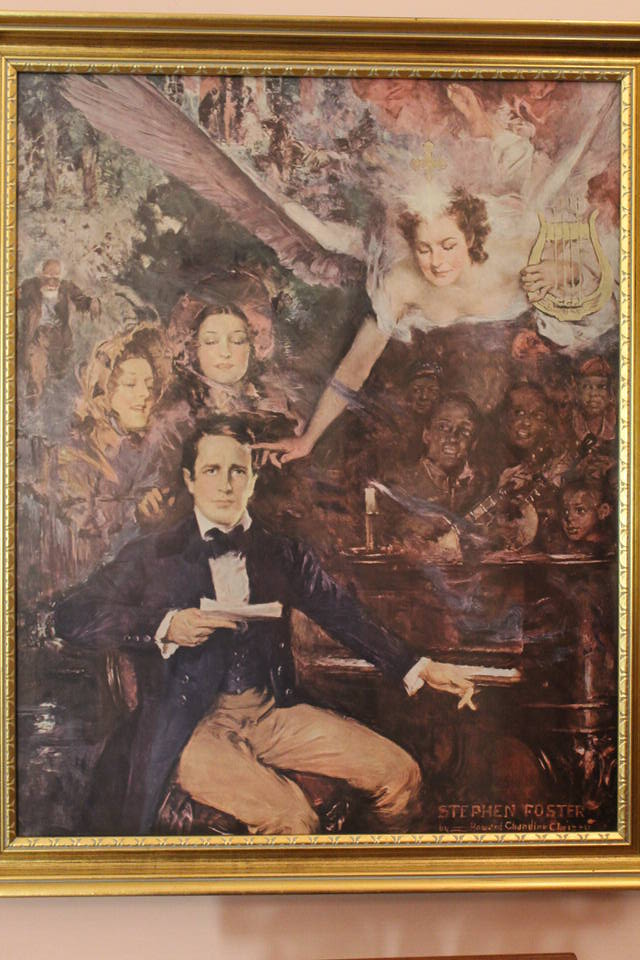
This is the one wing to the right as you enter. There are several interesting artifacts in here. The one that catches your eye immediately is the huge painting over the fireplace.
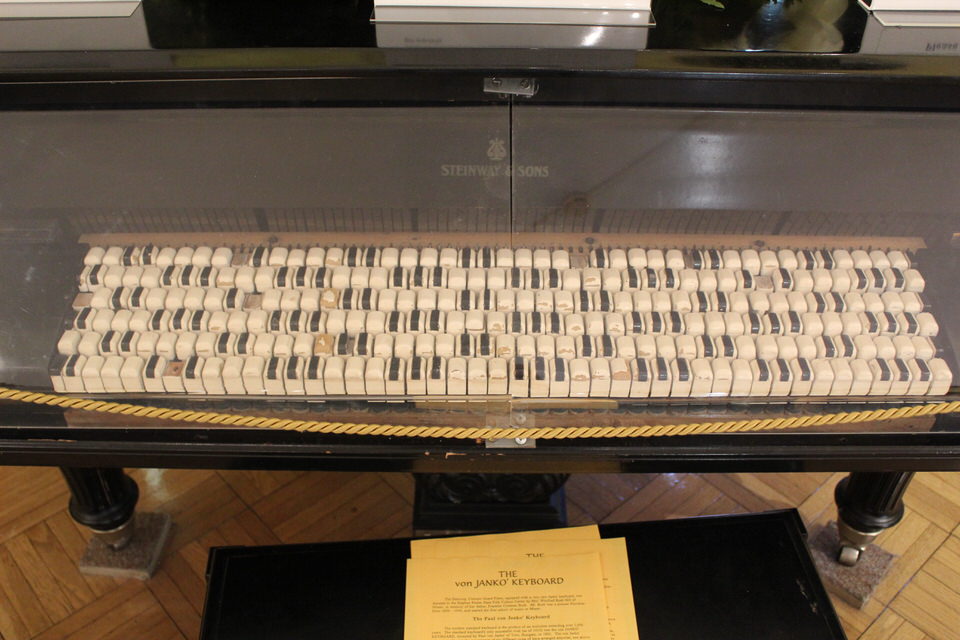
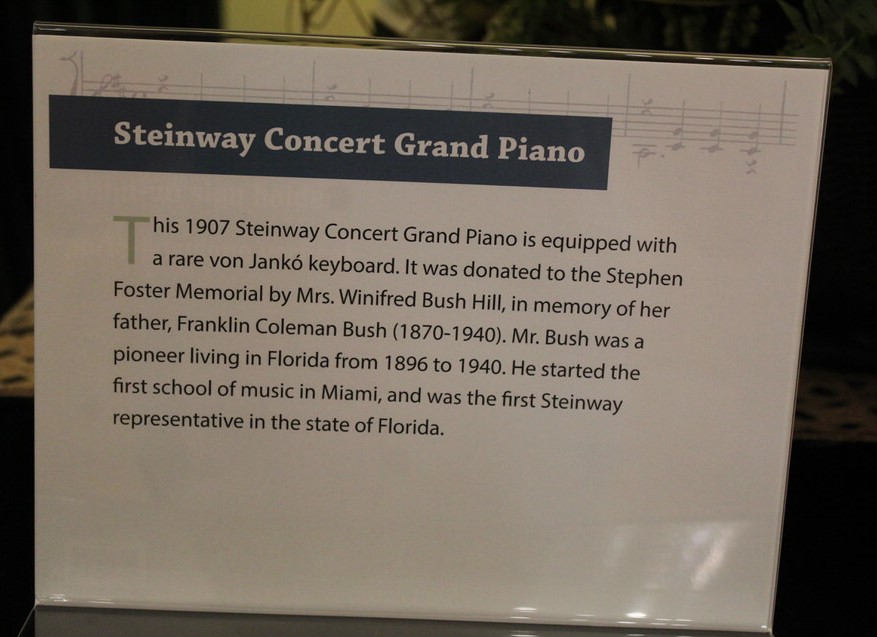
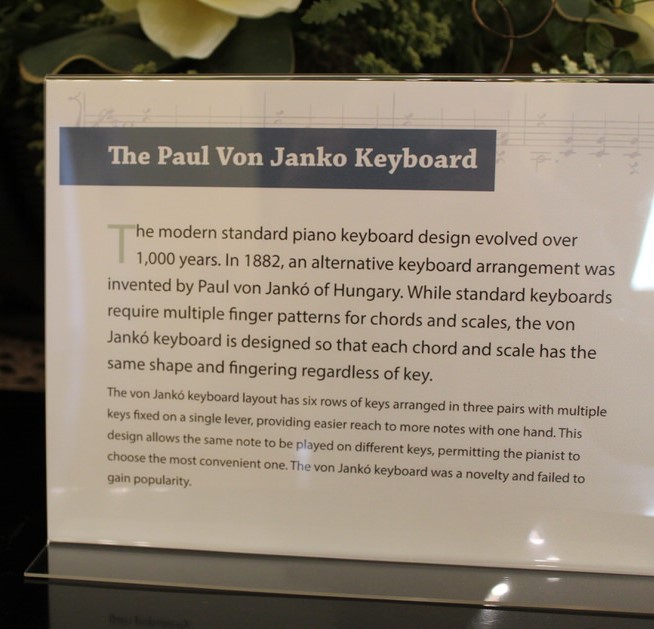
Also in this wing I found two other interesting items.
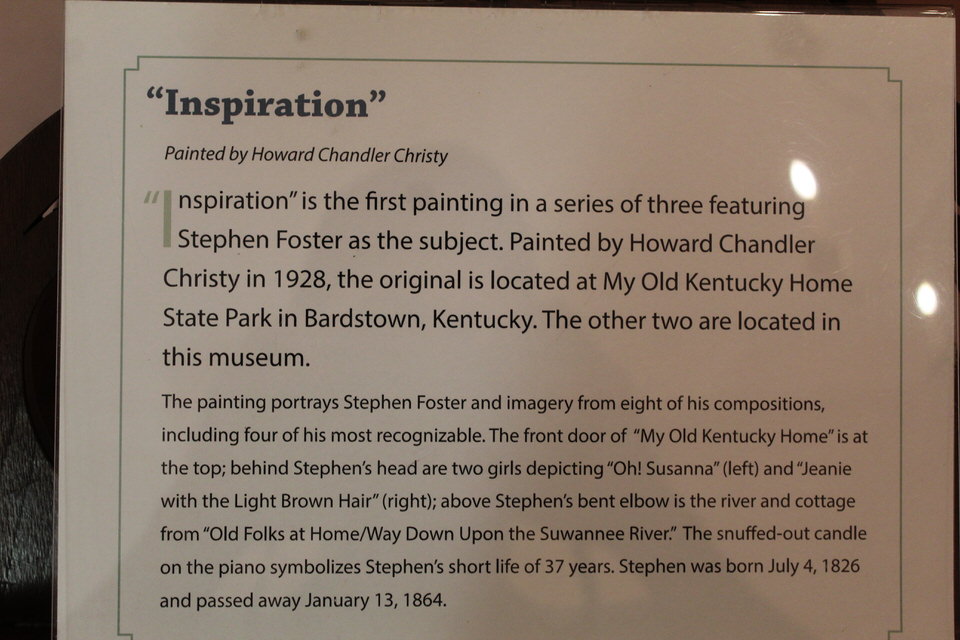
Moving over to the other wing, the one on your left as you enter we discover another painting by Christy.
Also in this wing is the third and final painting by Christy.
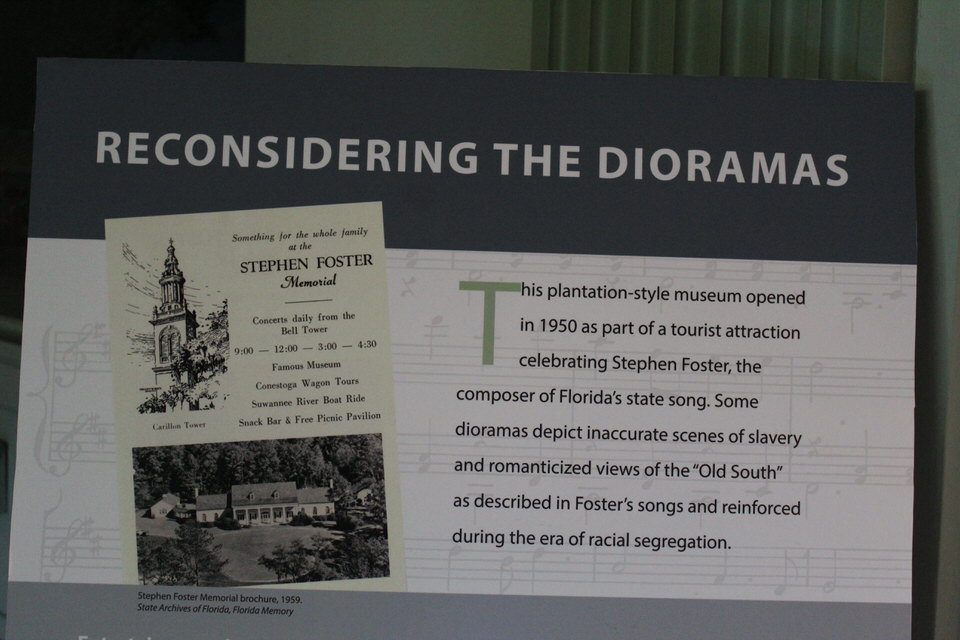
Throughout the center there are many Dioramas of Foster’s songs. However, there is this word of caution regarding them.
On one wall in the center I also came upon a small sheet of paper entitled Trivia. From it I learned, among many things, that:
There is a railroad car and a naval ship named for Foster.
A movie entitle Swanee River was produced starring Don Amechi and Al Jolson
In 1936 a 50 cent coin was minted with the name Stephen Foster
There is much more in the center to see and experience but there is one more impressive piece to this park that we need to see. And it is:
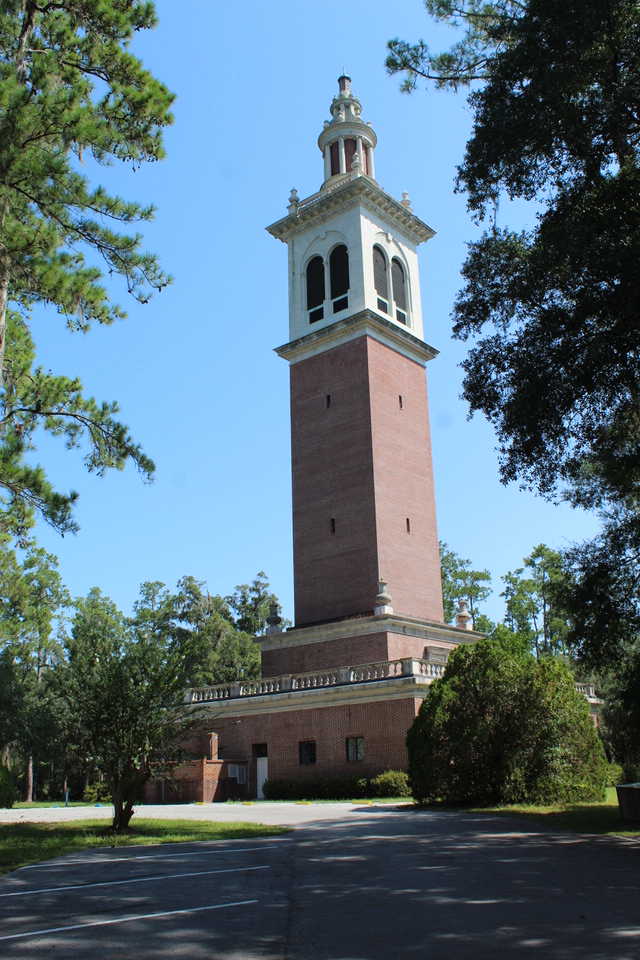
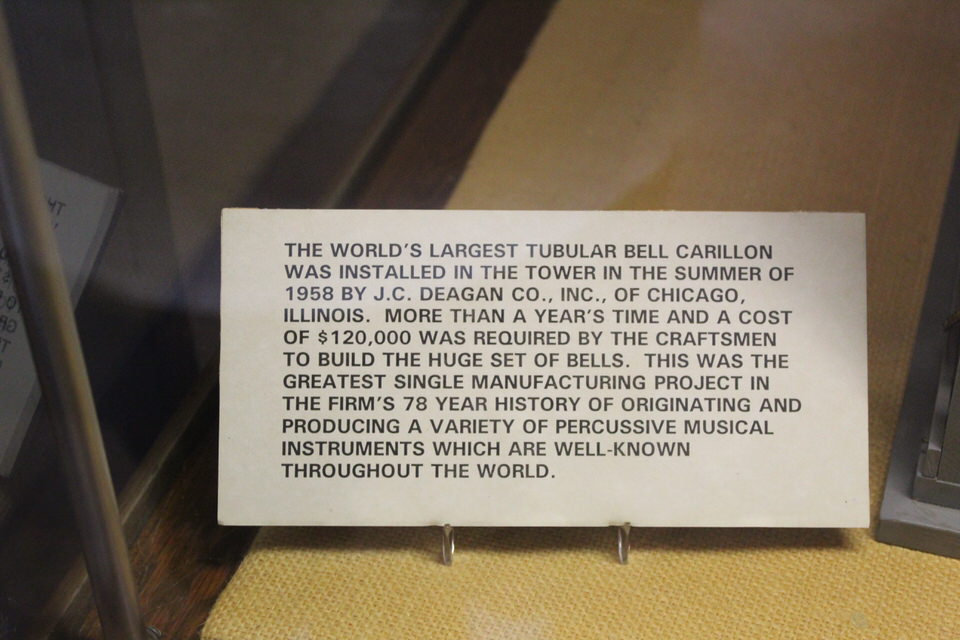
The Stephen Foster Memorial Carillon. What better way to keep alive the music of Foster than by having his music played daily on the quarter hour or at special concerts on this magnificent instrument. The 97 bell tubular bell tower was completed in 1958 at an original cost of $120,000. Unfortunately, at this time it is silent since it is undergoing a much needed restoration.
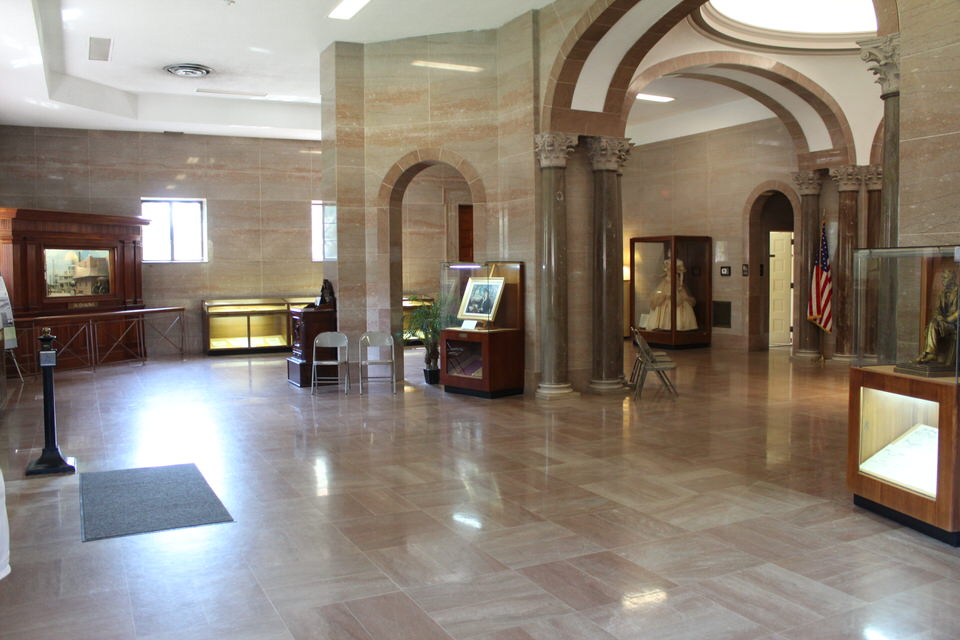
The inside of this tower is made up of
granite obtained from a quarry in Tennessee. It is absolutely breath-taking.
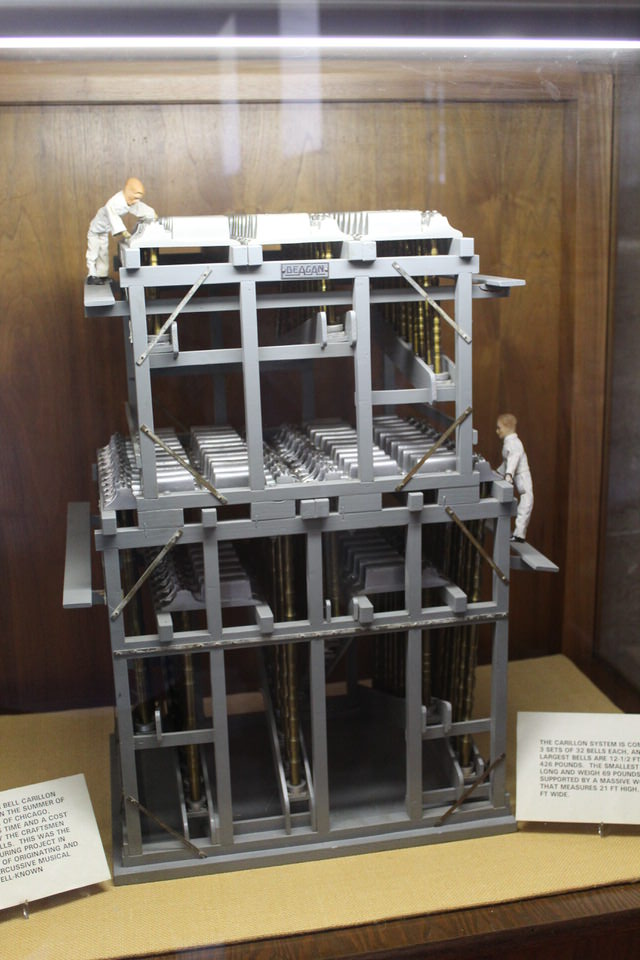
Now, regarding the bells. The unique feature of this musical instrument is that it is made up of
tubular brass bells rather than the typical cast iron bells commonly used in towers such as this. According to a sheet at the center the tubular bell is a more efficient design for the production of musical tone than the cast bell of the old world.
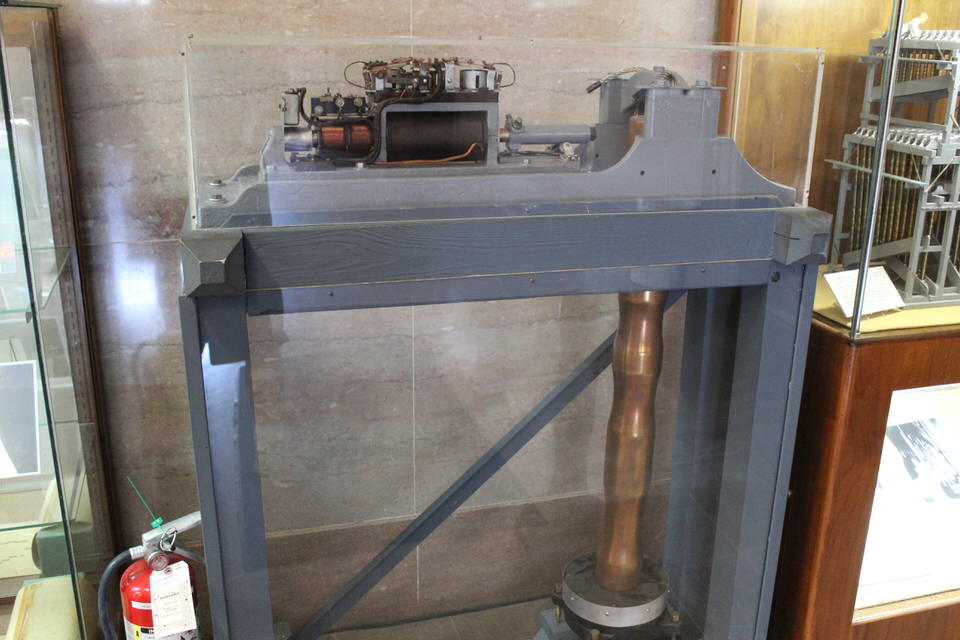
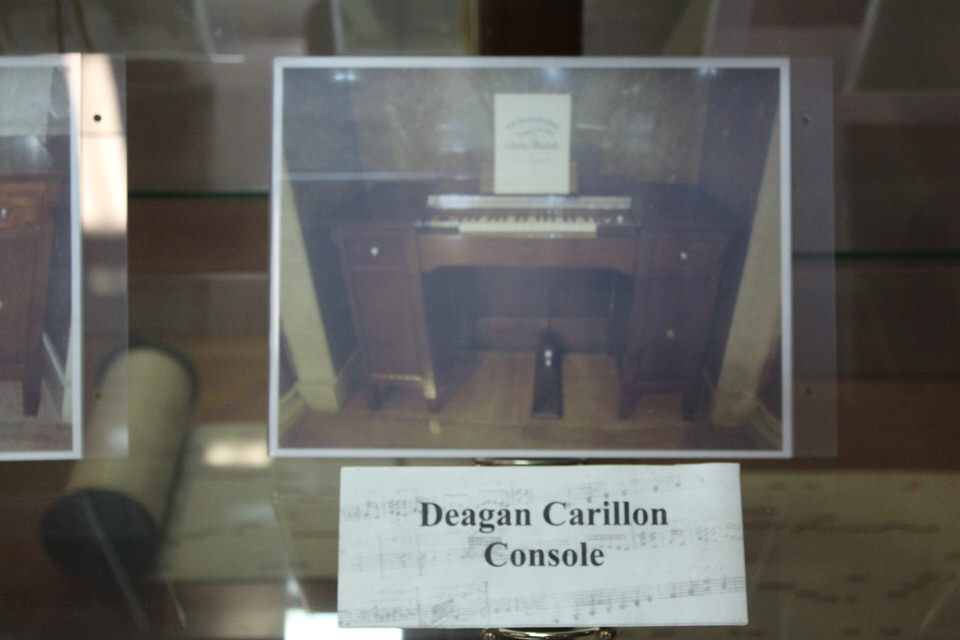
The bells are sounded by powerful electric striking actions activated from a piano type electric console when manually played or
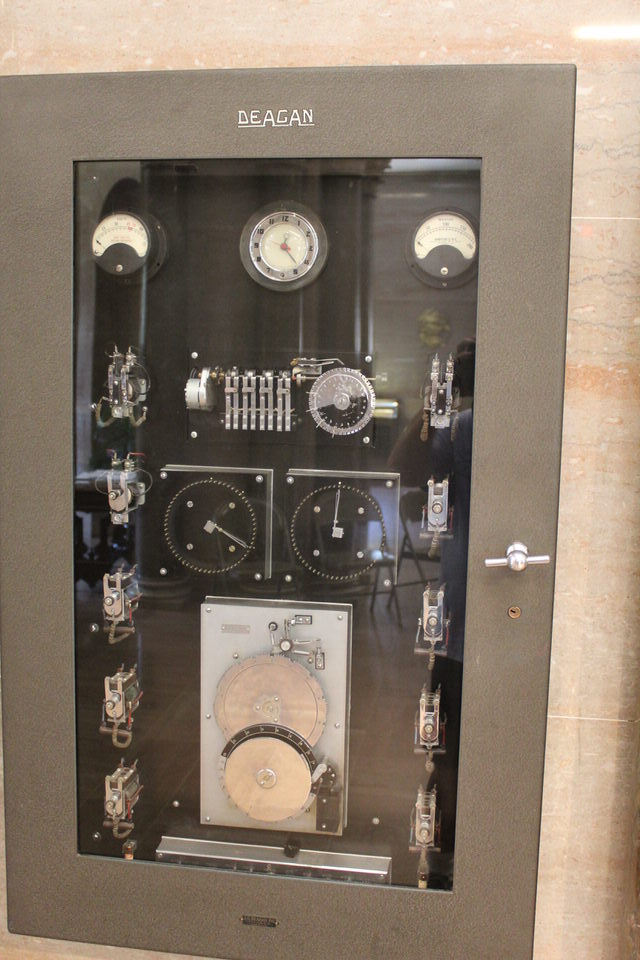
from carillon-playing devices which are fully automatic and under clock control.
We so wished that the bells were working and perhaps when they are completely restored and operational again we will return to hear them.
So, we’ve crossed off yet another item from our bucket list of attractions that we would like to someday see. It was a wonderful place to visit and if you are ever in Florida in the vicinity of the center do plan to stop and see the it for yourself.
Thanks again for spending some time with us. It’s always great to be able to share our story with family and friends. Comments? Feel free to share them with me. And always remember, cherish every moment of every day that God gives you and live those moments to the fullest.
Just a quick note in conclusion, we visited this center before Hurricane Idalia struck Florida. We left the area and returned home well before the hurricane tore through the area.
When I think of the Civil War what usually comes to mind are battles such as Gettysburg or Vicksburg, or sometimes Generals like Grant, Sherman, Lee or Jackson. I never, however, thought of it in terms of the navy. Truthfully, I wasn’t even aware there was a Civil War Navy or the role that it played in the North’s ultimate victory.
Thus, when we discovered this museum my curiosity was peeked. With time on our hands we decided to pay it a visit.
One of the first things I learned during an introductory movie was the significant role the navy ultimately played in the success of the Union Army. The navy was used to blockade Confederate ports and thus prohibit the flow of needed war materials and goods to the Southern States.
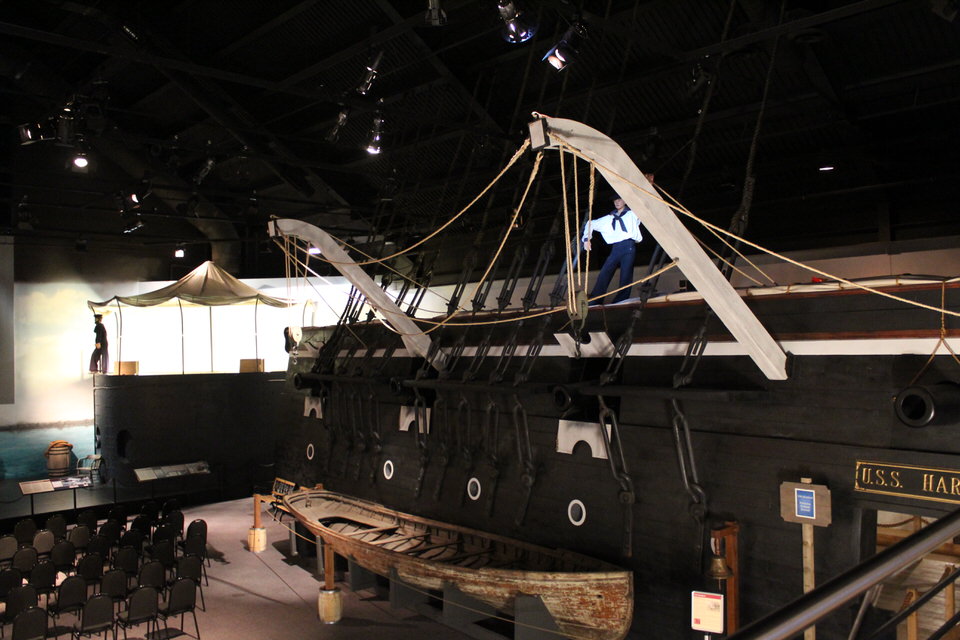
For instance, this is a replica of the U.S.S Hartford, the Flagship of Admiral David Farragut. It was powered by both sail and steam and had a long and storied history. The Hartford’s first major engagement was at The Battle of New Orleans. Despite fierce resistance the Hartford and a fleet of 37 other vessels were able to ultimately take New Orleans. They were thus able to close the mouth of the Mississippi and the wealthiest port in the South.
Later at the Battle of Mobile Bay as his fleet entered the bay one of his ships hit a mine throwing the rest of the fleet into disarray. Sensing that his ships were in danger Admiral Farragut lashed himself into the rigging to give him a clear field of vision and then bellowed his famous command Damn the torpedoes! Full speed ahead! The battle was brief but bloody, but in the end Union forces prevailed and Mobile Bay fell to them.
Another battle that was significant was the battle of
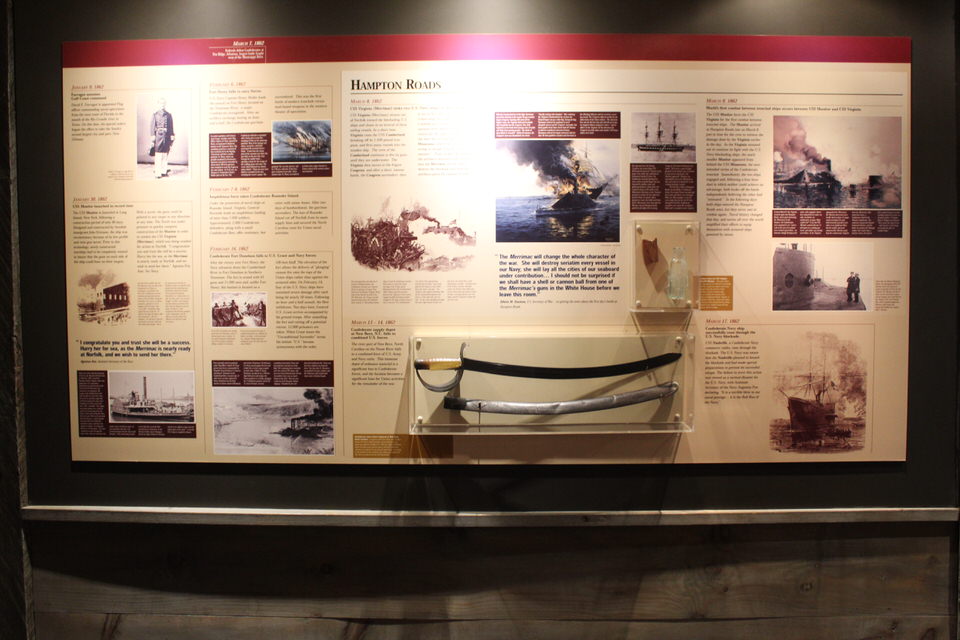
Hampton Roads between the ironclad vessels The Virginia and The Monitor.
The Virginia was the first steam powered ironclad vessel built by the Confederate Naval forces. It was originally a sailing vessel that was bunt and sunk by Union forces. However, Confederates forces were later able to salvage the ship. Noting that everything below the water line, including the engines were in good condition work began to turn the salvaged vessel into an ironclad. When completed it would have a total of 14 fixed gun ports. It’s biggest weakness was its size. It took over 45 minutes to turn it around and it took over a mile to do so. It was cumbersome and slow and this would hamper its ability to successfully engage Union forces.
The Monitor was the first such ironclad built and commissioned for the Union Naval forces. The Monitor was often called the Yankee Cheese Box because of its unusual shape. It sat low in the water and was distinguished by its central rotating turret and a small protruding pilot house near the bow. The turret housed two 11 inch guns. It was later found that the turret was problematic and difficult to control. The ship was powered by a single steam engine driving a single propeller. It was easy to maneuver and nimble in the water which gave it a distinct advantage when confronting the Virginia. It would be the first of many such similar vessels ultimately built for the U.S.S Navy.
The historic battle of Hampton Roads lasted some 4 hours with each vessel repeatedly bombarding the other. However, in the end neither vessel gained a distinct advantage. The battle was called off only when and because the pilot house on the Monitor was significantly damage. However, this battle ushered in a new era of naval warfare. Historic wooden ships would now gave way to armored vessels.
Throughout the museum there were a number of other fascinating exhibits.
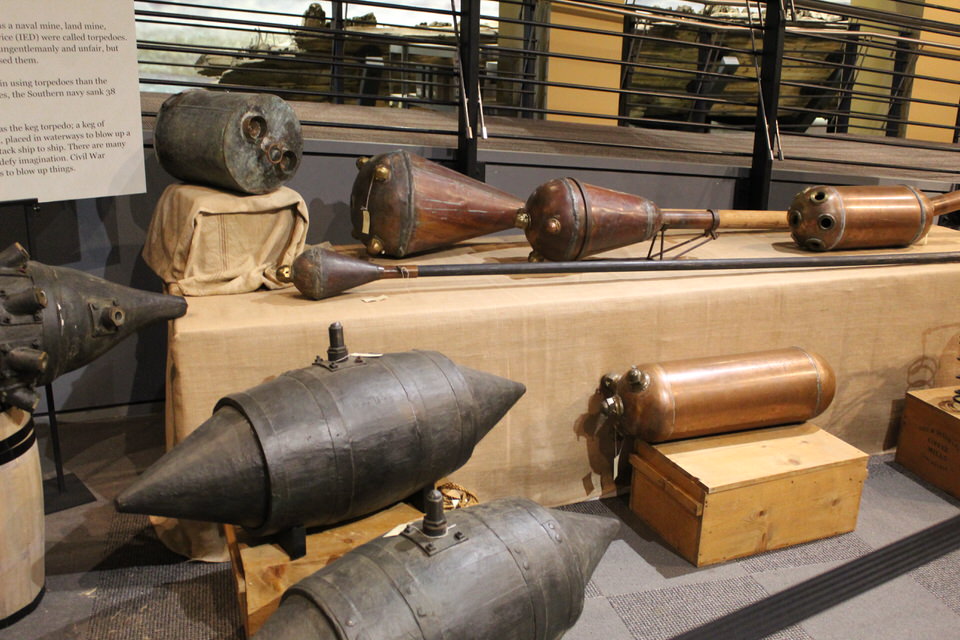
This is an exhibit of mines and torpedo’s that were used by both sides in an attempt to safeguard major ports. Many, however, were such that they needed someone to actually swim with them to a moored ship, arm it and then swim like you life depended on it – which it did – before it went off!
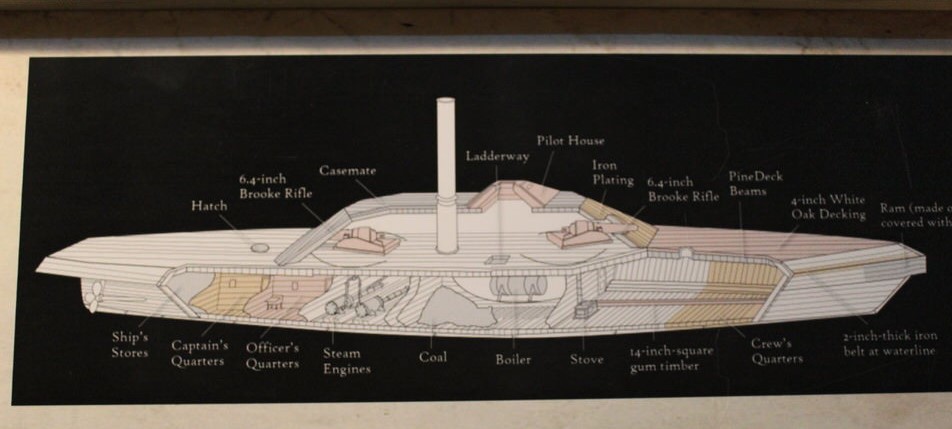
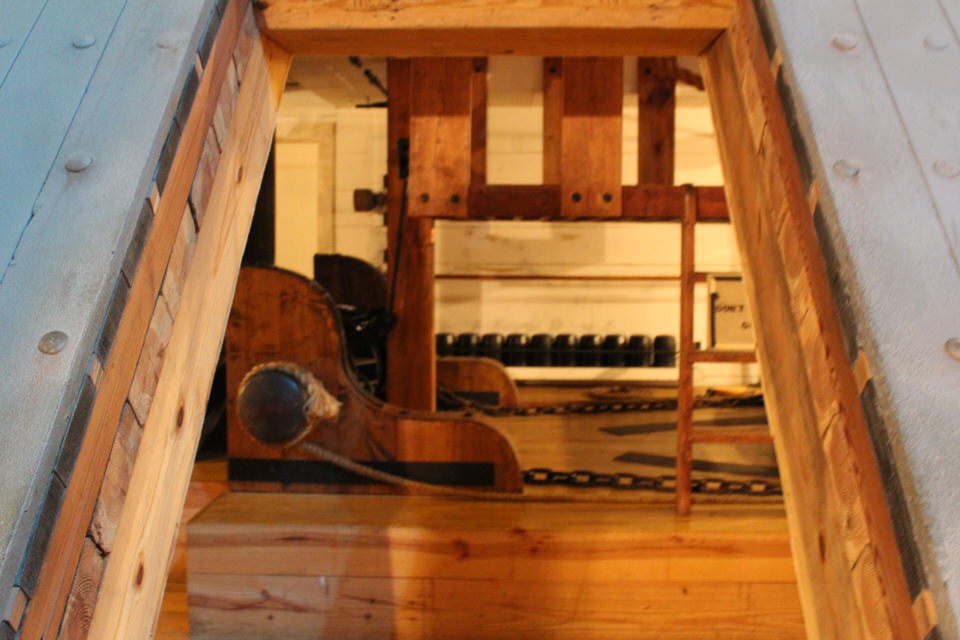
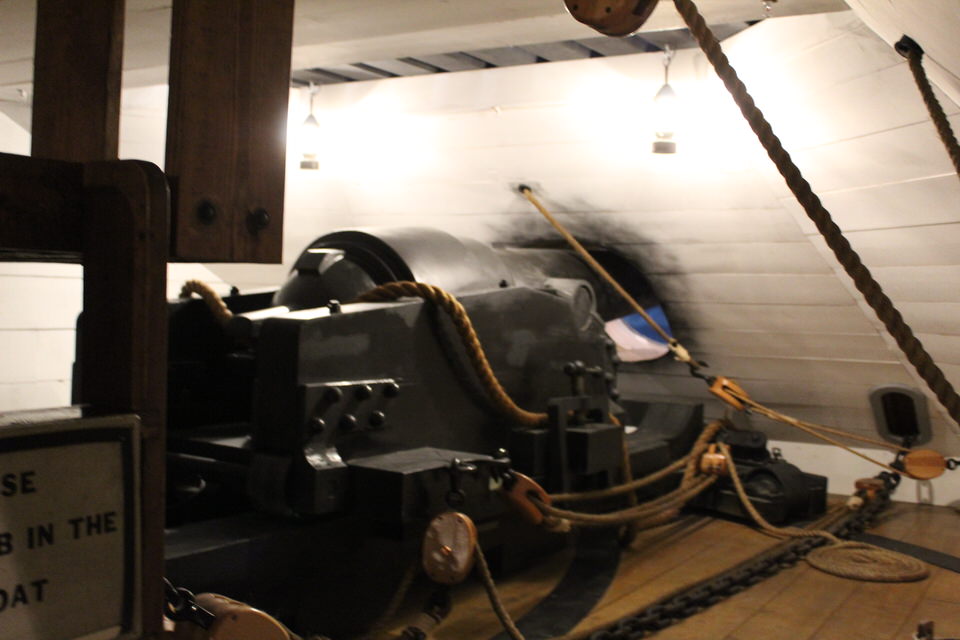
There was a full size model of the ironclad Albermarle which you could enter and walk around in. Note, in the entranceway in the above picture the thickness of the wood construction over which would be placed armor plating. The hull was built at a 35 degree angle, allowing projectiles to roll off easily. The crew would number 120 and even on a mild day the temperature inside would often hover between 120-130 degrees.
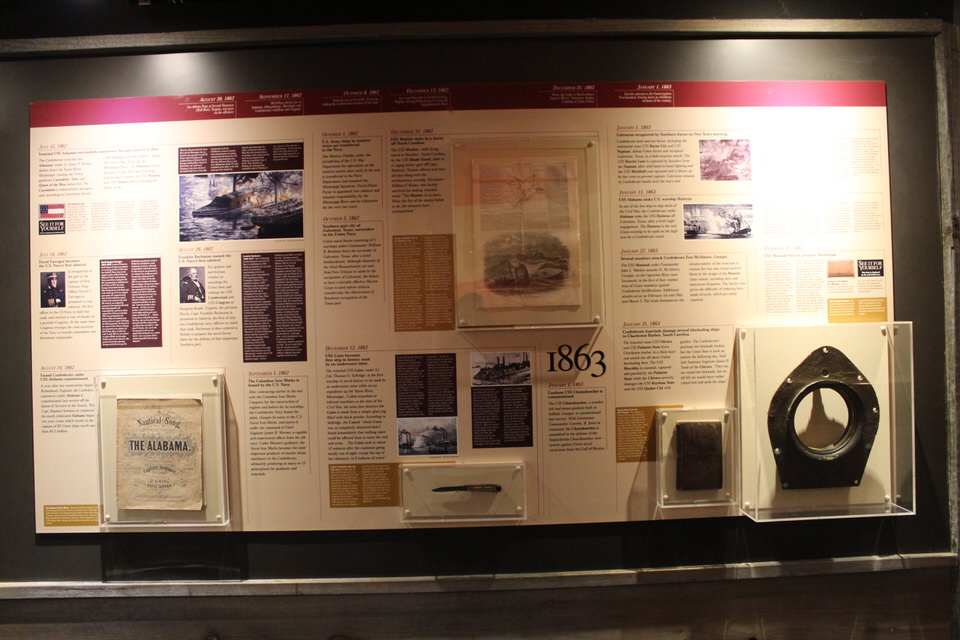
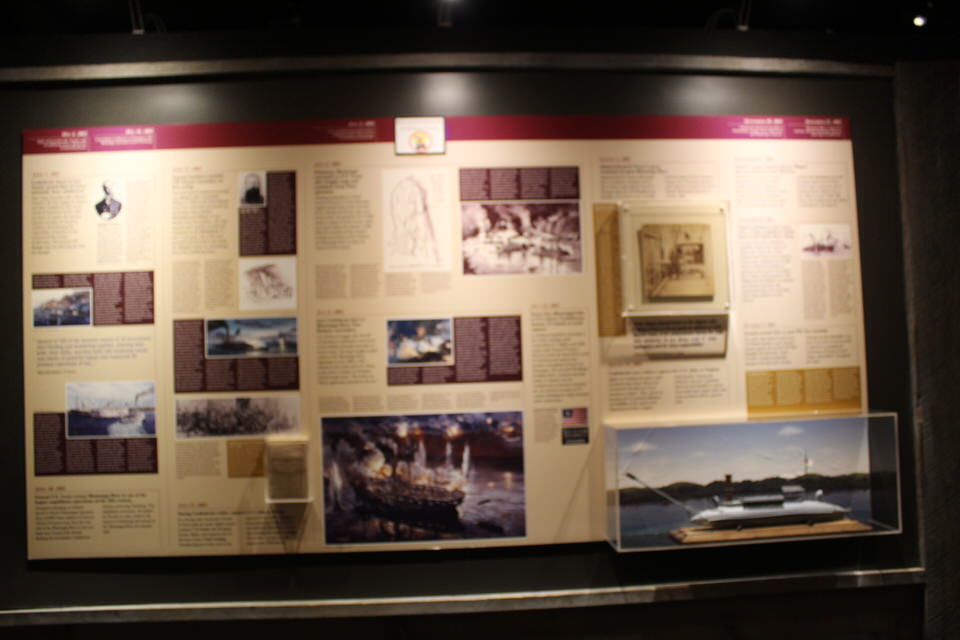
There was full wall detailing every major naval engagement during the Civil War. It’s amazing to realize that while the land battles of the Civil Way seemed to sway back and forth and rarely resulted in a strategic victory, the US Navy’s relentless campaign against the Confederate Navy ultimately tipped the balance of victory in their favor.
There was so much more there, enough that we ended up spending over two hours at the museum. Again, perhaps not a museum for everyone but it is one that taught me a number of things I never knew about our countries history. And when I can learn something new I consider that a good day.
Thanks again for spending some time with us. It’s always great to be able to share our story with family and friends. Comments? Feel free to share them with me. And always remember, cherish every moment of every day that God gives you and live those moments to the fullest.
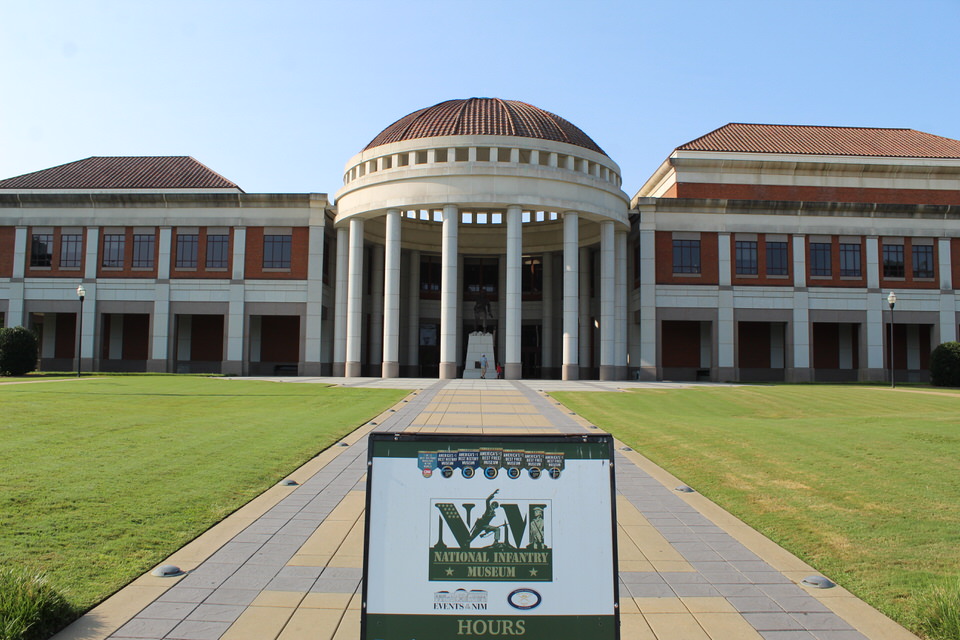
Let me begin by saying that this museum is not for everyone. Who is it for? If you have an interest in history, in particular military history, or if you or someone you know is a graduate of infantry school at Fort Benning you’ll enjoy a visit. Inasmuch as I check both boxes I was looking forward to getting back to my roots and learning a bit more about the grunts or infantry of today.
However, one thing I quickly discovered as I made my way through the museum was that there was just too much, way too much, to take pictures of. This is the first time that I honestly felt totally overwhelmed. So, let me just hit some of the highlights of this incredible place.
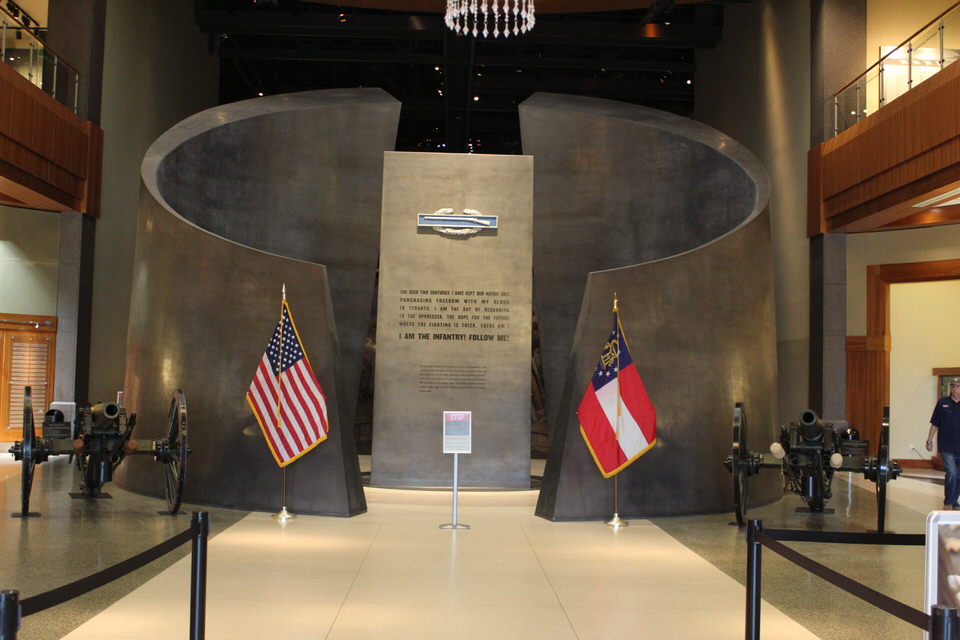
This statue at the entrance depicts the typical pose of the infantry squad leader: powerful, dynamic, alert, weapon in hand leading his men forward.
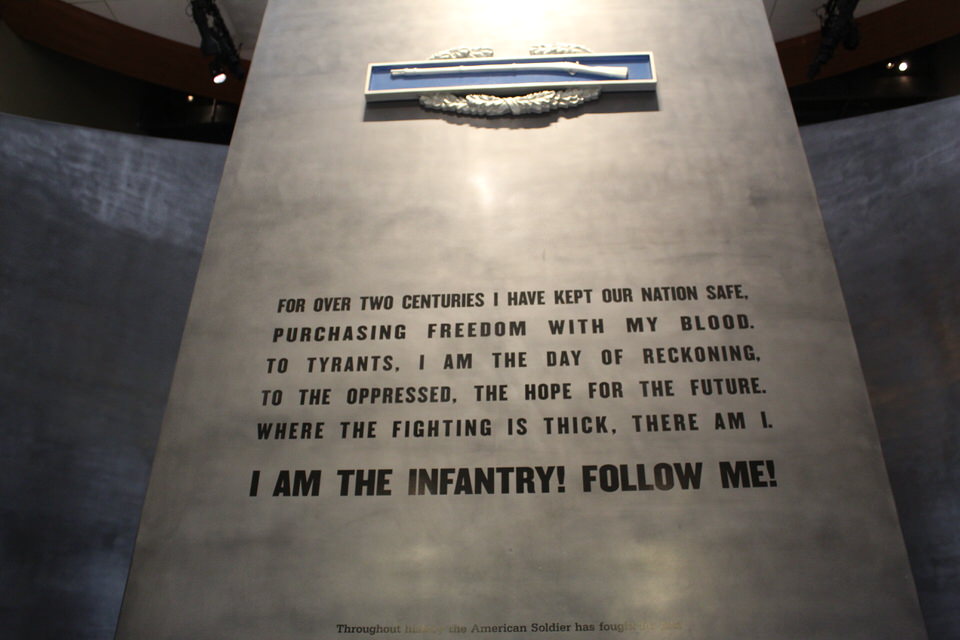
So it is, and so it will always be. Despite all the advances in technology, there will always be a need for boots on the ground. In every battle the last 100 yards of the fight belongs to the Infantry. They are the ones called upon to make the final push, to give their all inorder to achieve the final objective.
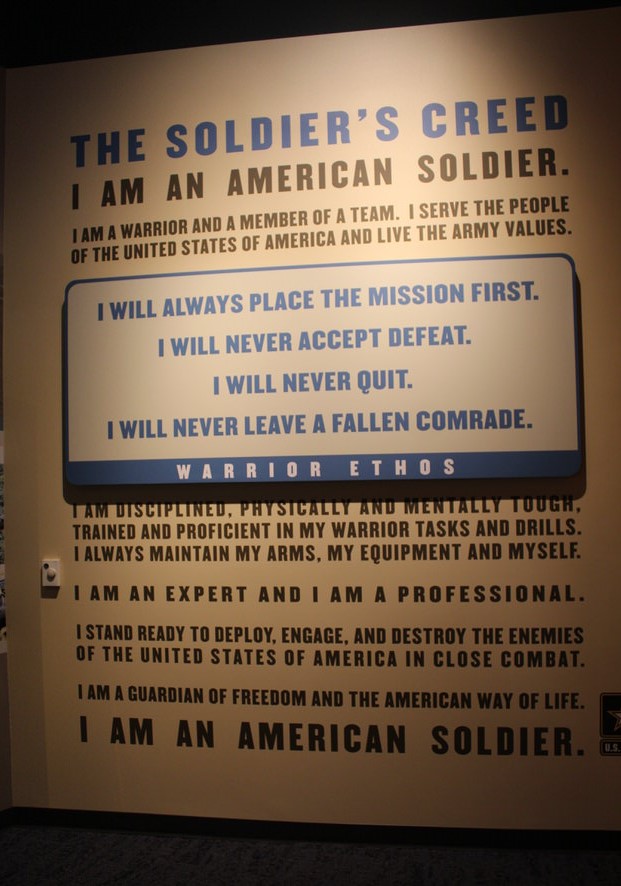
A soldier, a warrior, an American this is the creed we live and die by. I’m proud to say I was once a member of this group. And were I able to today, I would without hesitation serve my country again.
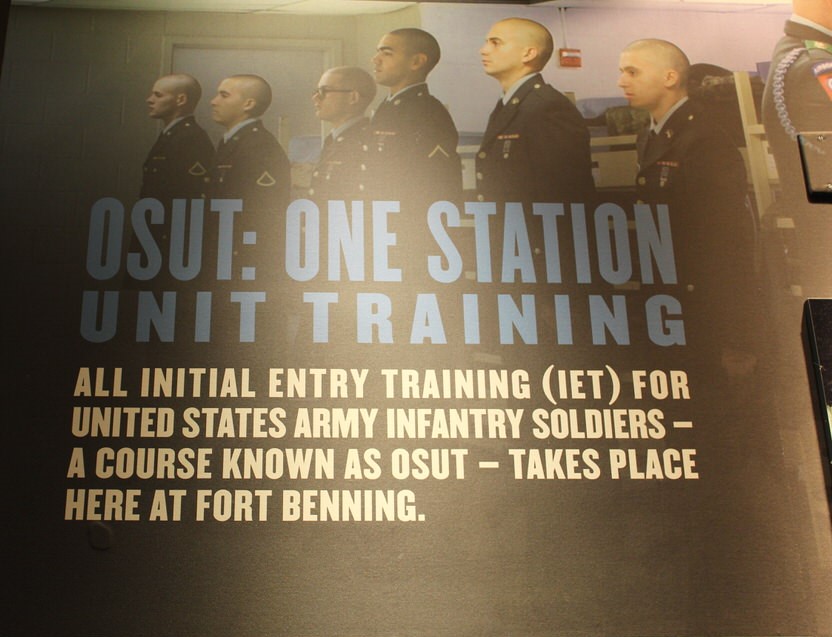
Shades of yesteryear. This is were my Army career began. How well I remember, as if it were yesterday how it all began. The moment you got off the bus you were assaulted from all sides with the Drill Sergeants yelling at the top of their lungs at you. They began immediately to let you know that you now belonged to them. Within hours your head was shaved and you were in a uniform the same as everyone else. You were no longer a name but a number. The transformation had begun.
And you ran, everywhere. Sometimes with nothing on your back. Other times with full equipment, often times exceeding 35 pounds in weigh.
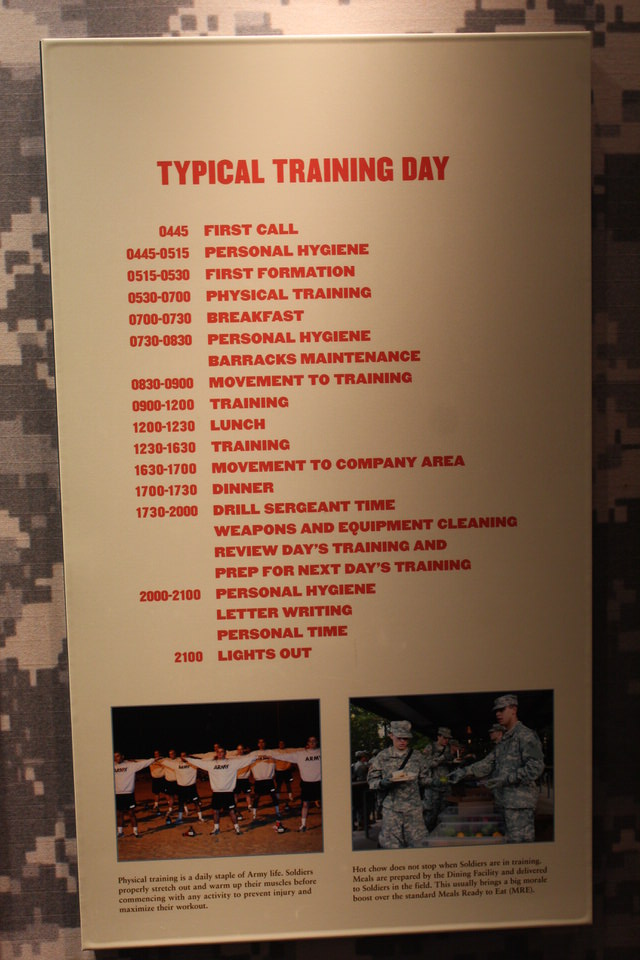
This was the day’s schedule. Oh my, I can’t even imagine doing this today. First of all, that is way to early for anyone to be getting up.
This is where it all ended. This is the parade grounds where final graduation was held. You stood at attention, tall and proud, because you realized you had made it.
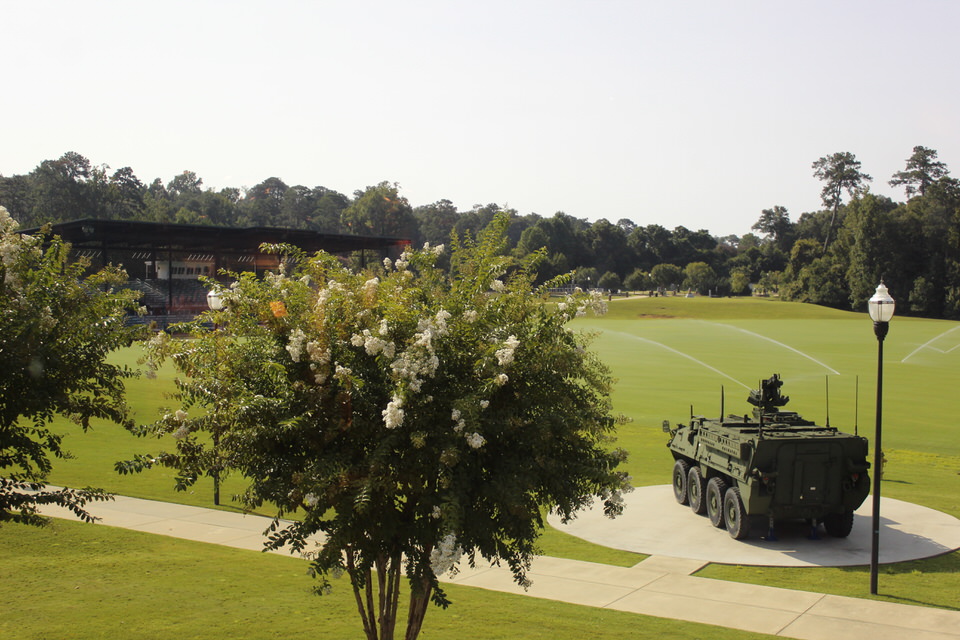
The only real thing that has changed from them until today is that Fort Benning is now known as Fort Moore. The base was originally named after a Confederate General and slave owner who fought against the United States during the Civil Way. By 2020 it became clear that the name had to be changed because it did not personify the Army’s policy of inclusion and diversity.
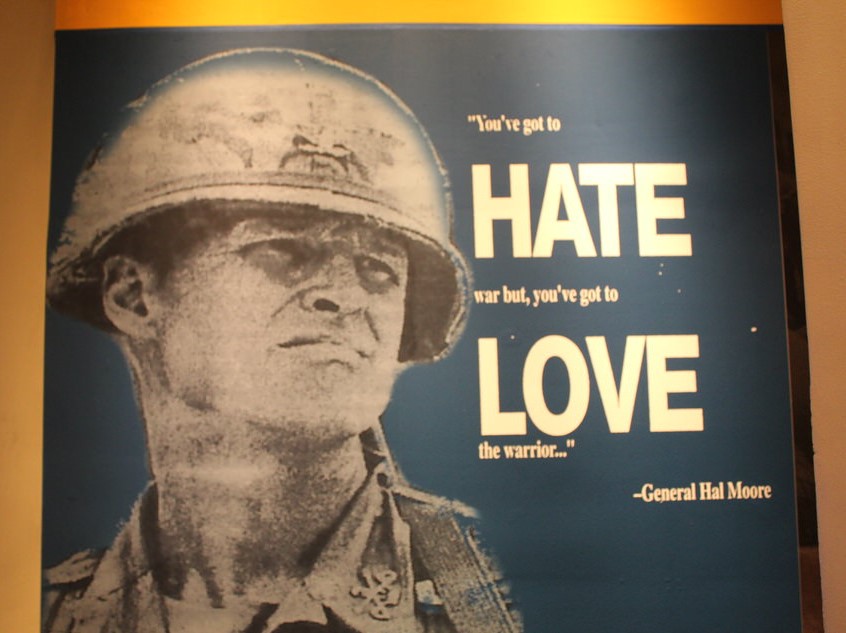
In 2023 the base name was finally changed to Fort Moore in honor of General Hal Moore who served with distinction in Vietnam.
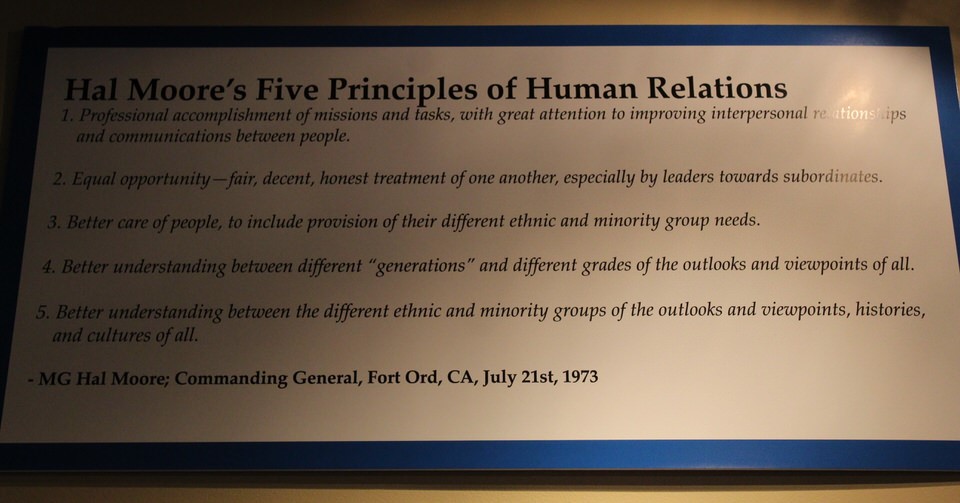
There were many reasons that General Moore was chosen, but just consider the following
Oh, that our country had leaders like this today.
There was so much more here to see. The history of warfare from the Civil War to today. The way that weapons have evolved and adapted. The changing technology that makes the life of an infantry soldier so much better today. There was a display regarding the formation and development of the Calvary. I absolutely enjoyed my time here and was thrilled that I had the chance to take in all that it had to offer.
Thanks again for spending some time with us. It’s always great to be able to share our story with family and friends. Comments? Feel free to share them with me. And always remember, cherish every moment of every day that God gives you and live those moments to the fullest.












 "On The Road of Retirement"