TOUR AMERICA, 2021: IVES RUN CAMPGROUND, TIOGA, PENNSYLVANIA

Saturday June 5, 2021

Abundant sunshine, Temperature 84

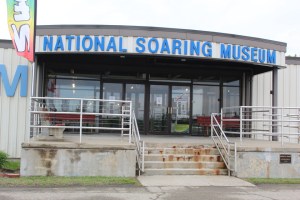
National Soaring Museum

When we were in New Mexico last year I really wanted to visit The US Southwest Soaring Museum. The online description and pictures of the museum intrigued me so much that I absolutely wanted to learn more about the sport of soaring. Alas, life got in the way, the museum was shuttered and we never got to visit it.
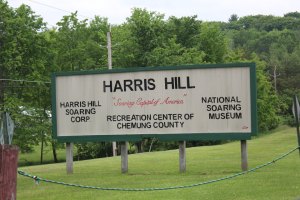
Imagine my delight then when I learned of Harris Hill in Elmira upon which was located The National Soaring Museum. A day of investigation was definitely called for. And what a day it turned out to be. I was thrilled with what I found.
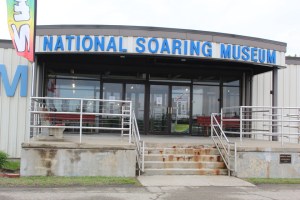
The National Soaring Museum is located at the top of Harris Hill in Elmira. The museum proved to be a fascinating walk through the history of gliding, soaring and sailplanes since the inception of the sport.
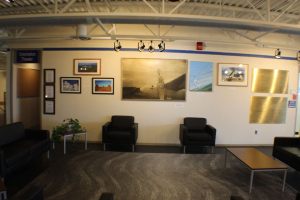
This is the lobby just beyond the entrance door.
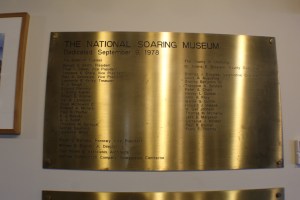
On display is the dedication plaque for the museum.
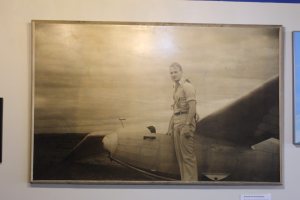
There is also a picture of Richard du Point standing beside his Minimoa sailplane. He won the National Soaring Contest in1934, 1935, and 1937.
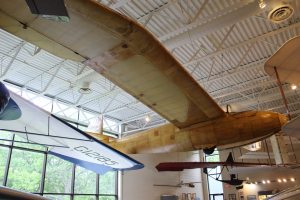
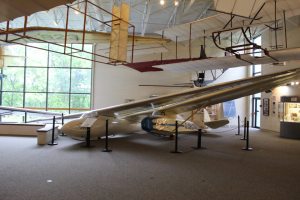
This is the actual plane which is on display at the museum. At least 100 Minimoas were built between 1935 and 1939. The plane was constructed of plywood and featured a gull wing design which made it extremely stable in flight. In 1938 this aircraft was also used to set a national distance flight record of 212 miles, from Wichita Falls, Texas to Tulsa, Oklahoma. Less you say, like I first did, what’s 212 miles – remember this is in a plane with no engine!
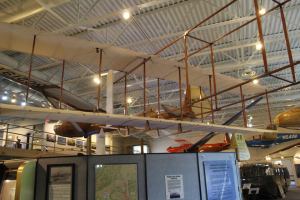
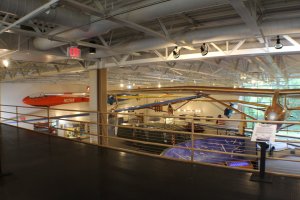
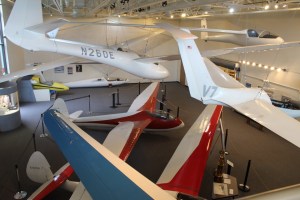
The museum is also chock full of other gliders and sailplanes dating back to the 1890’s when some of the earliest models were created.

Although gliding and soaring go back to the 1800’s
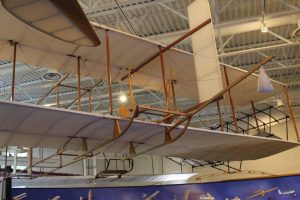
it was Orville Wright who made the world’s first duration glider flight in 1911 at Kitty Hawk, NC at nine minutes and forty five seconds. It was a record that would stand for over ten years. This successful flight also literally sparked the sport of soaring in America.

Unfortunately, after the successful flight the plane was abandoned at Kitty Hawk. It was later recovered and an attempt to restore was begun, however, it was destroyed in a fire before the restoration was completed.

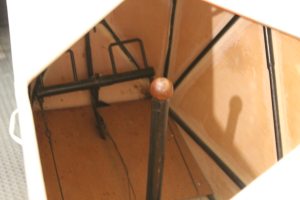
Above is a replica of this 1911 plane that is on display at the museum. Some things to note about the plane are: in an effort to improve its flight characteristics they mounted a large vane in the front and even hung a bag of sand in the front to change the center of gravity. Of special note, the fabric covering on the wings of the replica comes from the same Boston firm that made the fabric covering for the original plane.
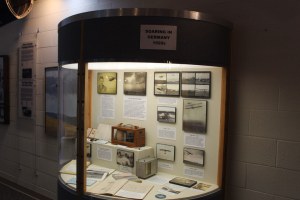
Following the close of WW I the development of powered flight in Germany was limited by the Treaty of Versailles. However, interest in flying was at an all time high which led to the revival of soaring there. German enthusiasts made great strides in designing and flying sail planes.
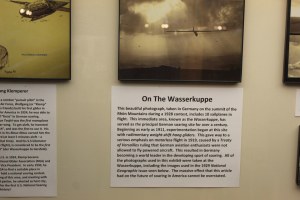
In 1921 a German pilot flew for thirteen minutes above the Wasserkuppe which was German’s premier soaring site. Orville Wright’s record of nine minutes 45 seconds set in 1911 had finally been broken.

Then in 1928 a German pilot flying above Cape Cod set a new American soaring record of four hours and five minutes. Until now soaring in American lanquished.
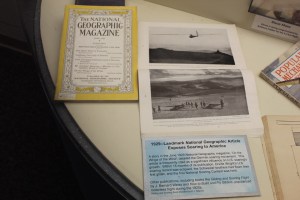
But that was about to change. An article in the June 1929 National Geographic Magazine entitled On The Wings of the Wind detailed the German soaring movement. This article is usually cited as the spark that rekindled the American interest in soaring.

But how did soaring come to Elmira?
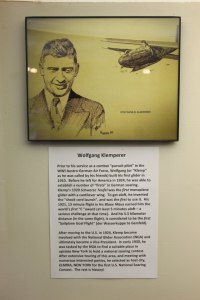
After moving to the US in 1924 Kemp became involved with the National Glider Association (NGA) and ultimately became its Vice President. In 1930 he was tasked by the NGA with finding a suitable location in upstate NY to hold a soaring contest. His search eventually led him to Elmira.
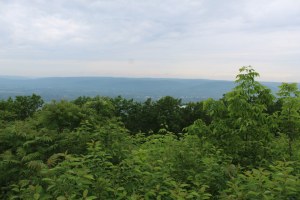
Elmira, with its majestic hills and prevailing winds, was naturally suited for sailplane flight and quickly attracted a number of soaring related activities. Soon, Elmira was selected as the Soaring Capital of America due to the topography of the area. Which leads to a brief discussion of how or why can a plane soar?
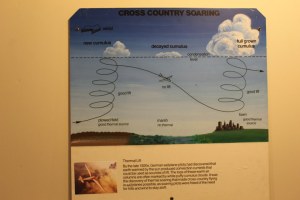
There is, first of all, what is known as thermal lift. The earth warmed by the sun produces convection currents that can be used as a source of lift. It was the discovery of thermal lift that made cross country soaring possible.
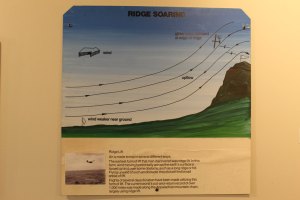
There is also what is known as ridge lift. Wind traveling horizontally across the earth’s surface is forced up and over some obstruction such as a long ridge or hill. Flights of several days duration have been made using this form of lift.

Both forms of lift are found in the Elmira area which makes it the premier area for soaring.
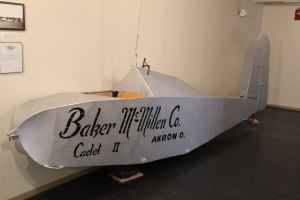
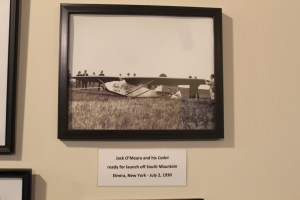
On July 2, 1930 Jack O’Meara, flying this glider stayed aloft for one hour and 38 minutes over a ridge south of town, to make the first sailplane flight in the Elmira area. The success of this flight led to the decision to make Elmira the official America soaring contest sight. The first National Soaring contest was held here in September of that year and the rest is history.

Well, there is much more to tell and much more to show but I’m going to call it a night as of now. Stay tuned because there is so much more to learn and so many more planes to show.

Our day on The Road of Retirement has come to a close. We’ve been spending more quality time with my sister, Cindy and her husband, Charlie. God bless my sister she is the ever gracious host and truly one of God’s beautiful people. It’s going to be a bitter sweet moment when we finally leave this area. I’m anxious to get back on the road but I’ll truly miss her and spending time with her. All I can say is, thank you Lord for these last two wonderful and special weeks.

Thanks for taking the time to read our blog.  We always appreciate your company, your comments, and your suggestions. Remember, take time to stop and smell the roses and live each day that God gives you to the fullest.

These are the voyages of  Elvira and her two intrepid travelers.  Our continuing mission: to explore as many new states as possible, to seek out new acquaintances and make new friends, to boldly go where we have never been before.

See you on down the road!
TOUR AMERICA, 2021: IVES RUN CAMPGROUND, TIOGA, PENNSYLVANIA

Thursday, June 3, 2021

Rain, Temperature 68 Degrees

Exploring Woodlawn Cemetery, City of Elmira, NY

I’m not even going to comment on the weather. Except to say this is really getting old!

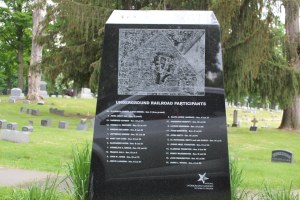
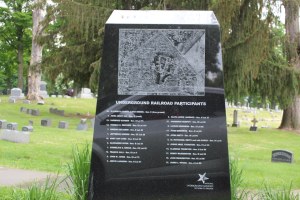
So, after we visited the grave site for Mark Twain on our way out we noticed this monument. Immediately, my curiosity was roused. What was the connection between the Underground Railroad, Elmira, and Woodlawn Cemetery?

Time for some investigation.

What was the Underground Railroad? : Harriet Tubman

The Underground Railroad was a network of secret routes and safe houses established in the United States during the early to mid-19th century. It was used by enslaved African Americans primarily to flee into free states and Canada.

A number of routes ran through New York but the most famous and most successful was the route that ran through Elmira. Elmira was a natural hub since it is at the center of several river valleys, which have always been the basis for transportation routes. The Elmira route started in Philadelphia, went through Williamsport, PA, then Elmira, NY and on into Canada.

John W. Jones (ex-slave) - Wikipedia

Of the many individuals who worked on the railroad in Elmira the most noted one was John Jones. He escaped to Elmira on the railroad and then decided to settle there. Between the years of 1851 and 1860 documentation shows that he helped over 800 fugitive slaves to escape through Elmira. However, many considered Elmira a safe place and like it so much that they subsequently settled there.

ELMIRA,NEW YORK-FIRST BAPTIST Church-(Unposted)-(Ny-E#3) - $3.99 | PicClick

Jones sheltered them either in his own home or at The First Baptist Church of which he was the sexton. He often received fugitives in groups of six to ten but at times groups of thirty or more would arrive together. It is said that when the railroad was in existence every church in Elmira assisted in harboring fugitives.

In 1850 when the New York and Erie Railroad Line came to Elmira Jones’s legacy really began. By making friends with railroad employees he induced baggage men to stow away fugitive slaves. The car in which they hid became known as The Freedom Baggage Car. Those going on beyond Elmira usually departed on the 4:00 am train since it was considered the safest, as it did not change cars until it reached St. Catherine’s, Ontario.

But Jones could not have done it alone. Some of Elmira’s most respected citizens (all listed on this monument) helped in this noble and illegal effort by providing overnight accommodations, money, food or clothing to make their stay and subsequent journey possible. These individuals provided a network of support at great risk to themselves, their families and their business reputations.

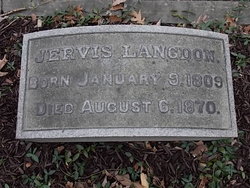
Jervis Langdon (1809-1870) - Find A Grave Memorial

One of the most famous was none other than Mark Twain’s father-in-law who is also buried at Woodlawn Cemetery. He was a prominent abolitionist and active in anti-slavery causes who helped in the funding of Jones’s operation. He also spent a great deal of his money on various social causes of that day and age.

There is so much more to be told about the Underground Railroad and its significance to our country’s history but time and space does not permit going further. I encourage you to Google it and discover for yourself the many people who risked their lives and everything they had to make it work. It’s a fascinating history that we should all be familiar with.

Tomorrow, we soar!

Our day on The Road of Retirement has come to an end. If you’ll excuse me its time now to go build an ark. Just big enough for the two of us and my stuffed dog, Harper. He is the only animal allowed on! Have a good evening.

Thanks for taking the time to read our blog.  We always appreciate your company, your comments, and your suggestions. Remember, take time to stop and smell the roses and live each day that God gives you to the fullest.

These are the voyages of  Elvira and her two intrepid travelers.  Our continuing mission: to explore as many new states as possible, to seek out new acquaintances and make new friends, to boldly go where we have never been before.

See you on down the road!

TOUR AMERICA, 2021: IVES RUN CAMPGROUND, TIOGA, PENNSYLVANIA

Wednesday, June 2, 2021

Rain, Temperature 61 Degrees

Exploring Woodlawn Cemetery, City of Elmira, NY

Neither rain nor yucky weather was about to keep us from going sightseeing today. Thus, despite rain drops falling on our heads we were up and out by 10 am.

We were headed to Elmira, NY where we wanted to explore both Woodlawn Cemetery and the National Soaring Museum.

Today, we’ll cover, in part, our visit to Woodlawn Cemetery. Now, before you bail on me thinking what in the world can you discover in a cemetery just hang with me for a little bit. So, lets go exploring.

Here we are at the entrance gates to Woodlawn Cemetery.

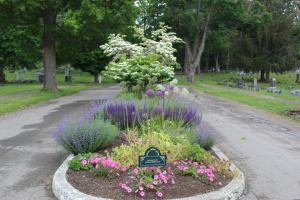
This floral arrangement is immediately inside the entrance. However, we were not here to view the flowers.

We were here to visit the grave site of Mark Twain. Of all the sites associated with Mark Twain in Elmira none attracts more interest than his grave in this cemetery.

An anonymous author once penned these words about his grave site: In years to come people will come from near and far to visit this last resting place of Mark Twain. ..Pilgrimages will be made to this spot in beautiful Woodlawn cemetery and thus has Mark Twain distinguished this Queen City where much of his labor was performed and where he met the girl he loved and where he finally came to lie in his last sleep.

The signs directing you to the grave site are clear and within a few minutes we were there. But before we visit the site. . .

First, a little background. Mark Twain was born Samuel Langhorne Clemens in Independence, Missouri on Dec 5, 1835. He was raised in Florida, Missouri.

Later after he began his literary career he moved to Hartford, Connecticut in order to be closer to his publisher. He rented a home at Nook Farm, a thriving literary community on the western edge of Hartford.

However, what many don’t realize is that he spent a fair bit of time in the Finger Lakes region of New York. Specifically, he wrote many of his significant works in a small study (more about this later) on a farm in Elmira, New York.

Now, to his final resting place.

Today, his grave site is only a short distance from his summer home in Elmira.

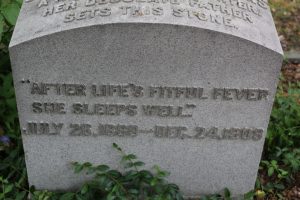
He is buried next to his wife who died of heart failure in Florence, Italy. Thought the inscription on the top of the tombstone seems to imply that only her ashes are buried here, there is substantial proof that that is not the case. Her body was actually embalmed in Italy and returned by a German steamship to be buried here in Elmira.

Mark Twain wrote in part regarding his wife: She was always cheerful; and she was always able to communicate her cheerfulness to others. . . She was always able to reason me out of my despairs and to find a bright side to the clouds and make me see it.

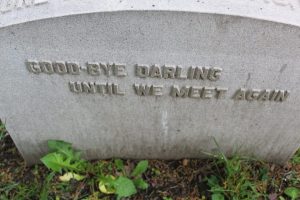
Other family members buried here

The name Lampton was the family name of Twain’s mother.

This was the first of Twain’s three daughters and she was known to her family as Susy. It is said that Susy had considerable literary talent.

This was his second daughter who was married to Ossip Gabrilowitsch and after his death to Jacques Samossoud. She was the only one of Twain’s four children to survive him. She was devoted to her parents and sisters, always on call when there was a family crisis or illness.

Then there is this.

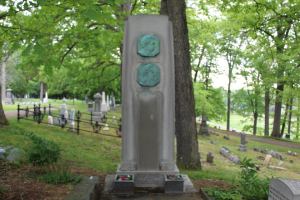
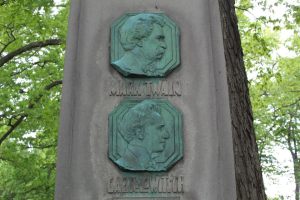
This is the Mark Twain/Ossip Gabrilowitsch monument. Clara Clements erected this monument in honor of her father and her first husband. The shaft of the monument is of Westerly granite, known in the trade as perhaps the finest stone in the world. The shaft is twelve feet high and weights ten tons. In the center of the front of the shaft is a panel that is highly polished that reaches about half way up the shaft. Just above it are two portraits in bronze of Twain and Gabrilowitsch.

On the base of the monument is the inscription: Death is the starlit strip between the companionship of yesterday and the reunion of tomorrow. To the loving memory of my father and husband.

OK, that is an overview of Mark Twain’s grave site and others that are buried there. Leaving the cemetery we had one more stop to make regarding Mark Twain.

This is his original study which was once located on Quarry Farm in Elmira. It was located on a small knoll about 100 yards from the main house and overlooked the Chemung River. In this study Mark Twain wrote major portions of the The Adventures of Tom Sawyer, Adventures of Huckleberry Finn, Life on the Mississippi, A Connecticut Yankee in King Authur’s Court, The Prince and Pauper, A Tramp Abroad, and many short pieces.

In 1952 the Mark Twain Study was given to Elmira College and hence moved from Quarry Farm to the college grounds.

In this blog I’ve just touched briefly on the life of Mark Twain, his finally resting place and his summers in Elmira. I encourage you to specifically Google Quarry Farm to learn more about this fantastic place and to take a virtual tour of the farm. It’s amazing to see it and to learn how it is continuing to be used today.

That in part was our Wednesday on The Road of Retirement. There is much more to come so stay tuned.

Thanks for taking the time to read our blog.  We always appreciate your company, your comments, and your suggestions. Remember, take time to stop and smell the roses and live each day that God gives you to the fullest.

These are the voyages of  Elvira and her two intrepid travelers.  Our continuing mission: to explore as many new states as possible, to seek out new acquaintances and make new friends, to boldly go where we have never been before.

See you on down the road!

TOUR AMERICA, 2021: IVES RUN CAMPGROUND, TIOGA, PENNSYLVANIA

Tuesday, June 1 2021

Temperature Low, 56 Degrees; High, 70 Degrees

Exploring Ives Run

This is what happens when you get bored to tears. You decide to go exploring right in your own backyard. We’ve stayed at Ives Run several times now but we really didn’t know much about the campground. Time to corrrect that.

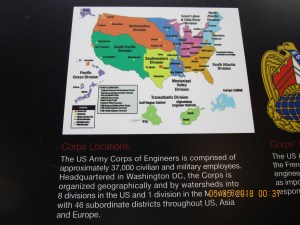
I’m sure most of us know that this is a Corps of Engineers (COE) Park. But who or what is the COE? I went back to our visit at Cape Cod for some information.

OK, so now that we know who built this campground, let’s learn a bit about the campground itself.

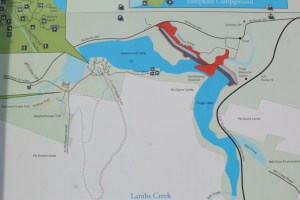
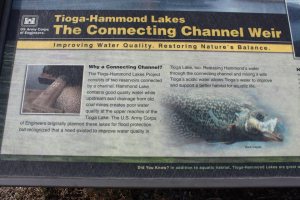
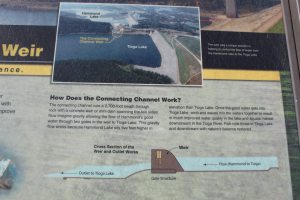
There are actually two lakes and two dams in this immediate area. Hammond Lake is a 640-acre lake and Tioga Lake is a 498-acre lake. You’ll note on the map above that there is a connecting channel between the two lakes. More about that in a minute.

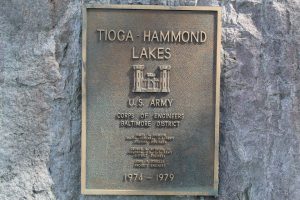
The two dams were constructed by the COE between 1974 and 1979 in the aftermath of the floods caused by Hurricane Agnes in 1972.

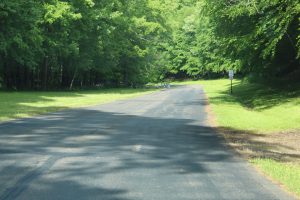
Now to find out more about that connecting channel we needed take a ride. . .

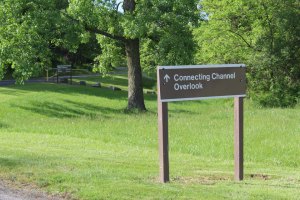
up the Connecting Channel Overlook road to . . .

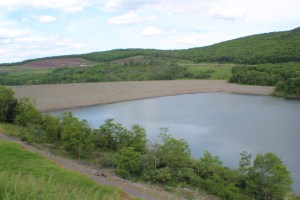
Once here we could see. . .

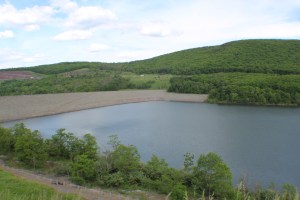
Tioga Lake and Dam to our left.

Hammond Lake and Dam to our right.

Now about that Connecting Channel. . .

Now we know what it is, why it exists and how it works.

The Channel itself.

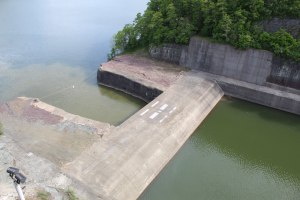
The Weir or the gate that controls the flow from one lake to the other. Two local gentlemen shared with me that the best catfish hole in the two lakes is right to the left of the Weir where you can see a rope stretched across the channel.

Back down from the Connecting Channel Overlook, this sign caught my eye. My curiosity, of course, got the better of me.

Investigating, I discovered the spillway for the Tioga Dam.

Back now to the actual campground.

The campground sits on the eastern shore of Hammond Lake. It is part of the Endless Mountain region of Pennsylvania along the Allegheny Plateau in the Appalachian Mountains. The campground has over 200 sites and a boat launch with overnight mooring for campers.

The sites here are really nice and there is a spacious sitting area at each site with a picnic table and a fire pit. Site separation is spacious everywhere with lots of open green, grassy areas

There was one area, in particular, that I had noticed on the map of the campground that I wanted to explore.

What was Pine Camp?

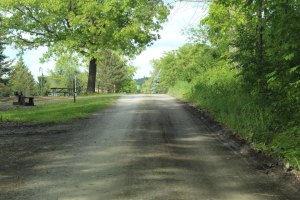
So exploring we went. The road was hard packed dirt so traveling it was not a problem as long as you took it slow. What we discovered was a primitive area more suitable for tents with no hookups at all.

There were, however, a couple of travel trailers back here with generators running. We stopped to talk to the couple at this site and they stated it was the best location in the whole wide world. They absolutely loved the solitude and the peacefulness of the location. Definitely, not for us.

That was our day on The Road of Retirement. What a wonderful day of discovery the day turned out to be. It always amazes me how much we find to see and learn sometimes even in our own backyard.

Thanks for taking the time to read our blog.  We always appreciate your company, your comments, and your suggestions. Remember, take time to stop and smell the roses and live each day that God gives you to the fullest.

These are the voyages of  Elvira and her two intrepid travelers.  Our continuing mission: to explore as many new states as possible, to seek out new acquaintances and make new friends, to boldly go where we have never been before.

See you on down the road!