We awoke to a rather cool day today. Temperatures were in the 60’s with clouds overhead. A rather nice morning if I may say so. So many mornings in the past were hot and humid and so uncomfortable. But not today. I’ll take it.
Today we had some banking to do and it could only be done by going to an actual Chase Bank branch. I remember when our local branch was no more than 5 minutes away. It

was easy and convenient. No more. The closest branch we could find was 124 miles north in Richmond, Kentucky. Now how about that. No sense whining about it, only one thing to do, get in the car and go. Go we did and in due time – like 2 hours – we were there. Now get this, what needed to be done only took us about 15 minutes! But it is done and that’s a great feeling.
Well, we figured why make this trip for just our banking. Could there be something in the area that was either historical or perhaps interesting looking that merited further investigation. Come to find out there were several sites that caught our interest. In the end we decided to visit one, Fort Boonesbourough.
The original Fort Boonesborough was the final terminus of the epic journey that Daniel Boone and his group of trail cutters made when they carved out Boone Trace. In March
and April 1775, these men opened the first road into what was to become Kentucky. Boone Trace was essentially a bridle path large enough for those traveling by foot or horseback.
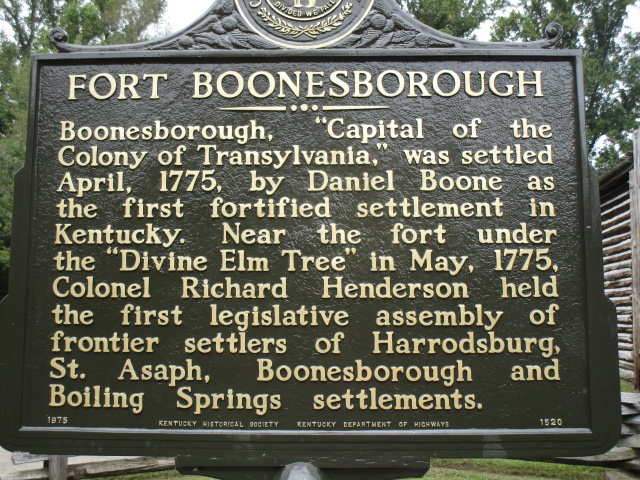
During its heyday the fort was one of the centers of settlement in Kentucky. The dream of a fourteenth colony called Transylvania located in the Kentucky wilderness seemed a reality. By the summer of 1775, the fort and settlement of Boonesborough consisted of 26 one-story log cabins and four blockhouses. The cabins and stockades had small portals for guns in case of Indian attack.
Boonesborough played an important role in the founding of Kentucky and the opening of the west. However, as time passed and conditions changed, Louisville became a more dominate municipal center. Part of the reason for Louisville’s emergence was because the Wilderness Road, a formally designed and engineered wagon road, led to that Ohio River location. When activity on Boone Trace diminished, and the disbursement of settlers claiming their own lands increased after Native American attacks lessened, all that was left of Fort Boonesborough was the memory and history of this location’s importance to the founding of Kentucky and America’s westward expansion.
The memory of Fort Boonesborough remained a vital part of the Kentucky frontier experience. The need to honor this hallowed site of pioneer Kentucky saw fruition in 1963 when Fort Boonesborough State Park opened on 153 acres on the banks of the Kentucky River. On August 30, 1974 a reconstruction of the historic fort was dedicated. The reconstruction is located on higher ground than the original structure and it is made up of 10,000 southern yellow pine logs. There is a museum of Daniel Boone’s life along with cabins displaying pioneer crafts. This is the Fort that we visited today.
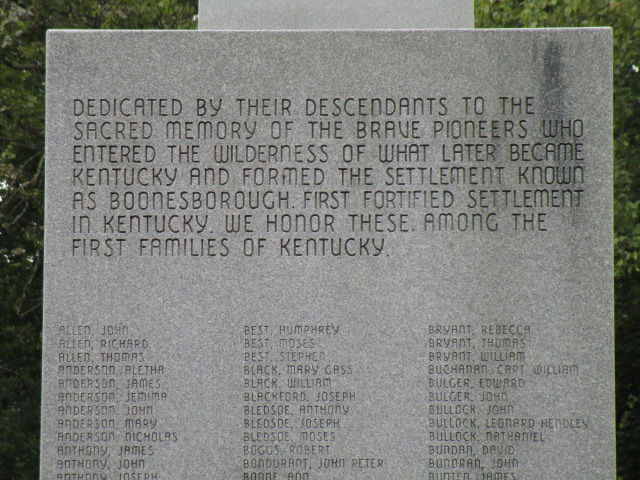
Arriving at the site of the reconstructed Fort the first item that we noticed was this monument. It is located just in front of the gate into the Fort. The plaque on it
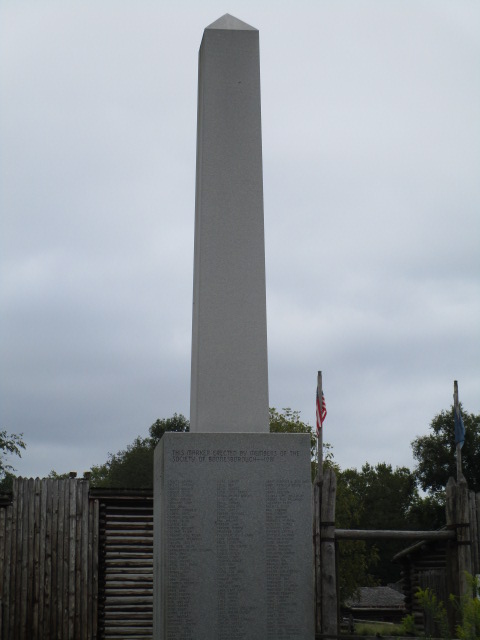
is self explanatory. It is dedicated to the early settlers that made up Fort Boonesborough.
Just pass the monument is the front gate to the Fort. Impressive walls to say the least!
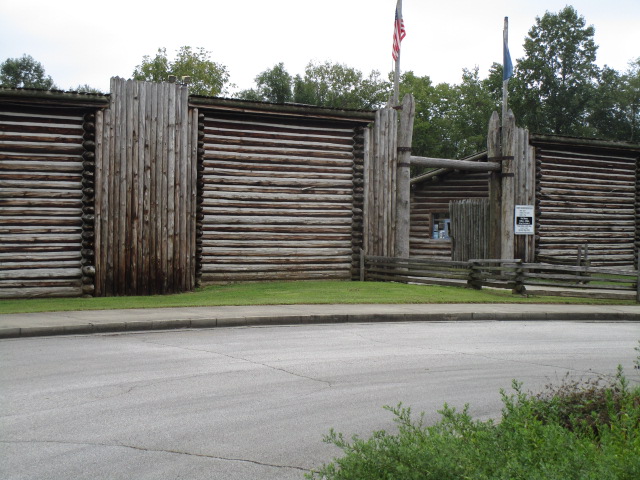
The entire Fort was not large. By the summer of 1775, Boonesborough consisted of twenty-six one-story log cabins, laid out in a hollow rectangle perhaps 260 by 180 feet. At each of the four corners was a blockhouse with a projecting second story, from which to
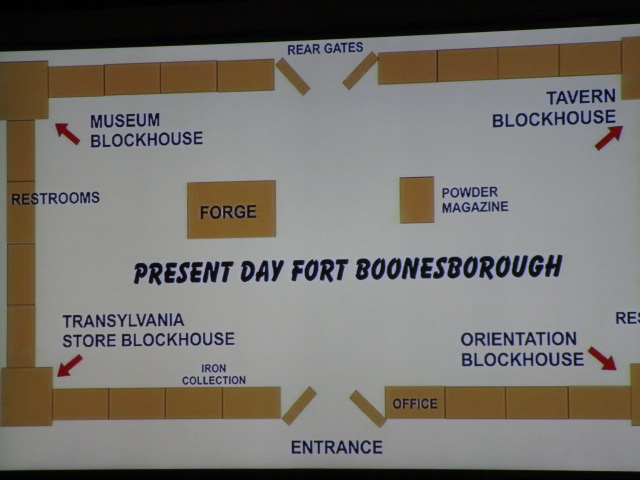
fire down on attackers. Like many of the frontier forts, Boonesborough initially had no well inside the fort. That fact created an obvious weakness in case of siege, but the settlers believed attacks tended to be quick-strikes of short duration, rather than prolonged sieges. How wrong this proved to be.
In the autumn of 1778 a large force of Indians attacked and laid siege to Boonesborough. For nine days and nights the Indians surrounded the fort. The defenders held out and the Indians abandoned the siege.

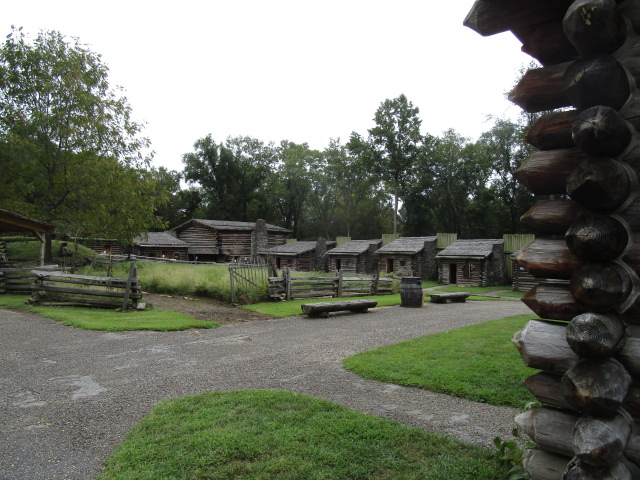
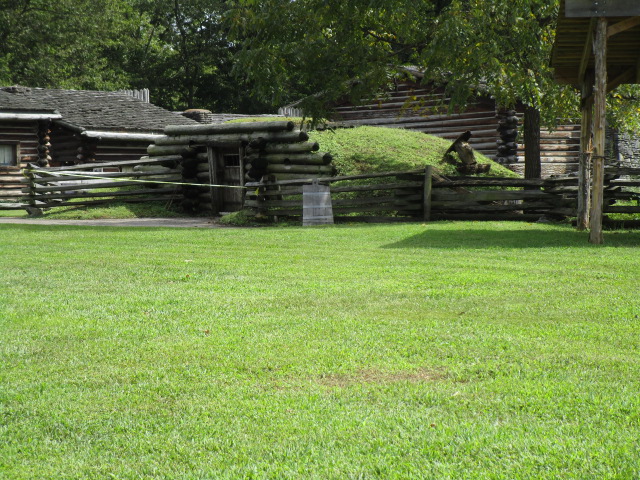
Below are some pictures of the inside of the current Fort with cabins and blockhouses. Almost in the middle of this picture and to the back is the Tavern Blockhouse.
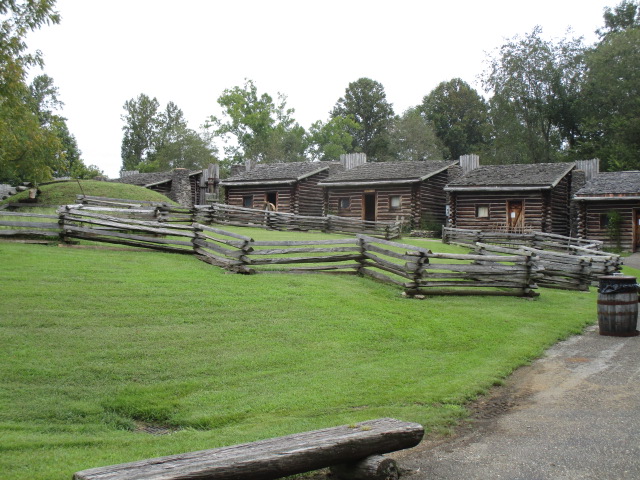
Additional log cabins.
In the middle of the Fort a storage magazine was constructed for the fort’s supply of gunpowder.
Life at Boonesborough during the early years of its existence offered little in the way of comfort. The cabins had only the bare minimum of comforts. A crude table made of a slab of wood, a bed with a feather tick or buffalo skins provided the early Kentucky
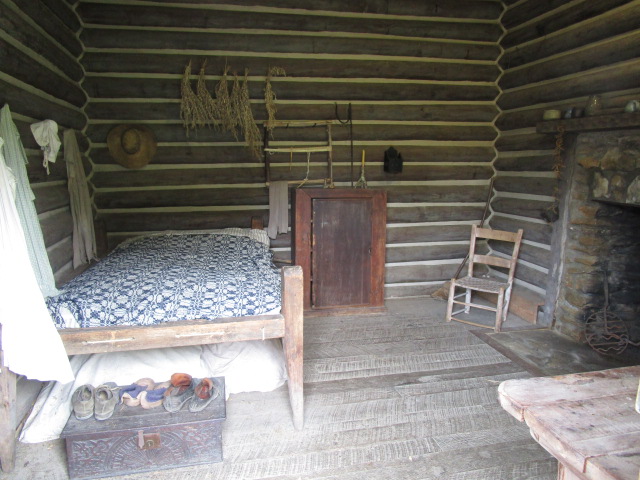
householder with a dry and warm place to sleep. The fireplace provided the only source of heat for the one room that held all the pioneer family owned, as well as the pioneers
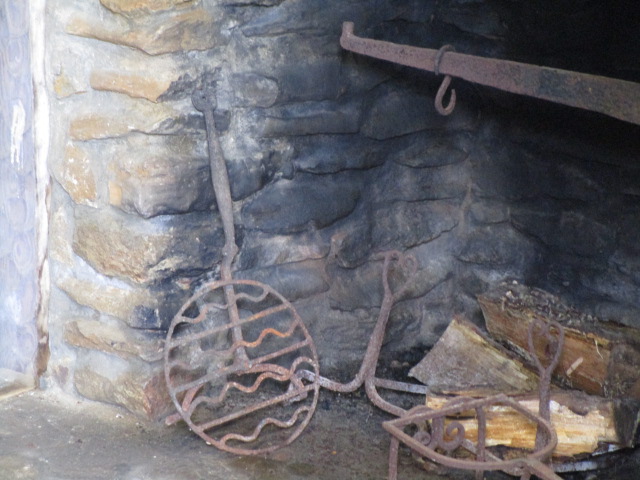
themselves. The chimney of the cabin was at best crude. Made from sticks and mud, it provided a means for smoke to escape the cabin, but also posed a serious risk of fire. If a chimney fire occurred the ingenious pioneers would push the chimney away from the cabin to save it from burning.
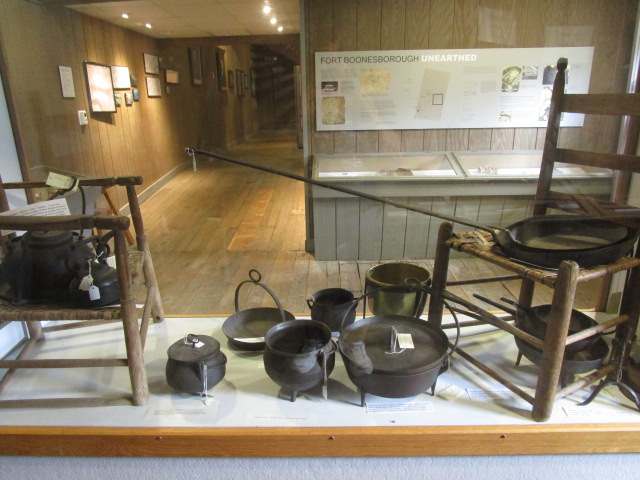
Here displayed are some of the items the early settlers would have used to cook with. There is a dutch oven, several frying pans, pots, kettles and so forth.
Within the Fort there were several cabins displaying pioneer crafts. This is the Weaver’s
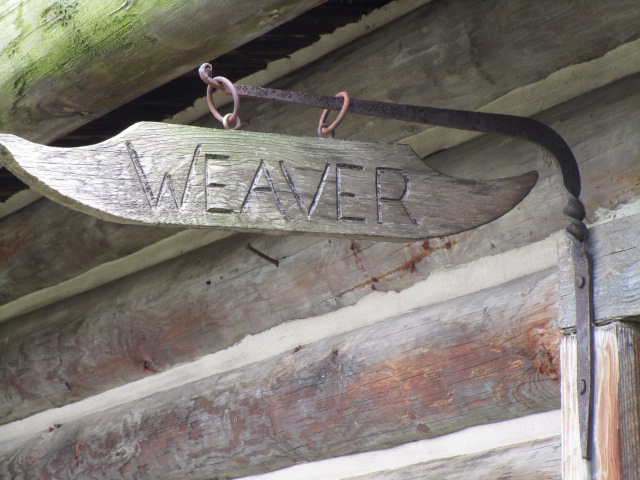
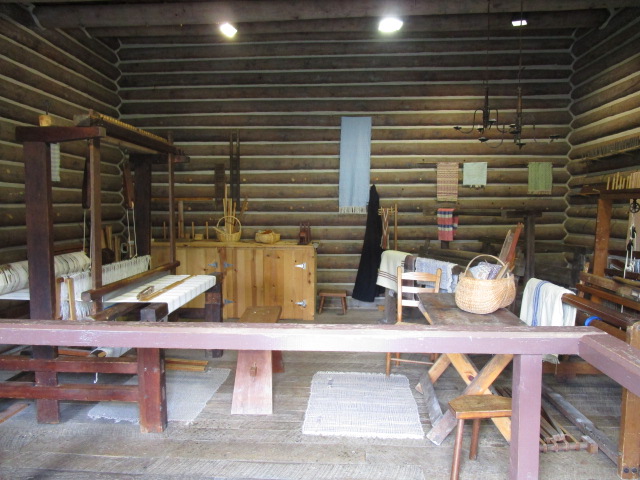
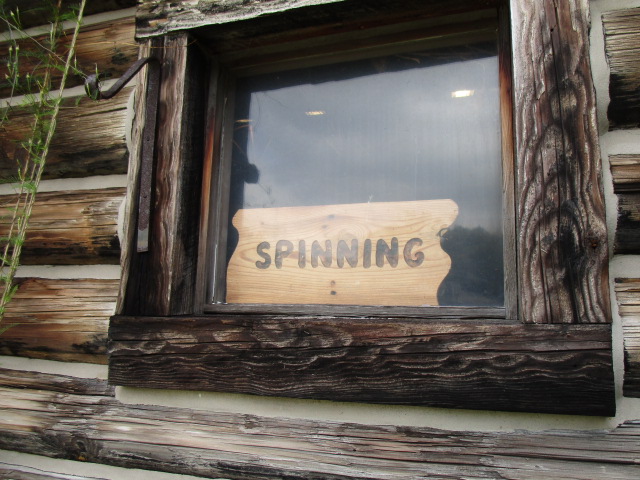
Next, we visited the Spinning cabin
Inside was a docent who was very informative.
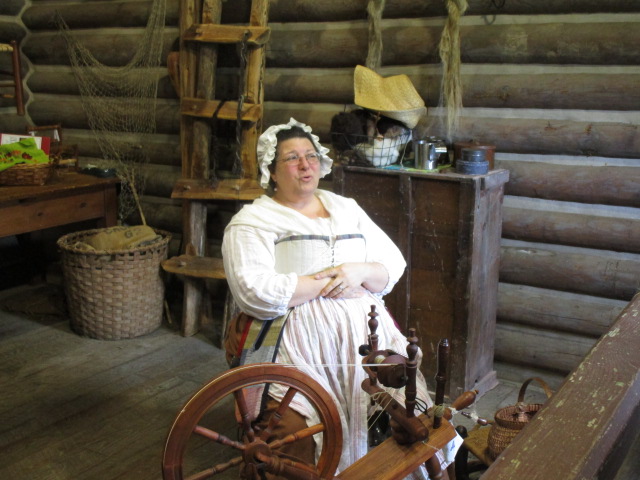
She explained to us that as important as food was, equally important was linen cloth from which clothing could be made. Thus, each settler upon arriving would not only plant a garden but a field of flax. The flax after it had been grown would be refined by beating until it was fit to be spun. The flax started out as on the left, then was processed until it could be spun and eventually woven into cloth that could be used to make clothing. No ordering from a catalog in that day.
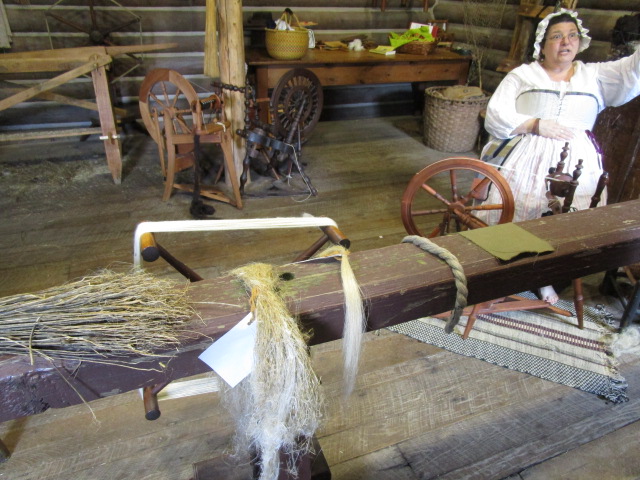
In addition she explained that usually each family had their own spinning wheel and loom or in some cases one had the spinning wheel and the other a loom. In the latter case one spun the flax for several families in return for woven cloth being provided by the family with the loom.
Another interesting cabin was that of the Candle maker. She makes two types of candles, to the left are paraffin candles and to the right are yellow beeswax candles.
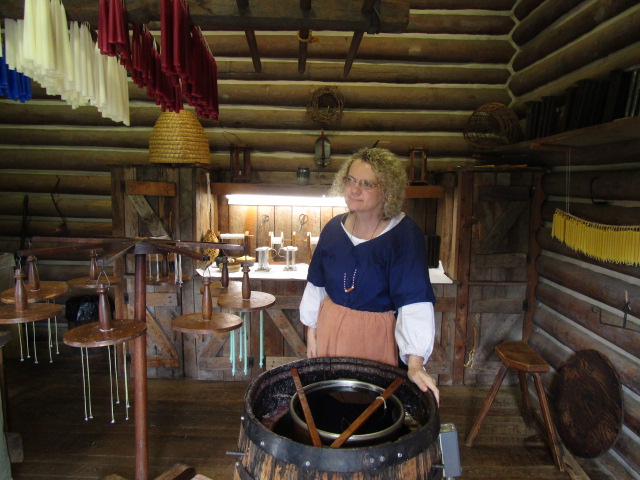
The paraffin candles are made by taking a rope (on the wheels to the left beside her) and dipping them repeatedly into the wax in the large barrel in front of her. She stated that it usually takes between 30 and 40 dips into the wax to make a typical paraffin candle. Sounds like a lengthy process but she assured us that because the wax cools so quickly by the time you are finished with one wheel another is ready to be dipped again.
This is the inside of the Tavern Blockhouse. In was a Tavern, a meeting house and so much more. On the back wall, the large brown hide is from a buffalo.
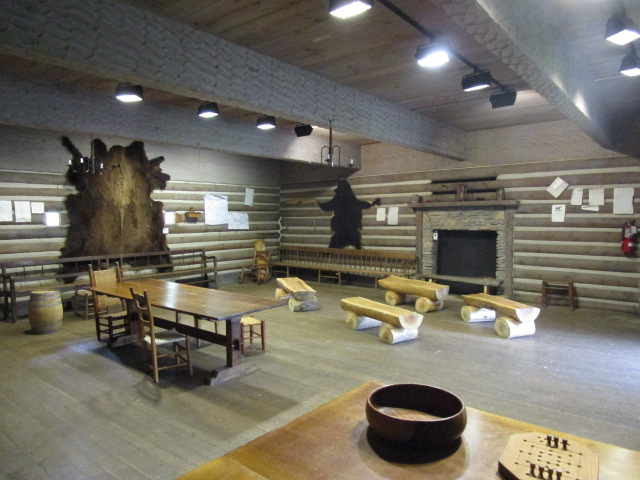
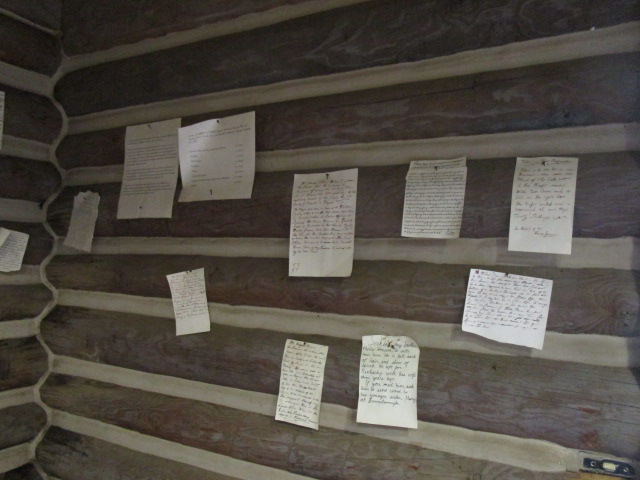
On the walls where often posted different documents requiring the attention of the settlers.
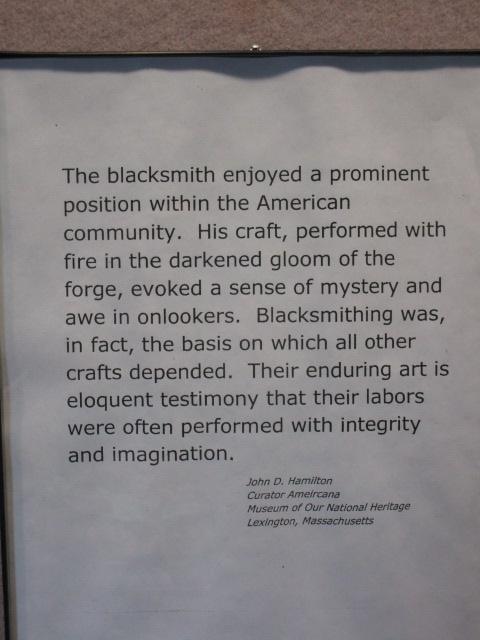
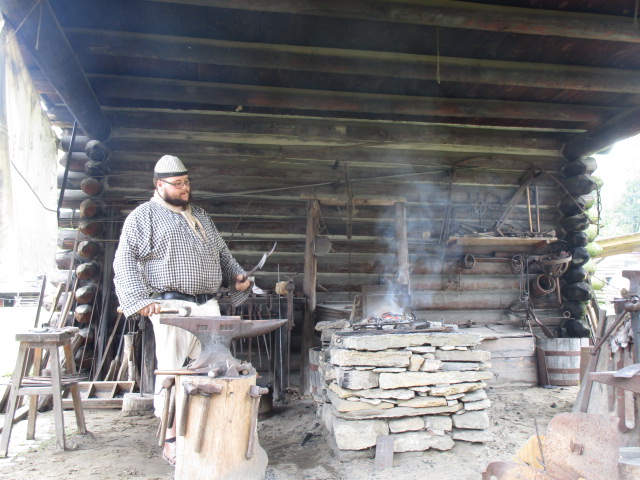
One individual that played an important role in the life of the settlers was the blacksmith. Anything and everything that needed to be made of metal was his responsibility.
Today, within the Fort there is a blacksmith constantly working and making all kinds of metals items that the early settlers would have needed.
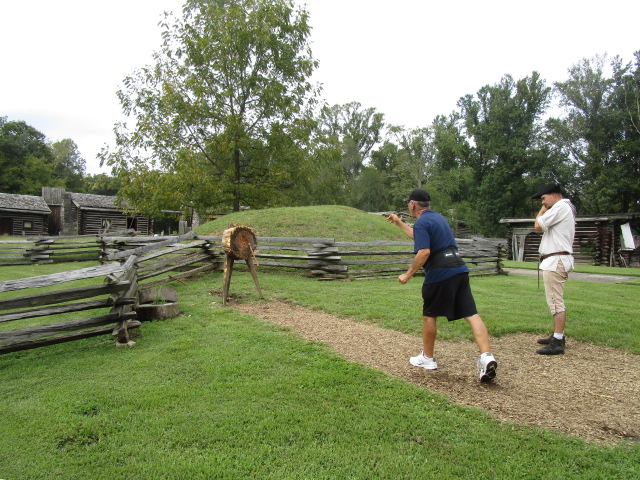
Oh yes, let me not forget. There was also a demonstration on ax throwing, with an opportunity to try it for yourself. The object is to throw the ax in such a way that you get it to land and stick in the log target in front of you. Hard to see, I know but I stuck it on my second try!
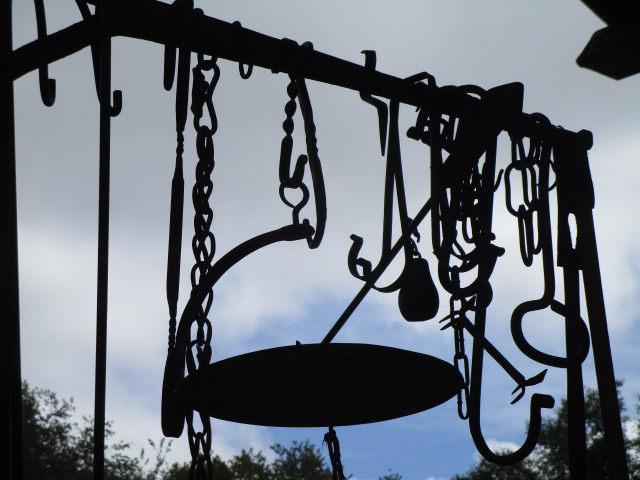
Now, when I saw this example of how meals were cooked by the early settlers all I could think to myself was I believe I’ll keep our Microwave/Convection Oven!
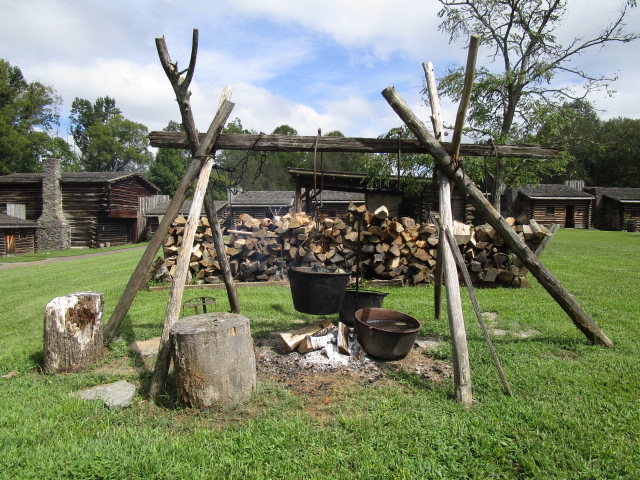
That then was our day. We took would could have been a negative – a two hour drive for just 15 minutes of banking – into a positive – another chance to visit an important historical site in the settlement of our great nation. I like it when a plan comes together.
So now the day is done. Thanks once again for coming along with us. We hope you enjoyed your journey with us. We had a great time, as always made better by the fact that we traveled along, hand in hand, singing our song. I do want to also ask for continued prayers for my mom. Though ordered to evacuate she refused to do so. And at 92 years young she was not going to be persuaded otherwise. I mean once she makes up her mind you can forget changing it. She did agree, however, to ride out the storm with a neighbor whose house is on high ground. Let’s hope not only she, but all down in her neighborhood and the surrounding area have homes to come back to.
In closing as always I want to leave you with something to think upon:

As always, if you are coming to the end of your day with concerns and worries, let me suggest that you turn them over to God. After all, He is going to be up all night so why not let him handle them for you.
Time now for our evening prayers and eventually some shut-eye. Till tomorrow.
These are the voyages of Graybeard and it’s occupants, four paws and two humans. Our continuing mission: to explore as many new states as possible, to seek out new acquaintances and make new friends, to boldly go where we have not been before

 "On The Road of Retirement"
When given lemons, make lemonade. You just did that and took us along. Thanks for sharing your day in words and pictures.
LikeLike