
August 21, 2023
National Civil War Naval Museum
When I think of the Civil War what usually comes to mind are battles such as Gettysburg or Vicksburg, or sometimes Generals like Grant, Sherman, Lee or Jackson. I never, however, thought of it in terms of the navy. Truthfully, I wasn’t even aware there was a Civil War Navy or the role that it played in the North’s ultimate victory.
Thus, when we discovered this museum my curiosity was peeked. With time on our hands we decided to pay it a visit.

One of the first things I learned during an introductory movie was the significant role the navy ultimately played in the success of the Union Army. The navy was used to blockade Confederate ports and thus prohibit the flow of needed war materials and goods to the Southern States.
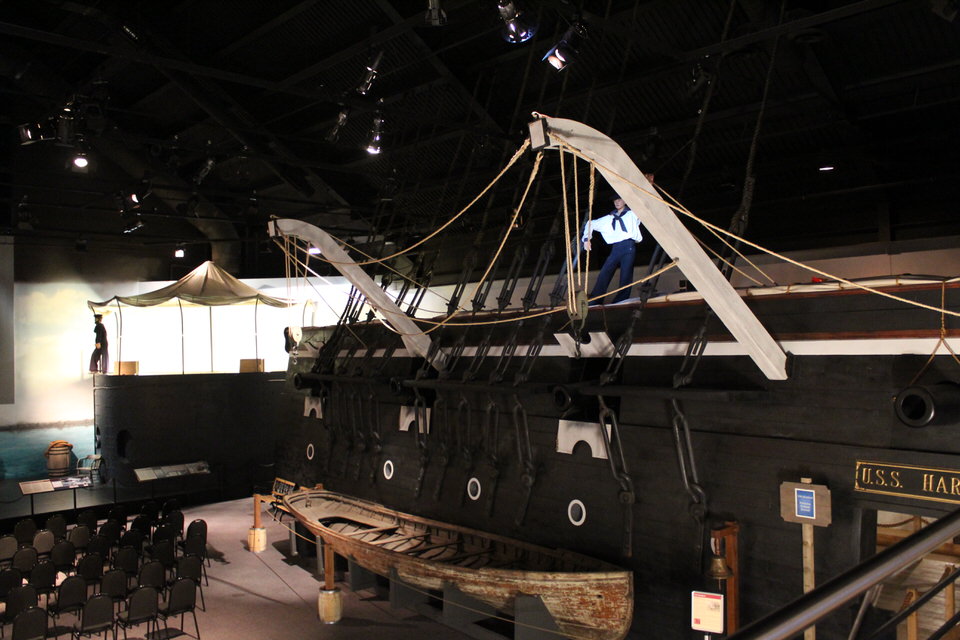
For instance, this is a replica of the U.S.S Hartford, the Flagship of Admiral David Farragut. It was powered by both sail and steam and had a long and storied history. The Hartford’s first major engagement was at The Battle of New Orleans. Despite fierce resistance the Hartford and a fleet of 37 other vessels were able to ultimately take New Orleans. They were thus able to close the mouth of the Mississippi and the wealthiest port in the South.
Later at the Battle of Mobile Bay as his fleet entered the bay one of his ships hit a mine throwing the rest of the fleet into disarray. Sensing that his ships were in danger Admiral Farragut lashed himself into the rigging to give him a clear field of vision and then bellowed his famous command Damn the torpedoes! Full speed ahead! The battle was brief but bloody, but in the end Union forces prevailed and Mobile Bay fell to them.
Another battle that was significant was the battle of


Hampton Roads between the ironclad vessels The Virginia and The Monitor.
The Virginia was the first steam powered ironclad vessel built by the Confederate Naval forces. It was originally a sailing vessel that was bunt and sunk by Union forces. However, Confederates forces were later able to salvage the ship. Noting that everything below the water line, including the engines were in good condition work began to turn the salvaged vessel into an ironclad. When completed it would have a total of 14 fixed gun ports. It’s biggest weakness was its size. It took over 45 minutes to turn it around and it took over a mile to do so. It was cumbersome and slow and this would hamper its ability to successfully engage Union forces.
The Monitor was the first such ironclad built and commissioned for the Union Naval forces. The Monitor was often called the Yankee Cheese Box because of its unusual shape. It sat low in the water and was distinguished by its central rotating turret and a small protruding pilot house near the bow. The turret housed two 11 inch guns. It was later found that the turret was problematic and difficult to control. The ship was powered by a single steam engine driving a single propeller. It was easy to maneuver and nimble in the water which gave it a distinct advantage when confronting the Virginia. It would be the first of many such similar vessels ultimately built for the U.S.S Navy.
The historic battle of Hampton Roads lasted some 4 hours with each vessel repeatedly bombarding the other. However, in the end neither vessel gained a distinct advantage. The battle was called off only when and because the pilot house on the Monitor was significantly damage. However, this battle ushered in a new era of naval warfare. Historic wooden ships would now gave way to armored vessels.
Throughout the museum there were a number of other fascinating exhibits.

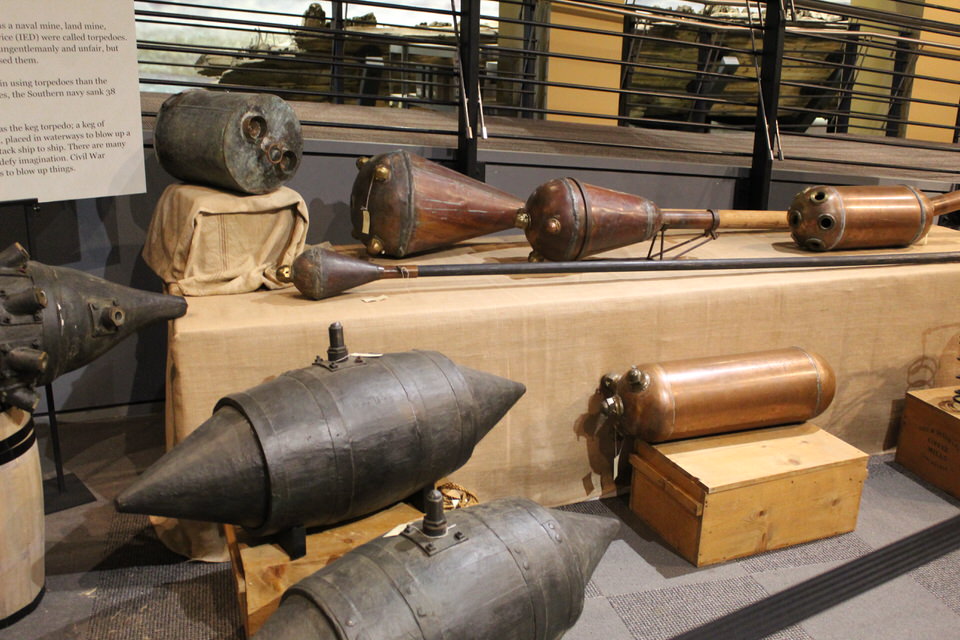
This is an exhibit of mines and torpedo’s that were used by both sides in an attempt to safeguard major ports. Many, however, were such that they needed someone to actually swim with them to a moored ship, arm it and then swim like you life depended on it – which it did – before it went off!

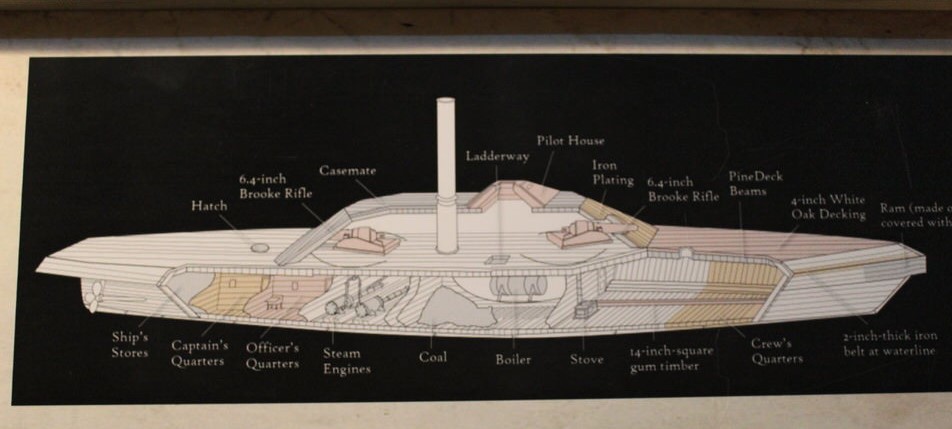
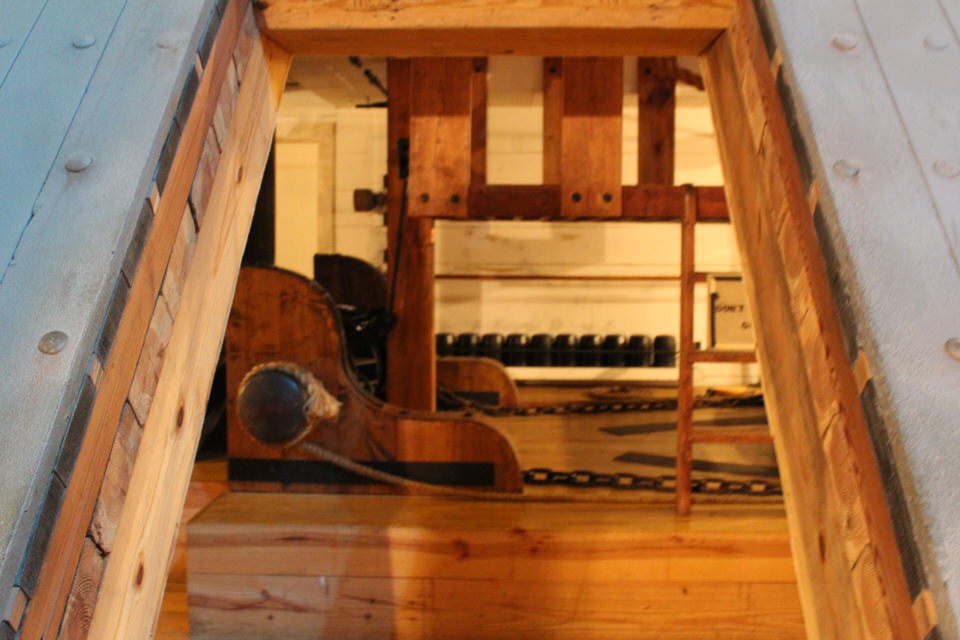
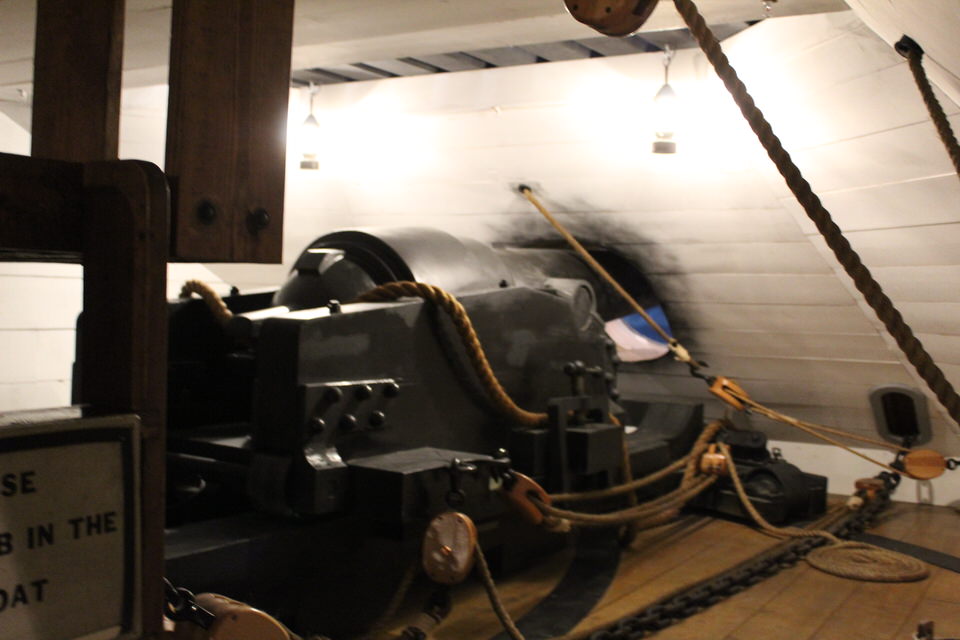
There was a full size model of the ironclad Albermarle which you could enter and walk around in. Note, in the entranceway in the above picture the thickness of the wood construction over which would be placed armor plating. The hull was built at a 35 degree angle, allowing projectiles to roll off easily. The crew would number 120 and even on a mild day the temperature inside would often hover between 120-130 degrees.
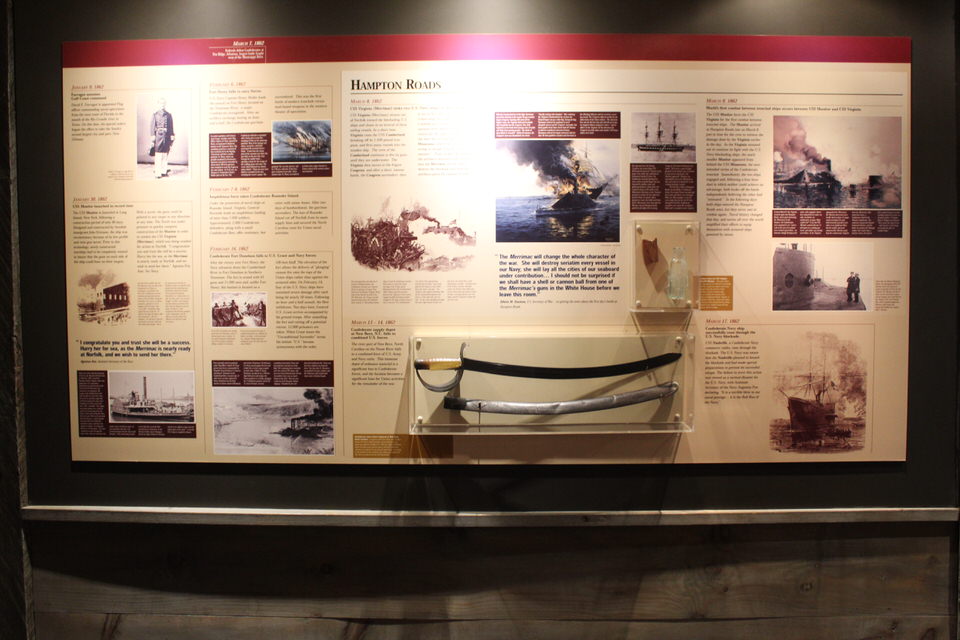

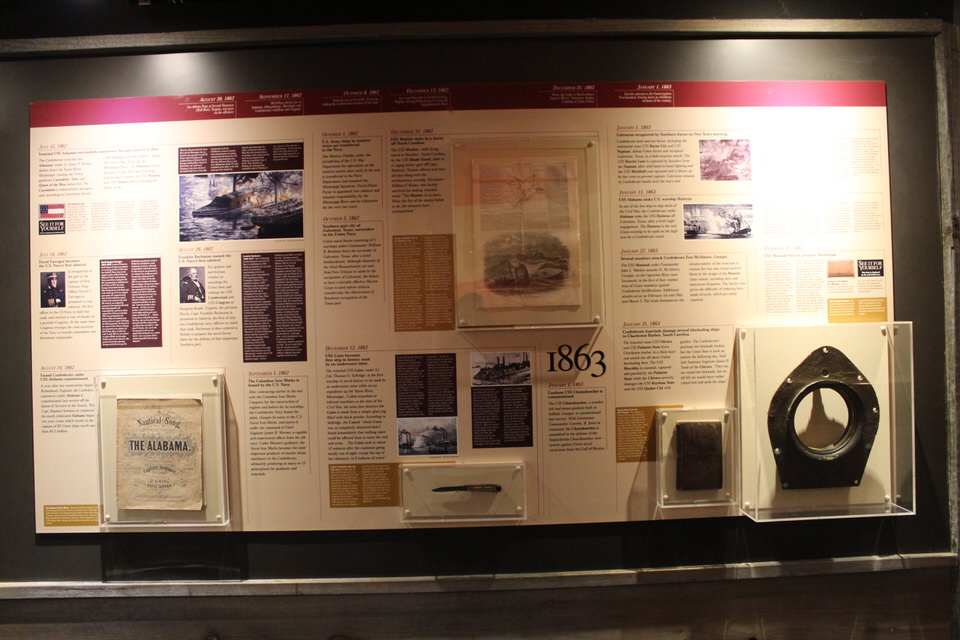
There was full wall detailing every major naval engagement during the Civil War. It’s amazing to realize that while the land battles of the Civil Way seemed to sway back and forth and rarely resulted in a strategic victory, the US Navy’s relentless campaign against the Confederate Navy ultimately tipped the balance of victory in their favor.
There was so much more there, enough that we ended up spending over two hours at the museum. Again, perhaps not a museum for everyone but it is one that taught me a number of things I never knew about our countries history. And when I can learn something new I consider that a good day.
Thanks again for spending some time with us. It’s always great to be able to share our story with family and friends. Comments? Feel free to share them with me. And always remember, cherish every moment of every day that God gives you and live those moments to the fullest.

 "On The Road of Retirement"
Bill, I found this post more interesting than I thought I would. (Hope you don’t mind me saying that!) I think I knew there was a Union navy during the Civil War, but I haven’t thought much about it. I found the salvaging of The Virginia quite interesting! And having to swim away from torpedoes – oh my! I never knew where the “Damn the Torpedoes. Full Speed Ahead” phrase came from. I can’t help but think of my brother who passed away in 2003. He had served in the navy, and he was a Civil War buff. He would have loved this place! Thanks for your post, and teaching me something today.
LikeLike
Glad I could impart some new knowledge. And to be quite honest, I found the museum more fascinating that I first thought it would be. We both said, ah 30 minutes top, and how surprised we were when 2 hours had passed! Take care.
LikeLiked by 1 person