
Part Six B: Juneau, Dog Sled Summer Camp
Ever sent your kids to summer camp? Have you ever gone to summer camp? I know I did when growing up as a kid. Well, guess what? They also send sled dogs to summer camp in Alaska.
When we signed up for this excursion we really had no idea what was in store for us. From the very beginning things got really interesting. We were escorted to a series of vans, approximately six or seven to a van. A van? Not an excursion bus?
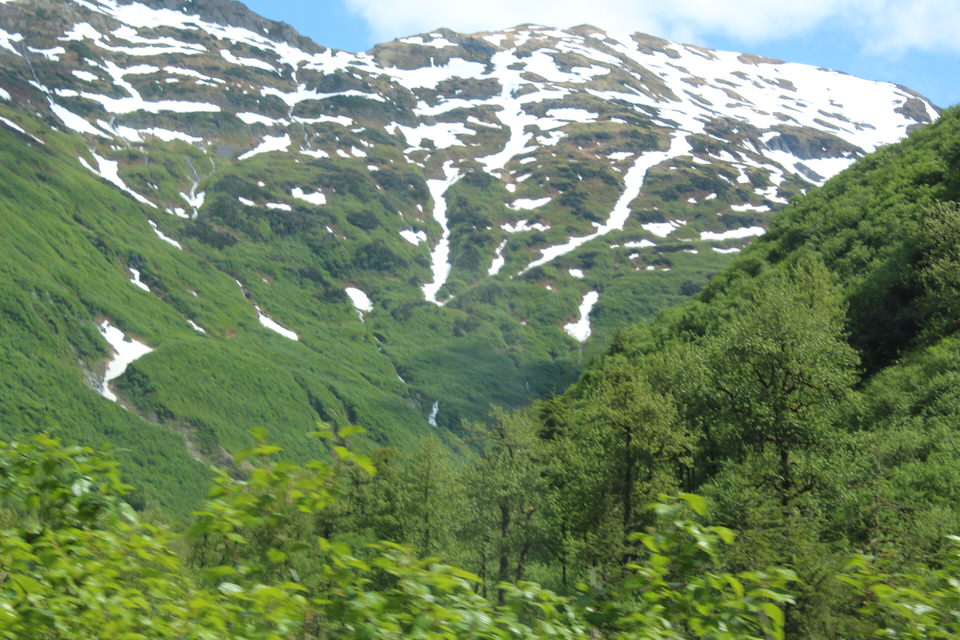
We soon discovered the reason why. We were going back country, a single lane, rutted dirt road that wound it’s way up the side of a mountain. All told it was about a twenty minute journey. Oh, what country we were in. The mountains surrounding the camp just took your breath away.
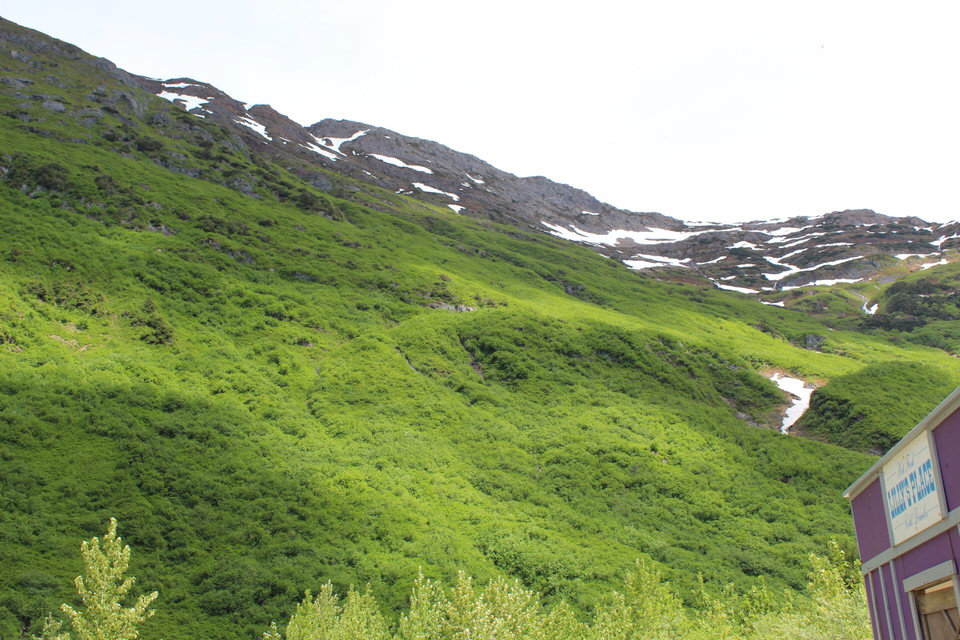
This is where the summer camp is located, at the foot of the above mountains.

Notice the different color dog houses? Each corresponds to a particular team of dogs and their musher. Teams of dogs and their musher come from various parts of Alaska as well as other states to spend the summer at this location in Alaska. Here they spend the summer months training for either long distance or sprint races. They are well cared for, eat a balanced diet and once in while are asked to pull a

wheeled card with a bunch off silly tourists on it a short but fun filled ride.
Ok, let’s back up a bit.
No one exactly knows when dog sledding actually began. Some researchers say it began about 9,500 years ago in Siberia. While we may never know where and when the use of dogs to pull sleds began, it is easy to see why it began. Humans can only go so far on their own two feet. They can only carry so much weight.

But even a small team of dogs can carry hundreds of pounds and cover dozens of miles in a day. Though used in the far northern region’s for hundreds of years, no one south of there knew much of them for the longest time. That, however, changed in 1896 with the discovery of gold near the Klondike River in Canada’s Yukon Region. Over 100,000 dreamers converged on the area, and sled dogs played an important role in carrying these dreamers to the gold fields.
However, it was what was called the 1925 Serum Run that brought sled dogs and their mushers to the forefront of the American public’s attention. Diphtheria had broken out in Nome, Alaska and the serum necessary to cure it was desperately needed. But the plane that would normally have been used to transport the serum was grounded for the season. So a group of 20 mushers and their teams of dogs were assembled and asked to transport the serum the 674 miles along the rugged Iditarod Trail through some of the harshest weather imaginable. With temperatures plunging to -60°F, gale-force winds, and heavy snows, the mushers and their dogs faced challenging conditions. They nevertheless made the run in a record-breaking 127½ hours without breaking a single vial of the precious serum. More than other event this run established sled dogs as a part of American culture. Furthermore, The Iditarod Race still run today, commemorates this historic rescue. And today, even though there are many other new fangled ways of transport available, mushers and dog sleds still remain a vital part of the Alaskan landscape.
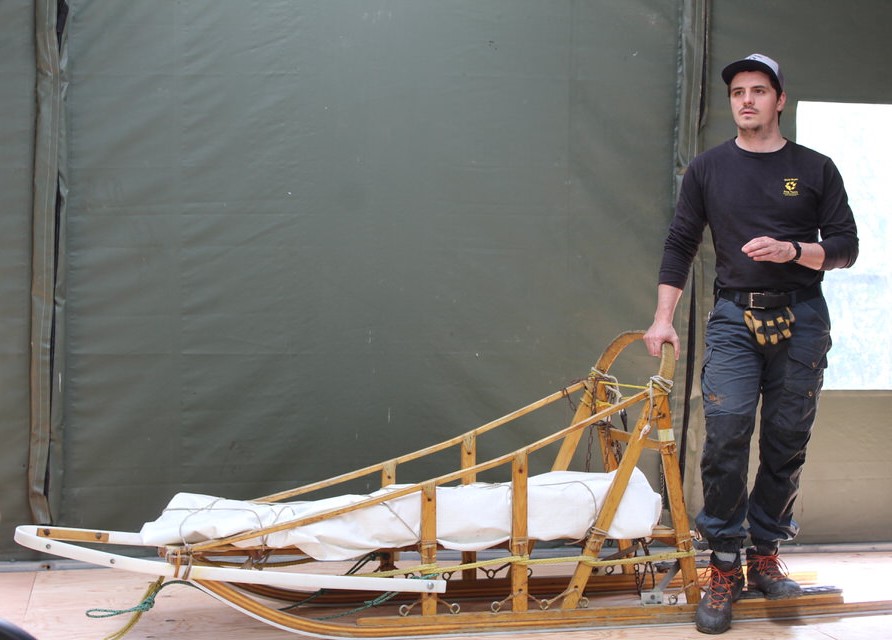
This was our musher and guide for the day. Forgive me, but I can’t remember his name. As for the name musher – we were told that it comes from the French word marcher which means to walk.
The modern day sled is typically made of white ash because it is light, strong and durable. The two types of sleds commonly used are either the basket or the toboggan. The former is for relatively light lights while the later can handle a substantially larger load. As for the most important piece of the whole sled? It is the braking system. The so-called regular brake is a spring loaded piece of wood with a hook on the bottom. The musher can step on this when necessary to slow the sled down. Then there is the so-called parking brake. This is a large hook which, when the musher gets off the sled, he sets deep in the snow. Forget to do so, well as our musher told us the dogs are just going to keep right on running! And you after them trying to catch up to them and regain control. He said he spoke from experience!
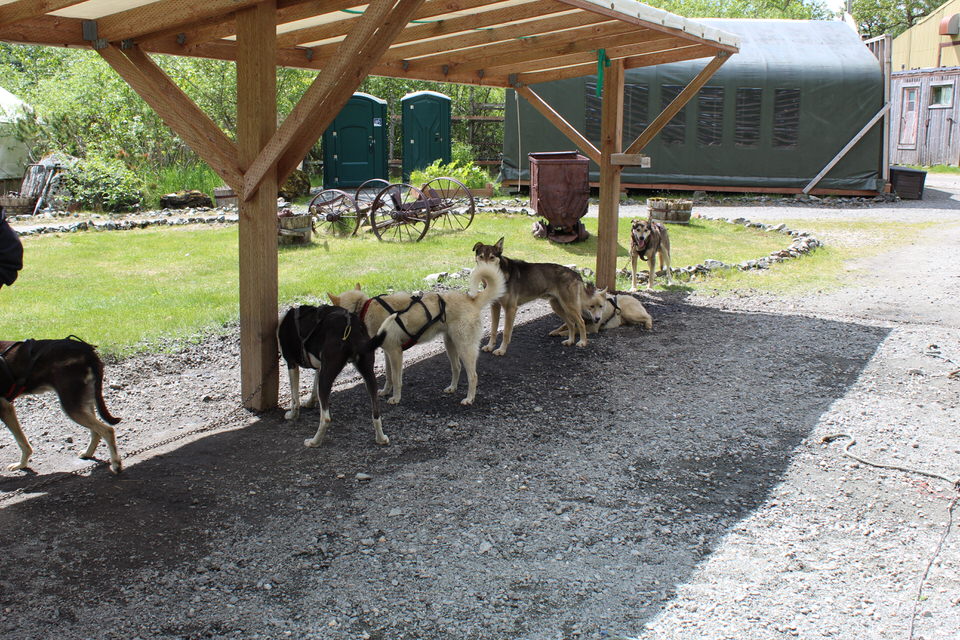
The musher is the one who leads the team of dogs by riding on the back runners of the sled. He controls the dogs through a set of lines hooked to harnesses on the dogs. Each individual dog is then hooked to a gang line which is hooked to the sled. This is the team we had waiting to be hooked to the gang line. The musher basically uses a standard set of commands. Hike means to start and run. Easy means to slow down. Whoa to bring the sled to a stop. Hee means to turn right. Haw means to turn left.
Finally, it was time to go for a ride!
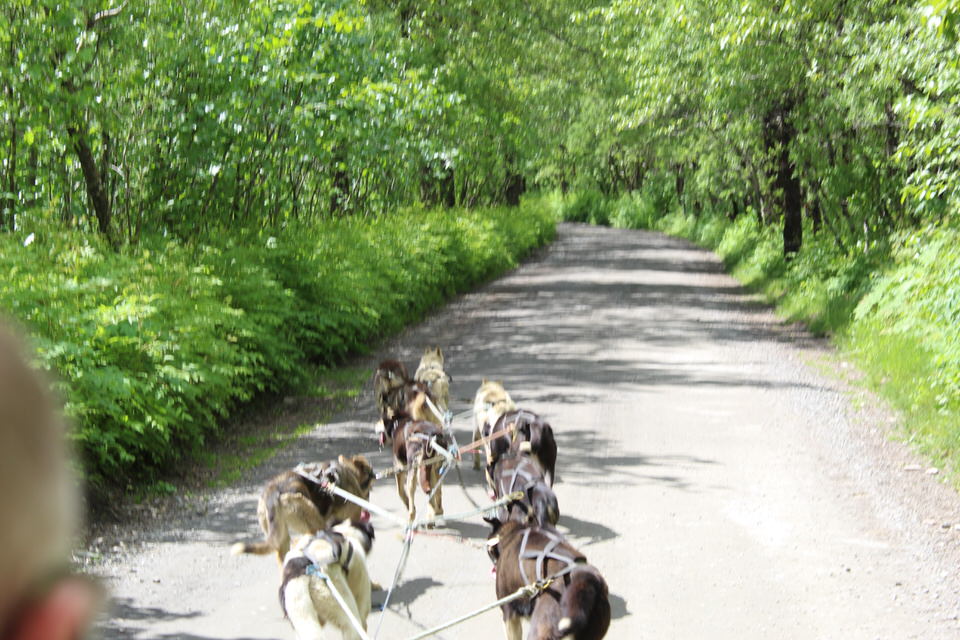
The dogs were hooked to the gang line and we were off on an approximately 2 mile run.
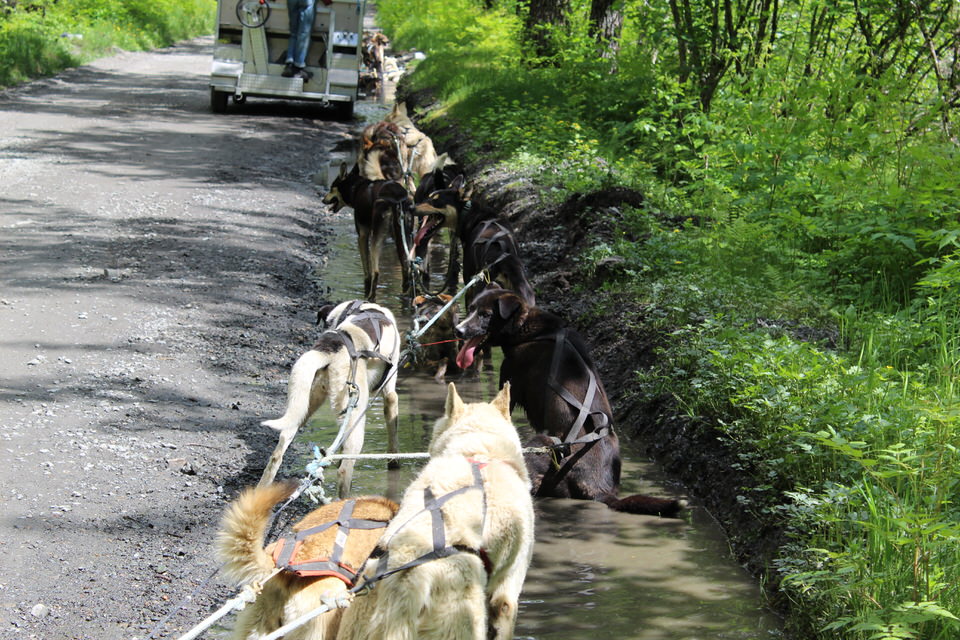
Remember I said how well the dogs were cared for? This is proof of it. On the return part of the run a large trough of water is provided off to the side of the road. The dogs are led into it and encouraged to lie down in it, roll in it, take a deep drink. Whatever they feel like doing.
Back from our ride it was time to help the some new born dogs with their socialization process.

Which means in so many words,


that we get to hold the puppies! However, you are discouraged from trying to take them home! Even so, we were told one cruise ship couple actually tired to. They got as far as their ship before they were discovered. At which point the puppy was taken from them, they were arrested and kicked off their cruise ship. I mean What were they thinking!
Now, after our trip to the Dog Sled Summer Camp and before we returned to our ship we also
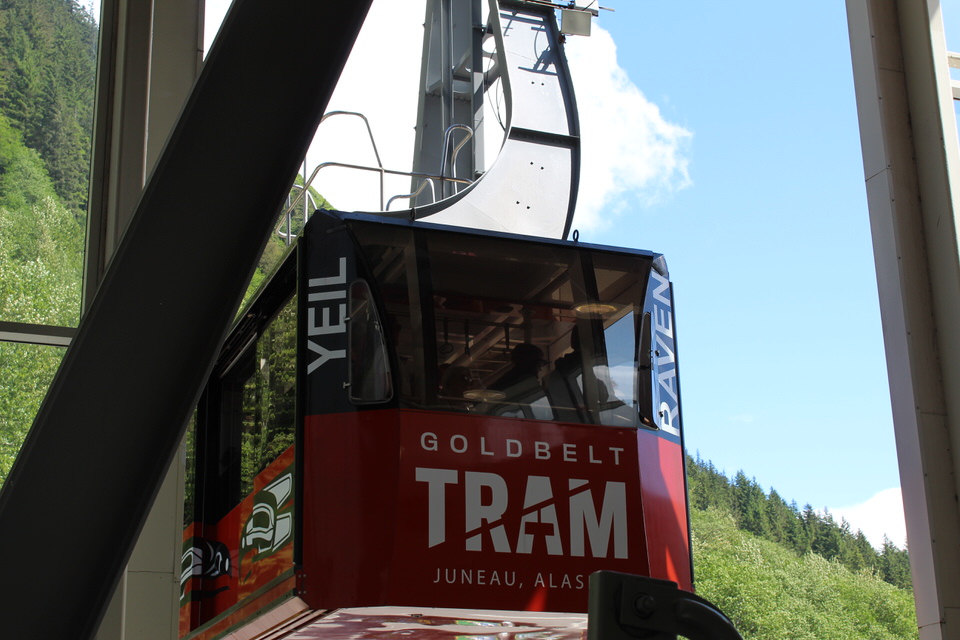
took the time to ride the Goldbelt Tram.
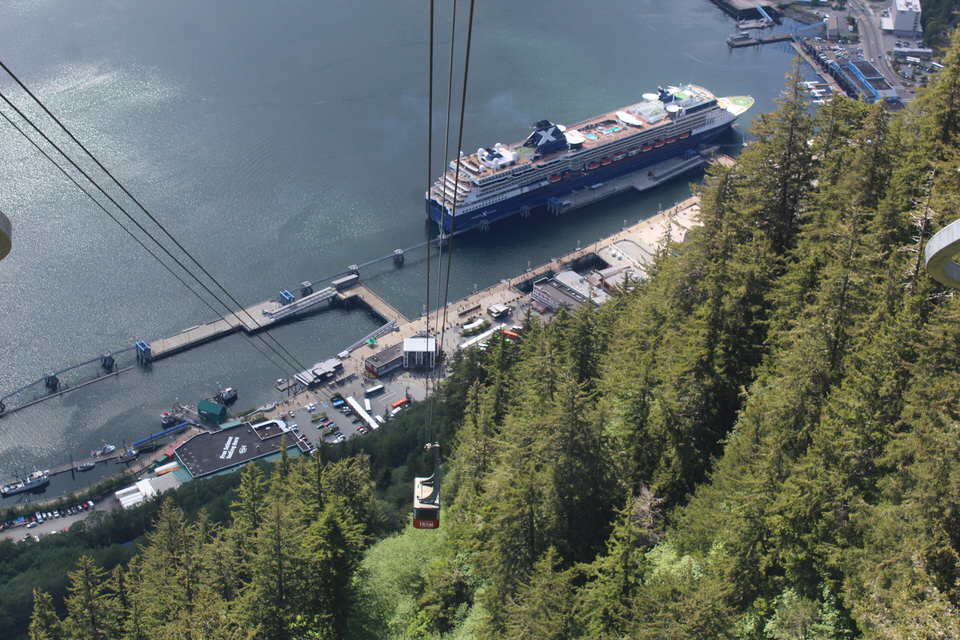
It is a six minute ride of 1,800 feet up to the Mountain House. The literature claims that it is the most vertical tram in all of Alaska. I believe it!
As for the view from the top, judge for yourself


There was also a restaurant, a gift shop and a number of hiking trails at the top. We were just content to make the trip up, spend some time walking around and then come back down. It had been a long but gratifying day, and we were anxious to just return to Summit and kick back and relax.
So ends our day in Juneau, Alaska. We had a wonderful day made even better by the fabulous weather we had. Thankfully, only one day of rain so far on our cruise. Now it was time to set sail for yet another port.

 "On The Road of Retirement"
Thanks for the very interesting post. I learned a lot about sled dogs.
LikeLike
Thanks for reading and so glad you were able to learn a bit more about sled dogs. I know I learned quite a bit.
LikeLiked by 1 person
What a fun day! Thanks for taking me along on the dog sled ride and the Gold Belt Tram – neither of which we did. I was also glad to learn the history of the Iditarod Race – this was totally new for me! Holding and petting those puppies looks like a very special time. I enjoyed reading your post and learning more about your day in Juneau!
LikeLike
Thanks for reading. Between the two of us and the different experiences we had I know I’ve learned a lot. What a fun time we each had.
LikeLiked by 1 person
But our times together were the best! 🙂
LikeLike
Can you imagine having the dogs take off because you didn’t set the brake in the snow? What a crazy video that would be! HA I think your musher probably learned his lesson. 🙂 Also, who would ever think it was okay to steal a dog and try to get it on the ship?! Glad the people were kicked off. I think there might be steep consequences for stealing a sled dog. Wow! What a great experience you had and you learned so much! Thanks for sharing.
LikeLike
Happy to share and thanks for reading. I mean, I can’t imagine anyone thinking that they would be able to steal a puppy and actually get it aboard the ship. But then again!
LikeLike
I really enjoyed reading this post, Barb. We had two Siberian Huskie back in Texas, and they loved to run, that is for sure. That would have been a fun day for me since I am a dog lover.
LikeLike
What amazed me, among many things, most of the dogs are not Huskie’s. They are all kinds of breeds. Some even look like muts. But of course they are anything but. Have a great day
LikeLike